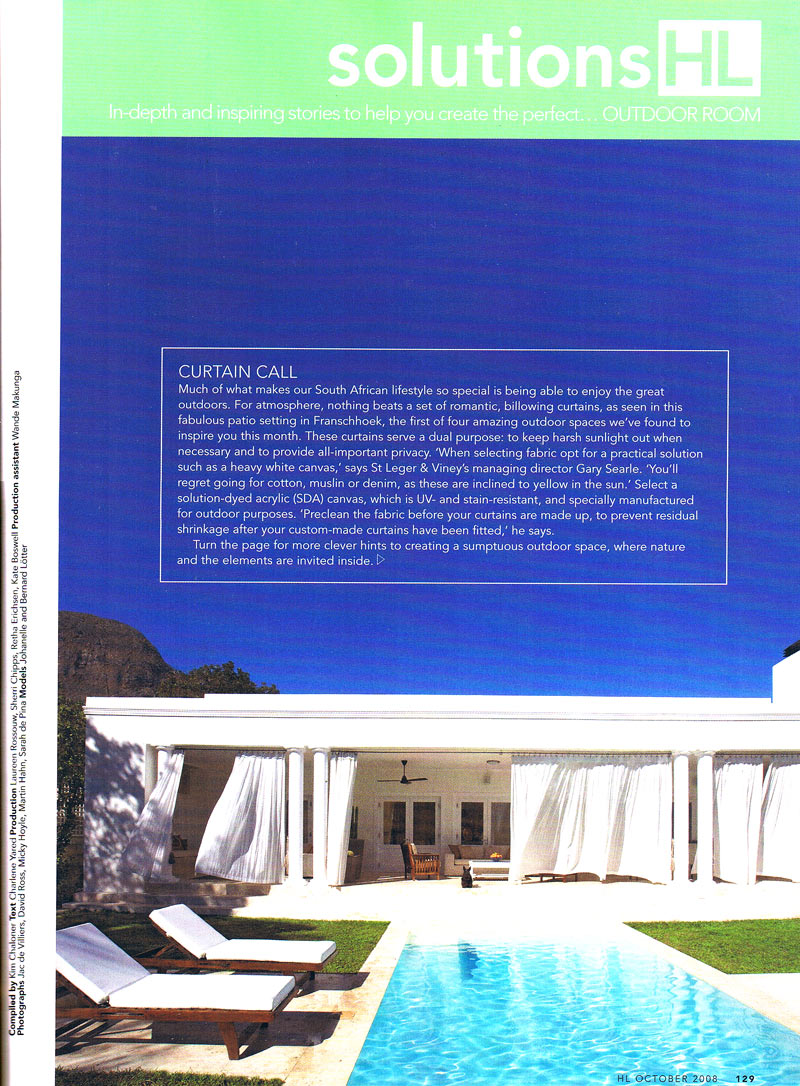
HL Solutions: Outdoor Rooms

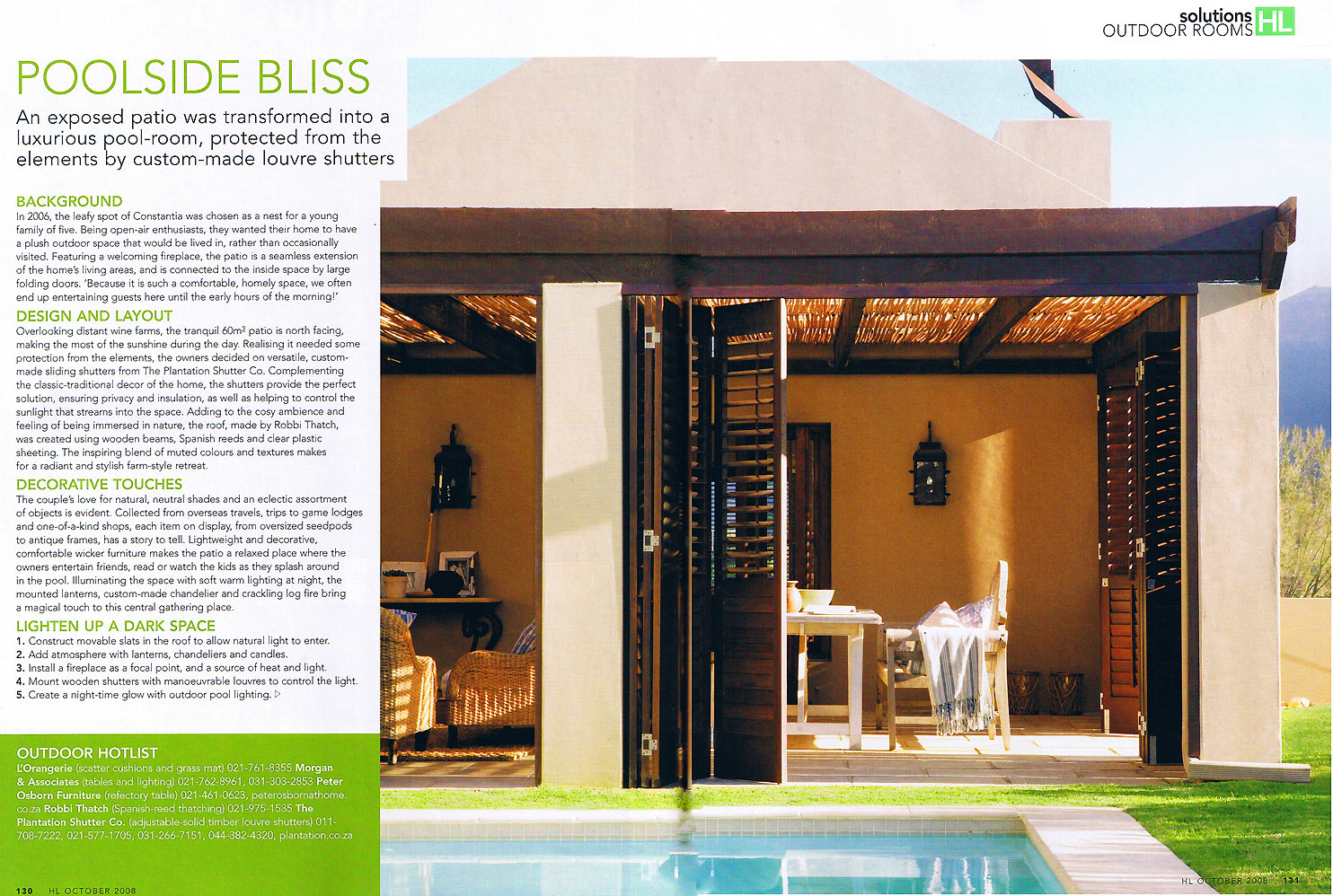
FIRGROVE HOUSE

An outdoor patio was transformed into this luxurious room, enclosed with custom-made shutters
BACKGROUND 
Before settling down to have children, this Cape Town couple indulged in their passion for redecorating homes, selling them and moving on to something new. In 2006, the leafy spot of Constantia was chosen as the nest to house the five of them. “We’ve never lived in a home that was just as perfect for our needs as this one,” say the owners. “It’s a very special home.” Being open-air enthusiasts, the couple wanted their home to have a plush outdoor space that would be lived in, rather than occasionally visited. Featuring a welcoming fireplace, the patio is a seamless extension of the living room and family room of the home, connected by large folding doors. “Because it’s such a comfortable, homely space, we often have guests staying over until the early hours of the morning,” says the couple.


DESIGN AND LAYOUT
Overlooking faraway wine farms in the distance, the tranquil 60sq m patio is north-facing, making the most of the sunshine during the day. Realising it needed some protection from the elements, the couple decided on versatile, custom-made sliding shutters from The Plantation Shutter Co., which gave the space the added benefit of being used throughout the year, no matter the weather. Complimenting the décor of the home, the sliding shutters provided the perfect solution, ensuring privacy and insulation, as well as helping to control the sunlight into the room. Adding to the cozy ambiance and feeling of being outside, the roof, made by Robbiethatch was created using wooden beams, Spanish reeds and clear plastic sheeting. The inspiring blend of muted colours and textures, using concrete flooring, wooden shutters, and light furnishings, make for a perfect farm style retreat with a stylish and radiant look.


DECORATIVE TOUCHES
The couple’s love for natural, neutral shades and objects with an eclectic feel is evident. “We could never get an interior designer to decorate our home for us from top to toe, because we love doing it ourselves,” they say. Collected from overseas travels, trips to game lodges and obscure shops, each item on display, from oversized seedpods to antique frames, has a story to tell. Lightweight and decorative, the couple chose comfortable wicker furniture for the patio, as a relaxed place from where they could entertain friends, read or simply watch their children as they splashed around in the pool. Illuminating the space with soft warm lighting at night, the mounted lanterns, custom-made chandelier and crackling log fire, bring a magical touch to the central gathering place for whole the family to enjoy.
 
FIVE TOP TIPS FOR LIGHTING UP DARK OUTDOOR SPACES

1. Construct slats in the roof for natural light to enter
2. Add atmosphere with lanterns, chandeliers and candles
3. Install a fireplace as a focal point for heat and light
4. Create a night-time glow with outdoor pool lighting
5. Mount Plantation Shutters with manoeuvrable louvres for light control
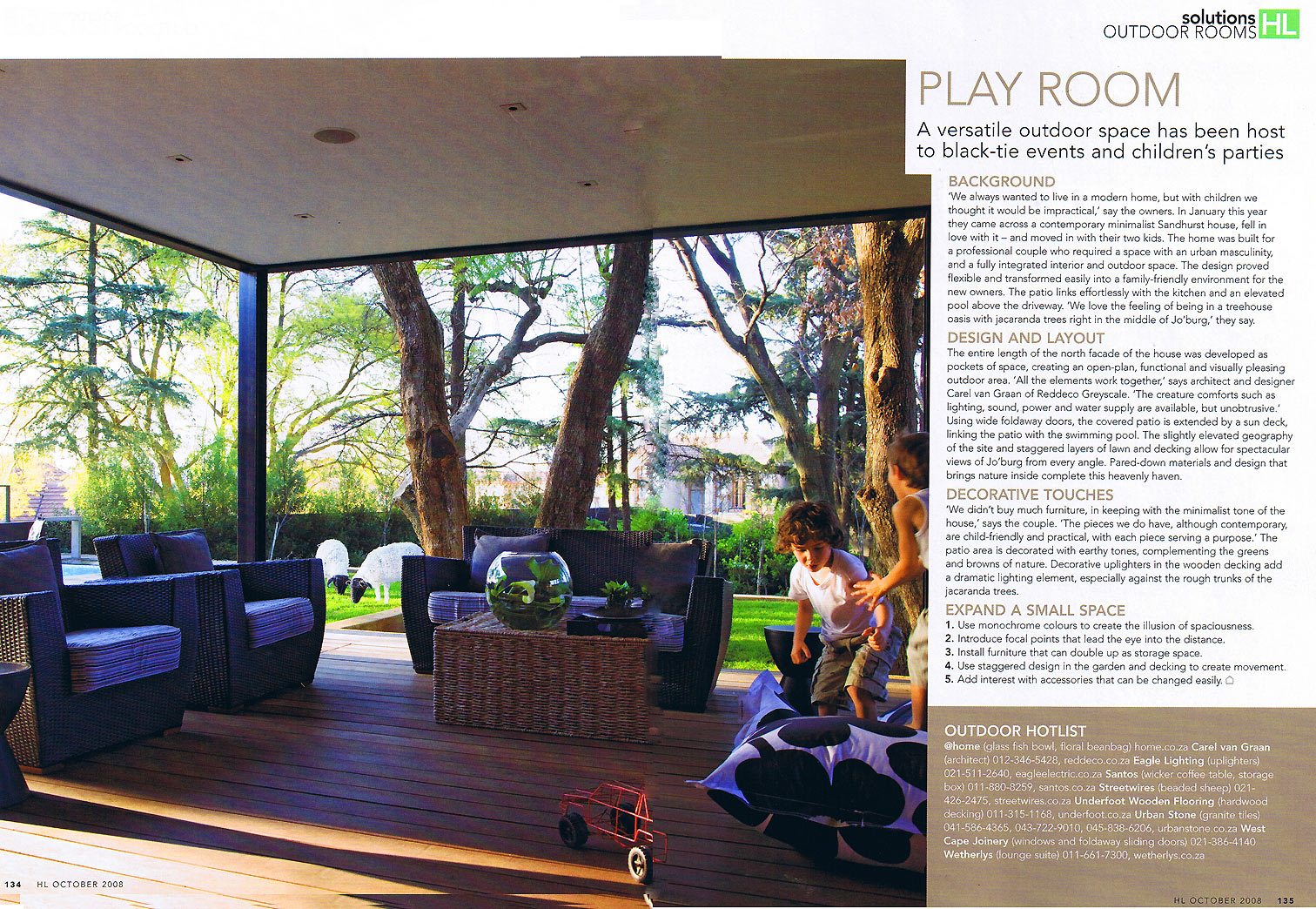
SANDHURST HOUSE

Making the most of the surrounding greenery, this outdoor space links indoors and outdoors with seamless style


BACKGROUND
“We always wanted to live in a modern home, but with children, we thought it impractical,” says the couple. In January of this year, however, they came across the contemporary minimalist Sandhurst House for sale, fell completely in love with it – and moved in with two young kids. The home was built on part of the original Sandhurst Extension 4 farm, for a childless professional couple who required a space with an urban and masculine nature, with the interior and outdoor space fully integrated. The design proved very flexible and transformed easily into a family-friendly environment, without compromising the design ethos. The patio links effortlessly with the kitchen and with an elevated pool above the driveway, the home emanates a character of dramatic sophistication. “We love the feeling of being in a treehouse lodge, an oasis with magnificent Jacaranda trees right in the middle of Johannesburg,” they say.


DESIGN AND LAYOUT
The entire length of the north façade of the house was developed as pockets of space, creating an open-plan, functional and visually pleasing outdoor area. “All the elements of the home work together as a unit,” says architect and designer, Carel van Graan. “The creature comforts such as lighting, sound, power and water supply are available, but are unobtrusive.” Using wide stacking sliding doors, the covered patio is extended by a sun deck, linking the patio with the swimming pool. The slightly elevated geography of the site and staggered layers of lawn and decking, allow for spectacular views of Johannesburg, which can be seen from any point of the outdoor space. Pared down materials, a mix of simplistic design techniques and bringing nature into the home makes the space a heavenly haven to live in.


DECORATIVE TOUCHES
“We didn’t buy much in terms of furniture, only the essentials, in keeping with the minimalistic tone of the house,” says the couple. “The furnishings we do have – although contemporary, are child-friendly and practical, with each piece serving a purpose.” Virtually another room of the house, the patio area is decorated with earthy colour tones, complementing the greens and browns of nature, giving the impression of being outside. Decorative uplighters in the wooden decking add a dramatic lighting element, especially against the rough trunks of the Jacaranda trees. Whether lazing on the inviting couches or tanning on the outdoor decking during the day, the space is versatile and has been host to an array of chic, black-tie evening events, in addition to boisterous children’s birthday parties.


FIVE TOP TIPS FOR EXPANDING SMALL OUTDOOR SPACES
1. Use monochrome colours and natural materials to create the illusion of spaciousness
2. Introduce focus points or an element that leads the view into the distance
3. Install furniture like built-in benches that can double-up as storage space
4. Amplify the space by introducing an accessory that can be changed easily
5. Use elements of staggered design in the garden and decking to create movement and space
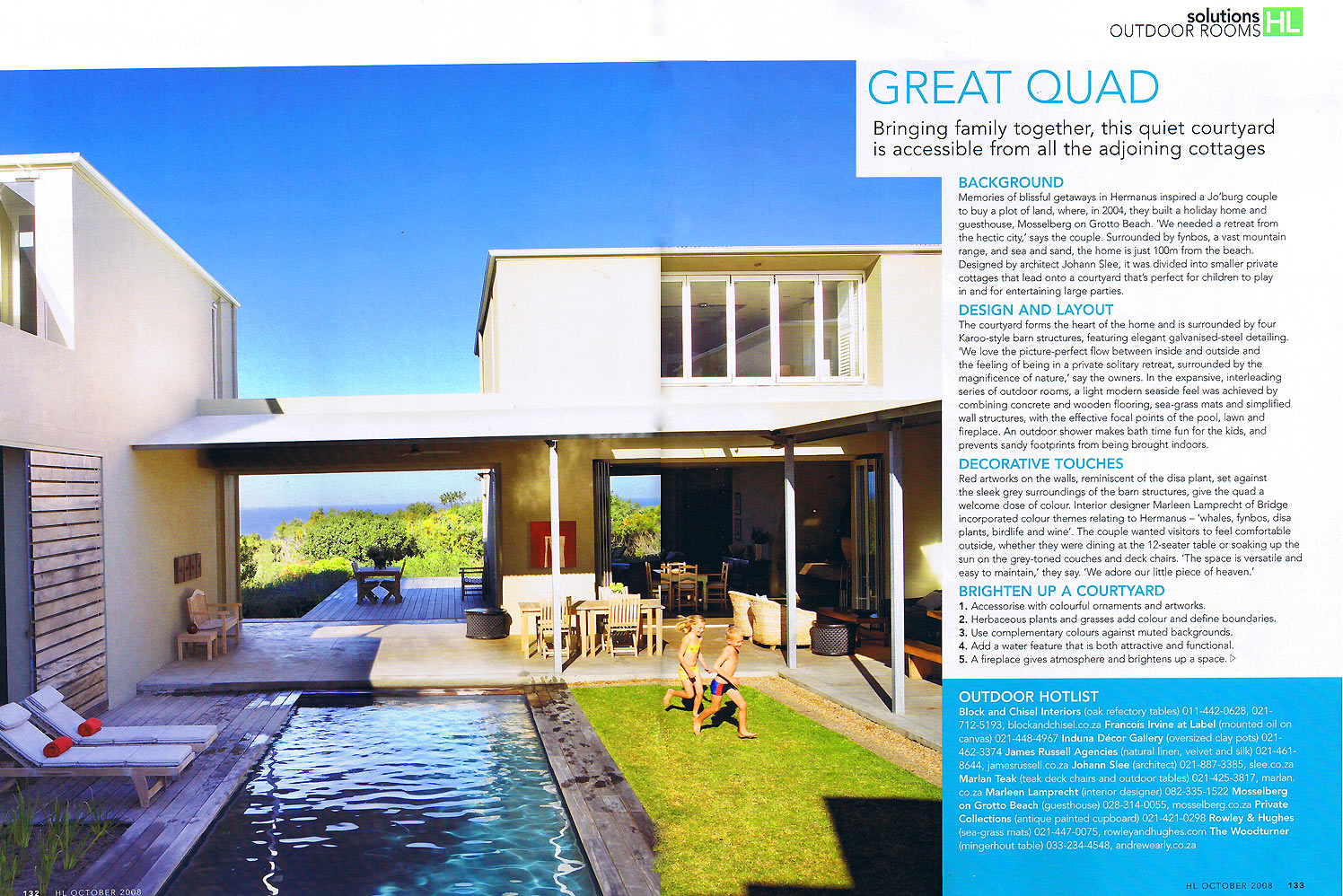
MOSSELBERG ON GROTTO BEACH

Bringing family together in one space, this quiet courtyard is accessible from all the adjoining cottages


BACKGROUND
Memories of their blissful getaways in Hermanus inspired the owners to buy land, where, in 2004, they built a holiday home and guest house. “We needed a peaceful retreat from the hectic pace of Johannesburg,” says the couple. “When the house isn’t being used by guests, we spend time there with the whole family.” Surrounded by fynbos, a vast mountain range, sea and sand; the home, designed by Johann Slee Architects, was divided into smaller, private cottages, all leading onto the outdoor courtyard space. Perfect for children to play in and entertaining large parties, the quad features a swimming pool that reflects the Mosselberg mountain in the north and at night, mirrors the stars.


DESIGN AND LAYOUT
Situated about 200m away from the beach, the courtyard forms the heart of the home and is surrounded by four easy Karoo-style barn structures, featuring elegant galvanized steel detailing. “The architecture of this home is a work of art for us,” they say. “We love the picture perfect flow between inside and outside and the feeling of being in a private solitary retreat, surrounded by the magnificence of nature.” Corroborating closely with Johann Slee, the couple ensured that the plans reflected their wishes exactly. A light seaside feel, synonymous with the words modern, calm and spacious, was achieved by combining concrete and wooden flooring, sea grass mats and simplified wall structures, with the effective focal points of the pool, grassy patch and fireplace.

DECORATIVE TOUCHES
Splashes of red artwork on the walls, reminiscent of the flamboyant disa plant, set against the sleek grey surroundings of the barn structures, enliven the quad with a welcome dose of colour. The interior designer, Marleen Lamprecht of Bridge, decorated each space of the home in colour themes relating to Hermanus and the Western Cape. “Rich in its diversity, we subtly used impressions from whales, fynbos, disa plants, birdlife and wine,” she says. The couple wanted visitors to feel comfortable outside, whether they were dining at the 12-seater table or soaking up the sun on the grey-toned couches and deck chairs. “The space is so versatile and easy to maintain,” says the couple. “We adore our little piece of heaven.”


Guest house details: Mosselberg on Grotto Beach 028-314-0055, http://www.mosselberg.co.za


FIVE TOP TIPS FOR BRIGHTENING UP A COURTYARD SPACE
1. Accessorise the area with light furniture, ornaments, and colourful artwork
2. Herbatious plant borders and grass add colour and also clearly define boundaries
3. Use complementary colours such as red and green against muted backgrounds
4. Add a water feature to the space that is both attractive and functional
5. Fireplaces give the space a mystical feel, brightening it up simultaneously


Author: Charlene Yared-West. Published in House & Leisure, October 2008, Issue No. 173, p. 129.
SA Media In Full Colour

“South Africa over the last 15 years can be characterised by its profound political and economic transformation, which has impacted all spheres of life for its citizens. Since 1994, the country has moved from racial discrimination to a non-racial democracy, where the rights of South Africans are protected in the Constitution,” says Lumko Mtimde, Chief Executive Officer of the Media Development and Diversity Agency (MDDA). But how far has the South African media come? To what extent has the sector committed itself to the overall transformational agenda?


According to research conducted by the MDDA, a public private initiative, established in 2004 through the MDDA Act of 2002 to encourage an enabling environment for media development and diversity, 13 private commercial radio stations have a Historically Disadvantaged Individual (HDI) ownership of 58% on average. On the television front, private commercial television station’s HDI ownership sits on an average of 64.4% per television station.


In the print media sector, HDIs have less than 26% ownership overall. Concentrated amongst four major players, namely; Naspers (through its subsidiary Media 24), Caxton, Avusa and other foreign-owned Independent newspapers, the research shows that the print media landscape post-1994 has not transformed much, in terms of ownership and control. Currently, the majority of print media is still owned by a few companies and individuals, in spite of the various interventions by the state, through the promotion of the transformation processes and Black Economic Empowerment initiatives.

According to Mtimde, the transformation figures in the broadcasting arena are relatively higher than the print media sector, due to a number of reasons. “The changes in the broadcasting industry reflects the success of the work of the then Independent Broadcasting Authority (IBA) (established in terms of the Independent Broadcasting Authority Act of 1993) and the Independent Communications Authority of South Africa’s (ICASA) regulatory and licensing interventions,” he says. “For example, one of the criteria to qualify for licensing enshrined in the IBA Act and now, the Electronic Communications Act, is ownership by HDIs, limitations on foreign ownership to 20%, and that broadcasting is effectively controlled by South Africans.”


Print media, on the other hand, has not been subjected to any similar interventions, explains Mtimde. The sector is self-regulated and any transformative changes that took place were made at the media’s own pace. The print media sector does not subscribe to any charter aligned to the Code of Good Practise for Broad-based Black Economic Empowerment; whereas the other sectors developed the MAC Charter (Marketing, Advertising and Communications) and ICT Charter (broadcast media and ICT broadly), which they are expected to adhere to.


Says Mtimde; “There may well be other reasons, including entry barriers, such as access to finance, technology and skills, as well as the fact that the business model of a start-up print media organisation would project a long-term breakeven, as a result of the expensive nature of production, printing and distribution,” he says. “We are constantly engaging with the sector and the information we gain will enrich our strategy going forward.”


Mtimde says that even though the historically disadvantaged individual ownership percentage is only at 26%, credit should still be given to the sector in terms of operational control by HDI management and editors, skills development and training, learnerships, internships, bursaries and the like.


“South African broadcast media is representative of the demographics of our country, though there is still room for improvement, more so with regard to indigenous languages on television, etcetera,” he says. “Print media, on the other hand, has shown some progress with respect to HDIs in business and editorial management, but is lacking in respect of ownership by HDIs.”


The MDDA maintains that transformation should take place not only in terms of employment equity, but also at the level of the shareholder – and at all other levels of the value chain. “Diverse media will ensure that our democracy advances, is deepened and is always defended,” says Mtimde. “The MDDA encourages the ownership, control and access to media by historically disadvantaged communities, as well as by the historically diminished indigenous language and cultural groups.”

Supporting the work of the MDDA is the Freedom of Expression Institute (FXI). The primary role of the FXI is to uphold the tenets of the Constitution and the promotion of individuality of thoughts and differences of opinion, as a means to enhance a culture of diversity, which is in accordance with the underlying intention and spirit of the Constitution.


According to Melissa Moore, acting executive director for the FXI, “One of the prime objectives of the FXI is to conduct a rigorous examination of all bodies, both public and private, and to ensure accountability and the broadest possible spread of opinions and views. We do not endorse any party political view but, in terms of transformation, we fully support the development of HDIs, since this is itself recognised in our Constitution,” she says. “The FXI also believes that it is important that HDIs are given the opportunity to participate under mentoring schemes, which enable the transfer of skills and technological know-how, without which it is not possible to have a meaningful role in any form of the media. The important thing is to ensure the right to participate in the market and the outright rejection of any system which limits or inhibits such participation. This can be done by ensuring that, within the regulatory framework, HDIs have access to new licenses, to promote a diversity of ownership and allow greater access to the economy.”


The MDDA is working hard to overcome obstacles to transformation through various means. In order to raise awareness on the trends of ownership and control of the media, research is conducted in accordance with the MDDA Act, advocating for diverse media in the country. Furthermore, the Agency supports and funds emerging media initiatives such as community and small commercial media. To date, the Agency has supported about 259 initiatives with just over R90-million from its inception in 2004. It has also supported a number of capacity building, skills development and training programmes, including providing bursaries to media practitioners practising in the community and small commercial media spaces.


Just recently, on Media Freedom Day, October 19, the MDDA, together with the South African Broadcasting Corporation, Commission for Gender Equality, South African Human Rights Commission and ICASA started a joint dialogue process, discussing the transformation of media and reflecting on the 15 years of democracy. Through the Transformation, Gender and Media Dialogue, the hope is to establish robust discussions on the reasons behind transformation challenges and adopt strategies that will assist in making the shift to a more demographically representative media, on all levels. “It is accurate to say that the process of transformation is on course, evidenced by the support the media has for the interventions resulting from the establishment of the MDDA and the funding agreements between the media houses and the Agency,” says Mtimde.


Present at the event (Media Freedom Day, October 19) were more than 100 individuals and groups from diverse backgrounds, including academics, trade unions, organs of civil society, media practitioners, media organisations, the Film and Publications Board and Chapter 9 constitutional institutions.


“In order to change the media landscape to be more representative, South Africa needs to reflect, look at the current trends, establish the challenges, identify transformational gaps and then together, strategise towards implementing change. We need to work together towards further transformation and towards achieving the goals of a growing, developing and diverse media, envisaged in terms of the MDDA Act of 2002,” says Mtimde. “The media in the next ten years should reflect the demographics of South Africa in every respect in the value chain.”

Moore agrees, saying that the easiest and most effective way to increase the participation of HDIs in the media is to reward businesses which actively pursue a policy of skills transfer and intellectual empowerment. “New opportunities should be created, rather than redistributing existing assets. There is an inherent danger in redistribution, since it tends to create new oligarchies, rather than to open up a vista of opportunity for the broader public and will replace one form of oppression with another. Opening up a vista of opportunity should be done in a manner that promotes greater freedom of expression and understanding of the nature and manner in which the media works,” she says. “Information is essential and more emphasis needs to be placed on training and development, as well as the provision of funds to emerging historically disadvantaged entrants in the market. By fostering competition, one will develop a far more representative media, which is responsive to a far broader spectrum of views and will erode monopolistic practice.”

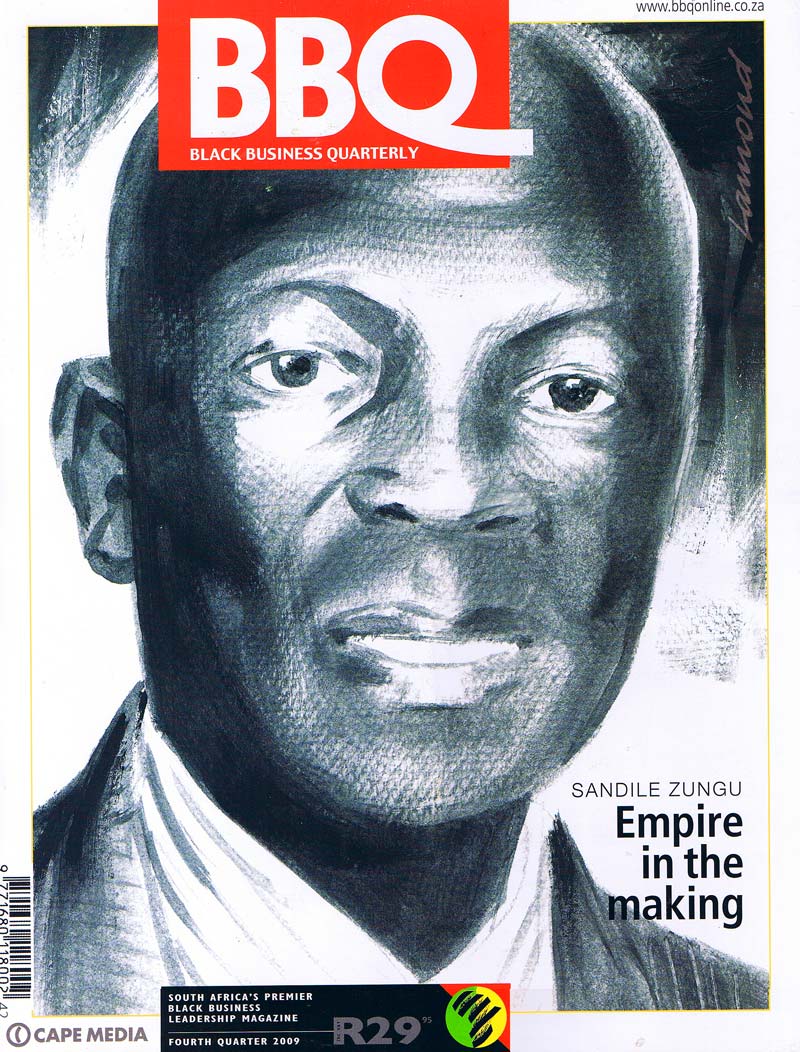
Author: Charlene Yared-West. Published in Black Business Quarterly BBQ, December 2009, Fourth Quarter Edition, p. 47.

Mrs Matilda Kalil

Pictures are memories:

The passage creaking with your footsteps,
Rosaries trickling down your papery thin fingers,
Your papery hands dissolving over oily food,
The passage creaking with your footsteps.
Garlic over everything you made!
Your papery hands dissolving over oily food,
Your drawer in the secret room, secret boxes…
Garlic over everything you made!
Your exit, a knife to my heart, my soul.
Your drawer in the secret room, secret boxes…
Pray the rosary everyday, everyday!
Your exit, a knife to my heart, my soul.
Rosaries trickling down your papery thin fingers,
Pray the rosary everyday, everyday!
Pictures are memories.

Author: Charlene Yared-West

Inside Out

A story to disguise the truth
On the outside I love you, on the inside, I don’t
Wild imaginings of my secret heart

Looking into the distance bewildered
Far faraway at the simple vision of stars
The sound of no sound

There, the organic space where artful stumbling occurs
And landing sure-footed in just the right place
Undaunted and tenacious

The lens of your inner eye shuts out half the truth
Visual and fluid

Author: Charlene Yared-West

Know Thyself

On the edge of my soaring spirit,
I look down to a field.
Over there, I am a mother with four sons.
Over there, I am a son to an Indian tribesman.

Over there, I am a murderer in a cold cell.
Over there, I am an old woman, crystals in my hands.

I slip down the slope towards them.
They do not speak, but their eyes are knowing.

All encircle me, I know them,
I recognise their faces.

The ground beneath us begins to swirl.
Slowly, our bodies meld

Where have they gone?
Inside you, a voice says.

I stand, arms wide open,
I hear a beautiful name,

I cannot see my face.

Author: Charlene Yared-West

Jeffrey’s Bay surfing champion Bertie Stuurman tells us about his favourite things…

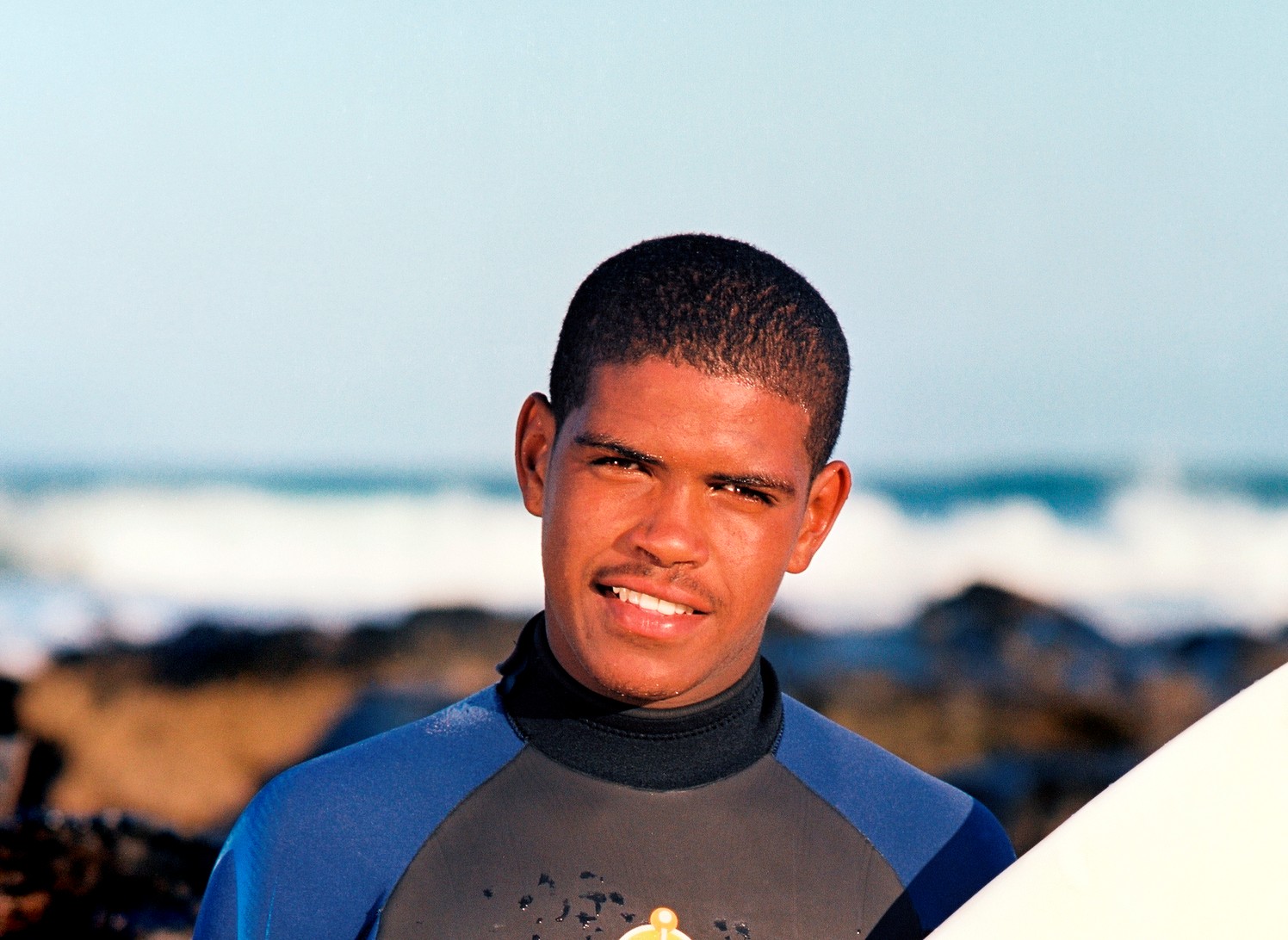
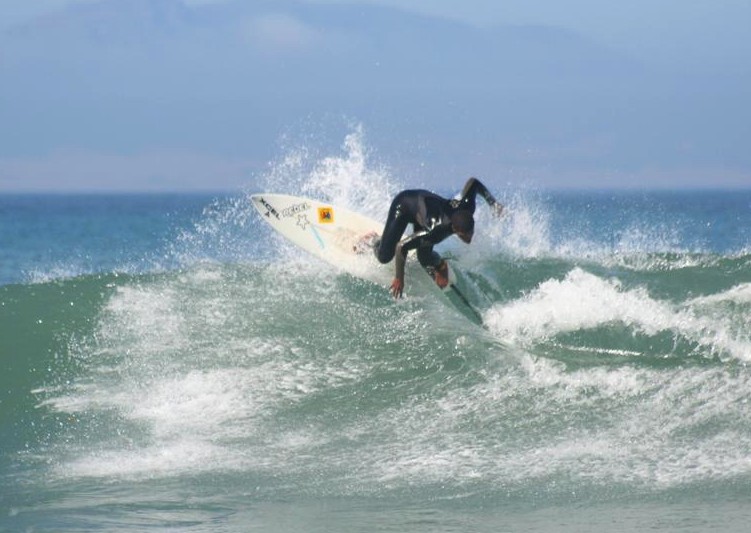
Known as one of the Eastern Cape’s most radical ‘goofy-footers’ for his moves as a left-handed surfer on SA’s waves, Bertie Stuurman has recently been awarded a surfing scholarship by the International Surfing Association for his consistent contest performances in 2007. Surfing from the tender age of 12, waterbaby Bertie from Pellsrus in Jeffrey’s Bay, started competing with the best in SA and abroad in 2003. In 2007, at 17, Bertie won second-place at the SA Surfing Championships in East London in the under-20 division. He also went on to represent his province at the O’Neill Junior Championships in Port Elizabeth and at the end of 2007, was selected as part of the 2008 SA Junior Surfing Squad.

Memorable moment
The day I started surfing! I was on the beach with my friends and we approached Etienne Venter, the current president of Eastern Province surfing and co-owner of J-Bay Surf School, who offered to teach us to ride the waves for free!

Time of day
After I have finished my homework, because that is when I head out to the beach to catch some waves. The weekend is non-stop surfing for me. Come rain or shine, I’m out on the water.


Wipe-out
I don’t have a favourite wipe-out – they all suck! It happened most when I first started surfing. We all fall – and it’s scary. It’s just a matter of picking yourself and your board up and finding the next super tube to ride!

Best ride
My biggest and best wave was about 6ft high at Supertubes in Jeffrey’s Bay. It was incredible – a hollow wave made of dreams that just ran all the way out to the beach.

Surf etiquette
Most commonly, the worst is when someone drops in on your wave. This is reason enough for disqualification in big competitions, but people still do it. It’s shows lack of respect towards another surfer, and I am proud to say that I have never done this professionally.


Under the sea
Thank goodness I have never seen a shark while out on the water, but I was attacked by an octopus. My friends who heard me yelling just thought it was the funniest thing… I did not! I have also swum alongside dolphins. They seem to race with you – a silent competition they know they’ll win.


All-round workout
A good jog up and down the beach always gets me warmed up and ready to paddle out to sea. I also swim against the current – this gives me a really good workout.

Favourite pre-competition munchies
Grape Energade, Jungle Oats Energy Bar and a toasted chicken mayonnaise sandwich fuel me up for my best moves; vertical snaps and big floaters.


Meal out on the town
I love chicken, so roast chicken and chips would be my first choice and a double-thick chocolate milkshake to wash it all down.


Favourite hangout
Any place where great food and good people come together – that’s where you’ll find me. If I’m not chilling at a friend’s house having a braai, I love going to the Jeffrey’s Bay KFC. Besides the tasty chicks you can get there (no pun intended!) it’s a good place to meet people.

Couch-potato down-time
When I need to put my feet up, after a hard day on the surf, I wind down on Tom and Jerry – they always crack me up! Step Up and the new Rambo movie are also favourites of mine that I can watch over and over.


Best book
South African author, Dalene Matthee’s book, Kringe in ‘n Bos is something I feel everyone should read. It taught me about bravery, perseverance and love for nature.


Sound of music
I love the sounds of Linkin Park, Chris Brown and me in the shower! It’s the best place to sing.

Three wishes
My first wish is to be the Surfing World Champion. Second, I want to surf in Mexico. Third, I want to make my country proud.

Three people
First, my coach Etienne, who made everything possible. My life made a 360 degree turn-around the day I started surfing. I am now a champ and going onto greater things – what an advantage! Second, my favourite surfer, the legendary Mexican-American Bobby Martinez. He is awesome. Third is my family, who have been very supportive of my surfing dreams.


Celebrity crush
I have to say, without a doubt in my mind; Halle Berry. Maybe one day she’ll notice me as a celeb’ surfer and then we’ll catch some waves together or even, make a movie?

Love interest
At the moment, my beautiful 5’10” white Rebel surf board – need I say more?


Travel companion
My surfing kit – I don’t leave home without it.


Life without the ocean?
This would be like not breathing for me, but if I was born in a land-locked country, I would probably have been a cricketer or soccer player – and hopefully I would’ve stayed away from habits that would bring me down, like drugs and alcohol. I realise how different life would’ve been for me without the sea.


Advice to aspiring surfers
Stay away from drugs and find out about surfing opportunities in your area. It doesn’t have to cost you much to start surfing – especially if you have talent! People will help you if you just ask.

Author: Charlene Yared-West. Currently Unpublished.