Want to spread the love this festive season? Here are some organisations across the country, which need your support…
Beds of Hope Campaign
The Beds of Hope Campaign seeks to raise R15 million by the end of 2010 for purchasing and equipping ICU and High Care Units for the Universitas and Pelonomi Academic Hospitals. At present, these hospitals function with outdated equipment sorely in need of being replaced or updated. “Many newborn babies face death due to the unavailability of adequate facilities in hospitals,” says head of the department of Paediatrics and Child Health at the University of the Free State, Professor André Venter. Children and babies from the Free State, Northern Cape, Lesotho and North West Province are all treated by the Department of Paediatrics and Child Health at these hospitals. Contact: T: 051-405-3181, E: turnaround@telkomsa.net, W: http://bedsofhope.ufs.ac.za
Engender
Engender is focused on changing patterns of violence and inequality in South African society and transforming victimhood to agency. Through workshops and in-depth research, the organisation covers areas such as genders and sexualities, gender-based violence, HIV/AIDS, human rights, justice, as well as conflict resolution and peace, Engender works with the most marginalised of communities and is need resources from funds to time. “Although our focus is on the Western Cape, we have strategic collaborations across the country, the continent and internationally,” says director, Bernadette Muthien. “In helping people empower themselves, we contribute to the general social wellbeing.” Contact: T: 021-447-6290, E: info@engender.org.za, W: http://www.engender.org.za
NOAH
Neighbourhood Old Age Homes (NOAH) is a programme of the Catholic Welfare and Development agency, which provides an integrated package of communal homes and services to pensioners who rely on the government grant to meet their needs. Run independently, these are ordinary homes in communities that are safe and affordable. NOAH also hosts weekly social clubs which have become a meeting place for companionship, support and sharing of ideas. “As a result of our work, elderly people feel secure and happier,” says programme manager, Dee Wills. “They stay connected to their communities, while retaining their dignity and independence and also remain healthy and active for as long as possible.” Contact: T: 021-447-6334, E: noahhse@noah.org.za, W: http://www.noah.org.za
Khulisa
Established in 1997, Khulisa is dedicated to preventing crime in South Africa. Amongst the many programmes they run are the ‘Ubuntu Clubs’ based in Gauteng, North West, Kwa-Zulu Natal and the Western Cape. “The clubs offer youth-at-risk a safe, warm and friendly space for interaction, personal development and a sense of belonging,” says managing director, Lesley Ann van Selm. “Between 1,000 to 5,000 youths are reached through each club, where they learn the age-old values of responsibility to the community, brotherhood and compassion.” Meetings are held after school hours, on weekends and during school holidays. Khulisa is in need of T-shirts, stationery, transport money, gardening equipment and opportunities to provide hiking or camping excursions. Contact: T: 011-788-8237, E: info@khulisaservices.co.za, W: http://www.khulisaubuntuclubs.co.za
DARG
The Domestic Animal Rescue Group (DARG) assists abused, injured, and abandoned cats and dogs find new loving and caring homes. “DARG is not only for neglected and abused animals, but also an adoption centre with many loving animals patiently waiting for new homes, as well as an educational facility for the community,” says director, Joy Giovanni. “We are pro-life and provide animals with the gentle alternative of a safe haven.” DARG invites people to visit the centre and perhaps even give a pet a home, or leave a donation in the form of cash or pet food. Contact: T:021-790-0383, E: info@darg.org.za, W: http://www.darg.org.za
Edmund Rice Camps
Edmund Rice Camps give children from marginalised backgrounds the opportunity to have a holiday with an emphasis on having fun, ensuring safety and building self-esteem. Using a mentoring ‘leader-buddy’ system for the duration of the holiday camp, the programme offers children the opportunity to explore, find hope and reach beyond their circumstances and limitations. “The volunteers create an atmosphere of safety and love to which the children, so used to fear and disadvantage in their lives, respond and blossom like flowers to rain,” says volunteer camp mentor, August Kamara. The project is in need of sponsors for the holiday programmes and children, volunteers and donations in kind, such as towels, blankets, sport and art equipment. Contact: T: 021-880-0795, E: edmundricecamps@yahoo.com
Karabo – I Am The Solution
Established in 2004, Karabo – I Am The Solution helps disadvantaged 5 to 8 year olds in Gauteng, KwaZulu-Natal and the Western Cape schools learn about and make informed decisions about HIV/AIDS. “We are unique in that we focus on the very little ones who can still be influenced, instead of teenagers who are already sexually active,” says managing director, Handa Blake. “The children then go into their communities and educate teenagers and adults about HIV and Aids.” The programme requires individuals to sponsor a child at R190 per year. Contact: T: 011-726-1397, E: uw@worldonline.co.za
Adopt a School Foundation
The foundation focuses on the provision of basic facilities for the creation and improvement of the school environment – for good quality learning and teaching to take place. To date, the foundation has adopted 50 schools in the seven provinces of South Africa and has built classrooms, administration blocks, ablution blocks, libraries, science labs, multi-media centres and provided grade R facilities. “The project has benefited disadvantaged schools and their communities through creating temporary job opportunities, as well as assisting over 50,000 children since its inception,” says executive director, Stephen Lebere. “Presently, 135 schools are waiting for adoption.” The programme is in need of funds, time or expertise and the adoption of schools for a minimum of five years. Contact: T: 011-305-8900, E: slebere@shanduka.co.za, W: http://www.adoptaschool.co.za
GRIP
The Greater Rape Intervention Project provides humanitarian assistance, rehabilitation and empowerment to all survivors of rape, sexual assault and domestic violence. Rendering a holistic service focusing on each and every aspect of the survivor going through the criminal justice system, GRIP provides police, hospital and court interventions as well as HIV support intervention. The organisation has extensive pre-court training, ensuring more convictions of perpetrators. “Our survivors give us hope,” says CEO, Annesta Hofer. “Hope that as a community, when we stand together, we can overcome our fear – and in our togetherness, we can give one another courage to take action against any form of violence, especially against our women and children.” GRIP is in need of soft toys, which give comfort to the survivor during the reporting process, especially for children survivors. Care packs, which contain the basic toiletries, are also needed, to help the survivor feel emotionally and physically clean once the medico-legal examination has been completed. Contact: T: 013-752-4404, E: info@grip.org.za, W:www.grip.org.za
Algoa Bay Council for the Aged
Algoa Bay Council for the Aged provides supportive services to older persons in the Nelson Mandela Metro, aiming to keep them active in the community for as long as possible. The organisation has three service centres and offers midday meals, where the elderly are able to enjoy social interaction with others. Counseling and advice services are also offered, as well as a home-care referral service, a sponsored home care project, a medication delivery service for house-bound aged and a low-cost rental housing facility. Not only does Algoa Bay Council for the Aged provide the elderly with a skills development programme, they also educate the public on issues around elder abuse. “I was so happy to help these wonderful people, who are so deserving of love, with my fabric painting skills,” says volunteer helper, Nobubele Mbiyo. “I gained so much from spending time with them and it gave me great satisfaction to bring some joy to their lives.” The council is looking for donors who will volunteer of their services, sponsor an elderly person, or even give donations-in-kind to help with home care, meal ingredients, furniture, household products and groceries. Contact: T: 041-368-8434 E: ceo@abca.co.za W: http://www.abca.co.za
Author: Charlene Yared-West. Published in the Clicks ClubCard Magazine, December 2008.
The Gautrain is on Track
The question on everyone’s lips is whether we will be ready for the Fifa 2010 Soccer World Cup. From soccer stadiums to road upgrades, South Africa’s sectors are coming together to host one of the biggest events the African continent has ever seen. One such project, the Gautrain, has been running since 2000 – four years before the announcement was made to hold the games in the country.
Building the Gautrain
The Gautrain system, with a fleet of 24 state-of-the-art train-sets, will cover 80km of dual track, with 15km of tunnel, 205 bridges and ten brand new stations. In time for the World Cup, phase one of the project will be completed by May 2010, with stations at OR Tambo International, Rhodesfield, Marlboro and Sandton. The second phase, to be completed by April 2011, will include lines to and from Pretoria, with stations at Hatfield, Pretoria City Central, Centurion, Midrand, Marlboro, Sandton, Rosebank and Park. There will also be links to this line leading to Sandton, Rhodesfield, Marlboro and OR Tambo International.
As a priority, security will include 450 CCTV cameras spread across the trains, stations and parking areas, as well as 350 patrolling security personnel. The project is currently finalising negotiations with the SAPS to base a police station at each of the train stations. “We are confident that from a personal security point of view, we can safeguard people using this mode of public transport,” says Project Manager of the Gautrain, Jack van der Merwe.
Spending up to R3 million per hour, with an overall budget of R25 billion, the construction spans 52 sites simultaneously. Not without its challenges, the project faced a near-disaster crisis with a recent sinkhole in Oxford Road. “When something like that happens, it is important to see that your safety systems worked – and in that situation, they did,” Van der Merwe says, explaining that the tunnel boring machine was removing more material out of the tunnel than it was supposed to. After investigating, the team discovered that an old water pipe had burst, which caused the soil to move down. Once they had filled the sinkhole with gravel and constructed a concrete slab over it, they were able to continue with construction after 36 hours..
Reliable and eco-friendly
“We can’t keep building ourselves out of congestion,” says Van der Merwe. In Los Angeles, in an attempt to overcome congestion, more roads were built. Today, the city covers over 100km of space with 20 to 30 lane freeways – and has some of the worst pollution statistics in the United States.
After conducting an environmental assessment of the project, it was found that if
135 000 people used the Gautrain per day, about 19 000 tons of carbon monoxide pollution would be prevented every year. “Not only will the Gautrain be the more environmentally friendly option, it will also be the more reliable choice,” says Van der Merwe. “A trip by car from Pretoria to Johannesburg takes about 60 to 180 minutes, depending on the level of conjestion and delays, but on the Gautrain, it will take you only 38 minutes.”
Part of the Gautrain marketing strategy is to make public transport a mode of choice, rather than a mode of force. “Currently, people are using public transport because they have no other option,” Van der Merwe explains. “Rather, we want people to view using public transport as an intelligent choice of commuting.”
The Gautrain will run every 10 minutes during peak hours and in the off-peak periods, at a maximum of every 20 minutes – from early in the morning until late at night.
Cost to the man on the street
At the time of conducting a feasibility study, the cost of fuel was at R4 per litre with the perceived cost of motoring at about 60 cents per km. This calculation translated into about R20 per ticket between Pretoria and Johannesburg and about R12 between Rhodesfield and Sandton, using the Gautrain. Since then, petrol prices have soared to over R10 per litre. “The South African National Roads Agency (SANRAL) is currently upgrading all the freeways in Gauteng,” Van der Merwe says. “Once this is completed, all cars will have transponders installed to be tolled automatically when using those roads,” Once this system is up and running, the average person can expect to pay about R1 000 extra – on top of the R100 each day in fuel costs between Pretoria and Johannesburg. “These developments make using the Gautrain a far more viable option,” emphasizes Van der Merwe.
Skills development and transfer
“The Gautrain project has been beneficial to ordinary South Africans, in that skills development and skills transfer programmes have been put into place,” says Van der Merwe. The project has, since its inception, created 21 600 jobs with training programmes and apprenticeships for about 2 000 people. The Concessionaire has also set up an office in London in the hopes of recruiting the skills needed for the project. To date, 51 South African engineers, who were working overseas, have since returned to work on the project.“We are bringing something that is comparable on an international level, to South Africa,” Van der Merwe says. “The project has brought in a wide range of new technology, created many jobs and has put South Africa on the map in terms of public transport.”
Author: Charlene Yared-West. Go Gauteng, September 2008.
Greening the City
Believe it or not, Joburg is the world’s largest man-made forest
When you think of forests, you think of lush trees, birds twittering on fresh breezes and the feeling of soft ground underfoot – a far cry from the concrete jungle of Joburg, right? Wrong. In 2005, the world discovered that Johannesburg was home to the world’s largest man-made forest. Comparative research was carried out in leading cities and satellite images of the earth showed that Johannesburg was the most densely forested city on the globe.
Originally savannah, Johannesburg started its greening transformation about 100 years ago, strangely enough with the growth of the mining sector in the city. “In those days, mostly affluent people lived in the city centres,” says spokesperson for Johannesburg City Parks, Jenny Moodley. “Tree cover expanded as more people settled in the city and wealthy immigrants brought with them varied species of trees – which is why many of the trees in Johannesburg are not indigenous.” Tree cover also spread through natural means of pollination and through people planting more trees themselves. Today, Johannesburg boasts as many as 10 million trees in both private and public spaces.
“But the southern part of the city remains a dust bowl,” says Jenny. “Johannesburg City Parks is planting more trees all over Johannesburg, but specifically in the far southern and northern areas, as part of our 2010 Greening the City campaign.”
This campaign has not been without its challenges. “In Johannesburg, space is at a premium, so we need to ensure that even though our priority is to plant trees, we retain space for pedestrians to walk,” Jenny explains. “Another challenge is that the cost of planting a tree has escalated from about R350 to R1 000 for an 80mm, 2m high indigenous tree.” To overcome this problem, Johannesburg City Parks has been lobbying for companies in South Africa to adopt greening campaigns and many of them have responded positively.
The ‘green team’ has also had to deal with the loss of trees to bad weather and vandalism. Jenny says that they lose two of every ten trees planted. As a result, they are now insisting that the service providers who care for the trees maintain a 95 percent survival rate – and should they drop below the 95 percent mark, the service providers are compelled to replace the damaged trees.
In line with the 2007 mayoral aim of planting 200 000 trees before the 2010 Fifa Soccer World Cup, Johannesburg City Parks have planted more than 93 000 trees, in the past five years. But to meet their objective, Johannesburg City Parks still has to plant 300 trees a day.
The ‘green team’s’ work is easy to see. Jenny urges visitors to take a drive down the main roads, such as William Nicol and Old Potchefstroom Road. She says to keep an eye out for the water features and large pots they are also installing as part of the city’s greening and beautification plan.
Johannesburg City Parks has also been involved with restoring old parks to their former grandeur. “Once you’ve restored the dignity and integrity of a space, there is a greater sense of community ownership,” says Jenny. “This impacts positively on the social, economic and ecological state of the city, reducing concerns such as littering, vagrancy, vandalism and illegal dumping.”
Jenny emphasizes that greening the city has incredibly positive spin-offs. She encourages more residents to plant trees – and not just indigenous types. They should look at planting fruit trees, she says, taking into consideration the global food shortage and the need to attract and retain urban biodiversity such as birds and butterfly species. http://www.jhbcityparks.com.
A breath of fresh air: OZONE DAY
This year’s International Ozone Day, celebrated on September 16, has the theme of ‘Montreal Protocol – Global Partnership for Global Benefits’. “Even though we stopped the production of CFCs in 1987 with the Montreal Protocol, we are still seeing the nasty effect of those gases on our planet,” says Specialist Scientist for the South African Weather Service, Casper Labuschagne. “Only within 60 years will the planet be effectively healed from CFC gases, provided we don’t pollute the air any further – and continue with the greening programmes.”
Tree of life: ARBOR DAY
Celebrating Arbor Week from September 1–7, Johannesburg City Parks aims to plant over 60 000 trees in the southern parts of the city this year. The organisation has invited 15 corporates to adopt streets in the southern dust bowl, where they are each to plant 1 000 trees, marking the start of Arbor Week 2008. South Africa is slowly making climate change a priority as it realises the effects of pollution.,The trees absorb a lot of the pollution in the air, acting like natural atmosphere scrubbers.
Author: Charlene Yared-West. Go Gauteng, September 2008.
Women of the new world

Igniting Progress
“Equal power and glory to the Women of South Africa!” Words spoken by former President Mandela in 1996, at a speech commemorating the 9th of August 1956, which has become South African Women’s Day. On this day, 52 years ago, over 20,000 women from all over South Africa united in their cause to protest against the pass laws of the time, by marching onto the Union Buildings in Pretoria, singing “Wathint’ abafazi, wathint’ imbokodo; uzokufa!” [Strike a woman, Strike a rock!] This phrase has become synonymous with the inner strength, resilience and courage of South African women, in the face of severe circumstances. Not only were these women contending with racism, they also had to overcome the challenges of being female in a white man’s land, within a misogynist mindset.
What was it that made these women so angry? Angry enough to come together in what is known as the biggest mass gathering of women ever to be held in South Africa? Throughout history, this anger has spurred millions of women the world over to stand up and fight for equal rights in a patriarchal society. Yesterday’s woman was confined to a life of housekeeping, child-rearing, keeping her man happy and even seeing to the agricultural responsibilities of the homestead. Today’s woman can proudly claim her position on the social, political and economic ladders of success, with or without a male counterpart in her life.
The Cost of Freedom
A peek into the history books will show how a fighting spirit, partnered with fury over a social cause, has moved mountains, triumphed over wars and won the vote for the ‘meeker’ sex. We can go as far back as the 14th century, where Joan of Arc, as a peasant girl, was able to convince whole armies to fight according to the divine guidance she received. Even though the French army won many of their battles under her leadership, it did not end well for her, as she was burned at the stake as a witch in 1431. Another woman, Florence Nightingale, otherwise known as ‘The Lady with the Lamp’, was not only influential in the fields of nursing and mathematics, but also fought for women’s rights, writing a book about the over-feminisation of women in the later half of the 18th century.
The 19th century saw even more women leaving dishcloths, gardening tools and motherhood behind and instead becoming more involved in the running of their countries. From the burning of the first bra in 1968 in the USA – in sheer defiance, to the 1980s in South Africa, where many women suffered police detentions or were forced into exile for their indignation and refusal to stay detached from the torment of the times. One of the first women to fight for freedom from unequal conditions for African women in South Africa was Charlotte Maxeke in 1913, the first president of the Bantu Women’s League, an earlier version of the ANC Women’s League. Around that same time, esteemed writer and feminist Olive Schreiner wrote on the topic of equal rights for women in the country, in her widely acclaimed book, The Story of an African Farm. She also campaigned for the rights of black people in South Africa, befriending Mahatma Ghandi, who shared similar views on unity of the people.
Without these brave forerunners, South African women would still be fighting as fiercely as before. Now, with the South African Constitution of 1996 in place, women can scale the same heights as men – and even surpass them, as equal contenders in all spheres of life.
International Women’s Day
In the prefect scenario, women from every corner of the globe would be free, living in an equal society. Sadly, women in the Middle East, various African countries and other parts of the world, continue to suffer horrendous violations of their basic human rights. International Women’s Day, held annually on 8 March, since 1909, celebrates the rights wrought by women throughout history and also generates awareness around the plight many women continue to face. The day also commemorates the Triangle Fire of 1911, in New York City, where over 140 working women lost their lives. This devastating incident resulted in many changes to the labour legislation and working conditions in the USA and acted as a catalyst for change internationally.
Challenges Overcome
Women of today are more assertive, more demanding and more ambitious than ever before. Today we have women in space, female presidents and prime ministers. We also have university graduates, career moms and female pastors. Celebrate South African National Women’s Day with pride and remember the words in the petition presented to the Prime Minister in Pretoria on 9 August, 1956; “We shall not rest until we have won for our children their fundamental rights of freedom, justice, and security.” Thanks to their persistence, women now control their own choices, as a result of the hard-won triumphs of the past.
Notable Milestones in the History of Women
- 1491 – Queen Isabella of Spain funds Christopher Columbus’ voyage, which leads to the discovery of America.
- 1786 – Astronomer and scientist Caroline Herschel of Germany becomes the first woman to ever discover a comet.
- 1895 – Annie Londonderry of America is the first woman to bicycle around the world in 15 months.
- 1905 – Charlotte Maxeke becomes the first black South African Black woman to receive a Bachelor’s degree.
- 1908 – Cecilia Makiwane becomes the first Black professional nurse in South Africa.
- 1912 – Canadian Mary Dawson develops the concept of minimum wage.
- 1915 – Audrey Munson of America is the first woman to appear nude in a motion picture in Inspiration.
- 1926 – American Gertrude Ederle is the first woman to swim across the English Channel.
- 1930 – White women in South Africa get the vote.
- 1947 – Mary Malahlela-Xakana becomes first female black doctor in South Africa.
- 1955 – Patricia Jobodwana becomes the youngest black woman in South Africa to enrol at a university, at age 14.
- 1956 – 20,000 march to the Union Buildings in Pretoria, South Africa, to protest against passes for women.
- 1963 – Russian Valentina Tereshkova becomes the first woman to go to space.
- 1975 – Japanese Junko Tabei becomes the first woman to summit Mount Everest.
- 1979 – Margaret Thatcher becomes the first female Prime Minister of the United Kingdom.
- 1974 – Isabel Perón of Argentina, is the first woman with the title of President.
- 2006 – In celebration of National Women’s day 50 years before, women again march to the Union Buildings in Pretoria, where they hand a memorandum of grievances to President Thabo Mbeki.
Author: Charlene Yared-West. Published in Go Gauteng Magazine, August 2008, p. 12.
Destination Kyalami

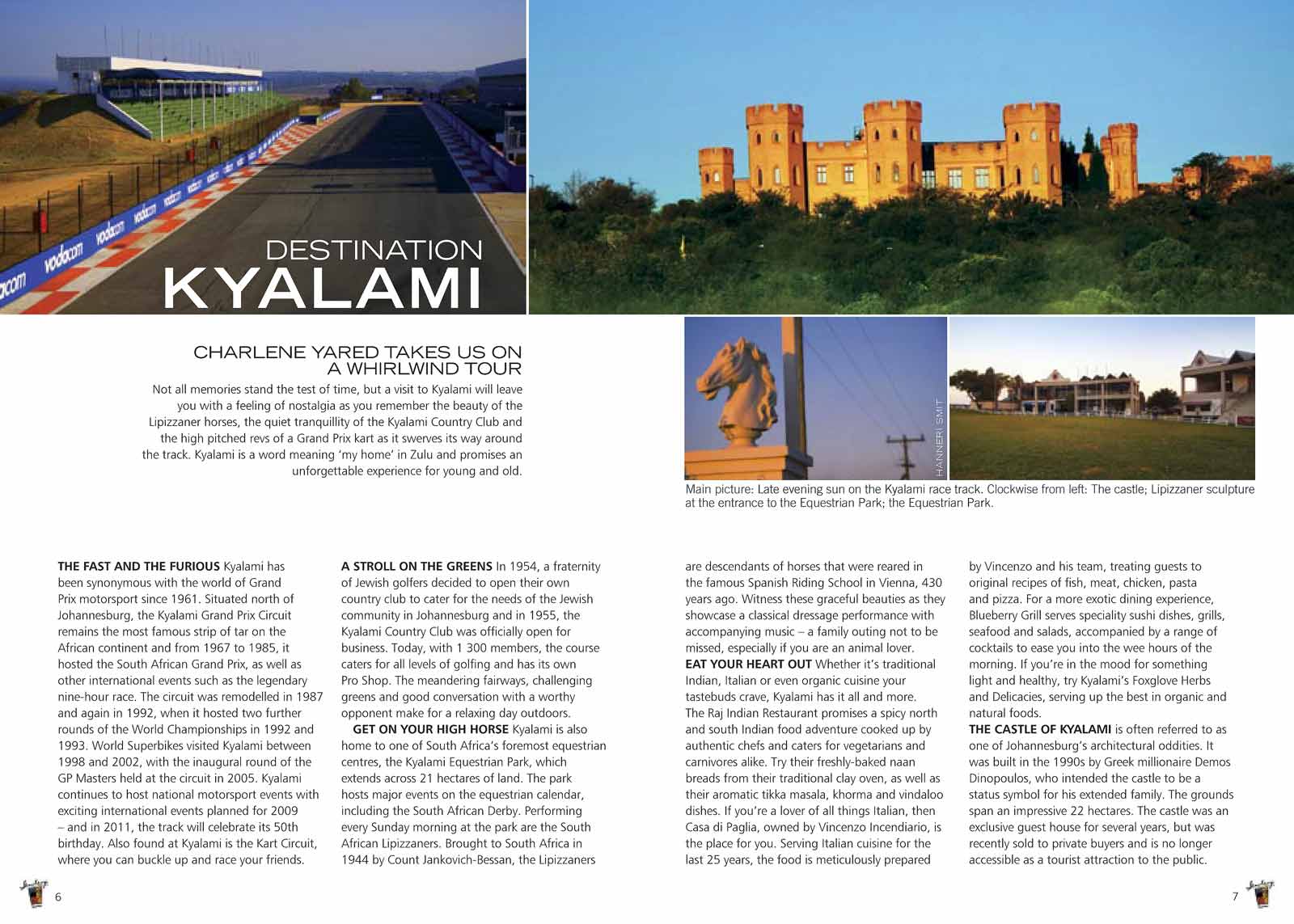
Not all memories stand the test of time, but a visit to Kyalami will leave you with a feeling of nostalgia, as you remember the beauty of the Lipizzaner horses, the quiet tranquillity of the Kyalami Country club and the tearing zoom of a Grand Prix kart as it swerves its way around the track. Kyalami a word meaning ‘my home’ in Zulu, promises an unforgettable experience for young and old, ensuring all visitors enjoy her adventurous hospitality and wide open spaces, and leave with glorious stories to tell…
The Fast and the Furious
Kyalami is synonymous with the world of Grand Prix motorsport, since its founding year of 1961. Situated north of Johannesburg, the Kyalami Grand Prix Circuit remains the most famous strip of tar on the African continent and from 1967 to 1985, hosted the South African Grand Prix, as well as other international events such as the legendary 9-hour race. The circuit was remodelled in 1987 and again in 1992, when it hosted two further rounds of the World Championships in 1992 and 1993. World Superbikes visited Kyalami between 1998 and 2002 with the inaugural round of the GP Masters held at the circuit in 2005. Kyalami continues to host national motorsport events with exciting international events planned for 2009 – and in 2011, will celebrate its 50th birthday. Also located in the Kyalami racing circuit is the Kyalami Kart Circuit, just waiting to give you the driving experience of a lifetime, from R200 for 12 laps. Step into Schumacher’s shoes as you whiz around a track run by motor-sporting enthusiasts, the Piazza-Musso and Wentzel brothers.
A stroll on the Greens
In 1954, a fraternity of Jewish golfers decided to open their own country club to cater for the needs of the Jewish community in Johannesburg. After finding the perfect spot, they started laying out the plans for their dream course and in 1955; the Kyalami Country Club was officially open for business. Today, with 1300 members, the course caters for all levels of golfing skill and boasts its own Pro Shop. At R375 for non-members, the green meandering fairways, challenging hazards and conversation with a worthy opponent, make for a perfect day spent in the sunshine. Celebrate your win with sundowners at the clubhouse.
Get on your High Horse
Kyalami is also home to South Africa’s foremost equestrian venue, the Kyalami Equestrian Park, which extends over 21 hectares of land. The park is host to major events on the equestrian calendar, including the South African Derby. Performing every Sunday at the park are the South African Lipizzaners at 10:30am at the price of R80 per ticket. Brought to South Africa in 1944 by Count Jankovich-Bessan, the Lipizzaners are descendants of horses that were reared in the famous Spanish Riding School in Vienna, 430 years ago. Witness these majestic beauties as they gracefully showcase a classical dressage performance with accompanying music – a magnificent outing not to be missed.
Eat your Heart out
Whether it’s traditional Indian, Italian or even a tender T-bone steak your tastebuds crave, Kyalami has it all and more. The Raj Indian Restaurant promises a spicy north and south Indian food adventure cooked up by authentic chefs and caters for vegetarians and carnivores alike. Try their freshly baked naan breads from their traditional clay oven, as well as their aromatic tikka masala, khorma and vindaloo dishes. If you’re a lover of all things Italian, then Casa di Paglia, owned by Vincenzo Incendiario is the place for you. Serving Italian cuisine for the last 25 years, the food is meticulously prepared by Vincenzo and his team, treating guests to original recipes of fish, meat, chicken, pasta and pizza. For a more exotic dining experience, Blueberry Grill serves speciality sushi dishes, scrumptious grills, seafood and salads, accompanied by a range of cocktails to ease you into the wee hours of the night. For the most succulent prawns in Kyalami, turn into Jimmy’s Killer Prawns and taste a variety of seafood, harvested off the coast of Africa. In the mood for something light and healthy? Try Kyalami’s Foxglove Herbs and Delicacies, serving only the best in organic and natural foods, where guests can shop or relax in the adjoining coffee shop.
Shopping Spree
Kyalami is host to an array of interesting shopping nooks – but first, drop the kids off at Earth Kids Play Patch, a supervised kids play-park and playground, so that you can browse Kyalami’s two shopping centres at your leisure. Stroll around the Crowthorne Centre or the Kyalami Downs Shopping Centre, where you can shop until you drop, perusing clothing, jewellery, adventure, toy and hobby shops.
Useful Contacts
- The Kyalami Grand Prix Circuit: 011-466-2800
- Kyalami Kart Circuit: 011-466-3678/9
- Kyalami Country Club: 011-702-1610
- Kyalami Equestrian Park: 011-702-1657/8/9
- South African Lipizzaners: 011-468-2718
- The Raj: 011-468-1861
- Casa di Paglia: 011-466-2618/42
- Blue Berry Grill: 011-466-2664
- Jimmy’s Killer Prawns: 011-466-9502
- Foxglove Herbs and Delicacies: 011-466-9977
- Earth Kids Play Patch: 083-233-7806
Author: Charlene Yared-West. Published in Go Gauteng Magazine, July 2008, p.6.
Donor Directory for Development
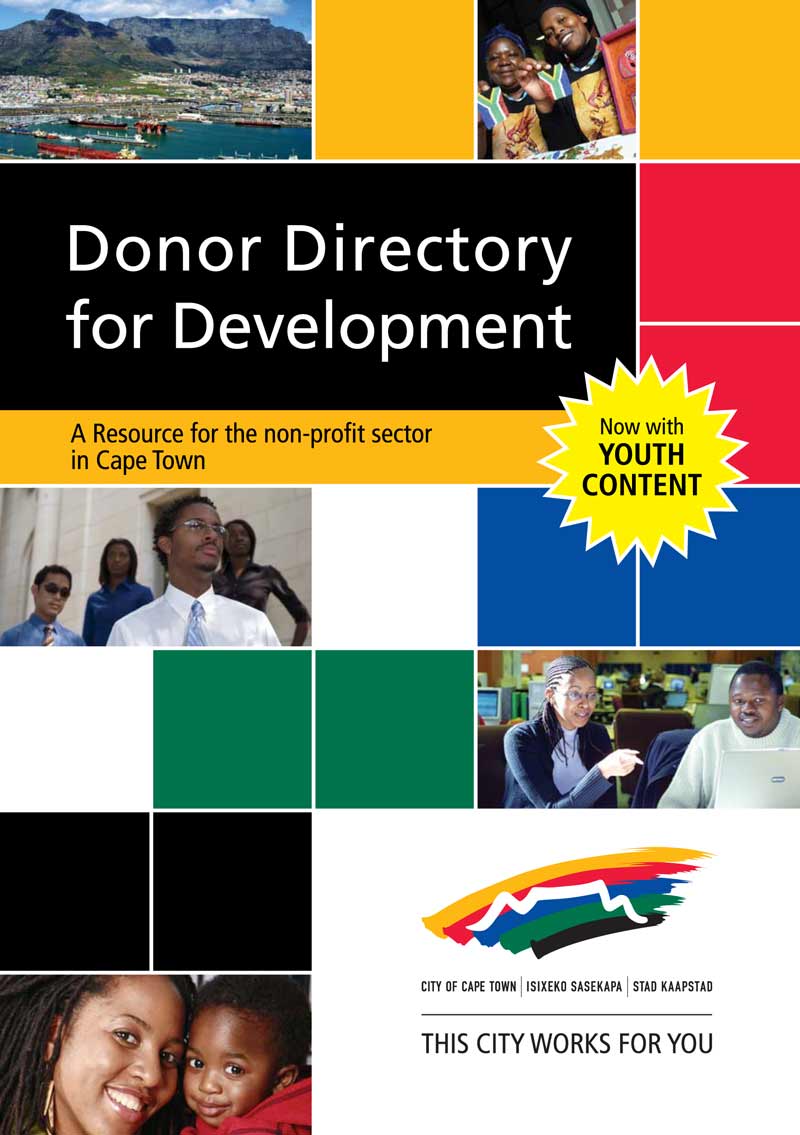
In 2007, I was part of the Development Works creative team to edit the 2006/2007 edition of the Donor Directory for Development, a resource for the non-profit and development sector of the Western Cape.
Please click here to read the PDF of the Donor Directory.
2010 Website for the Western Cape
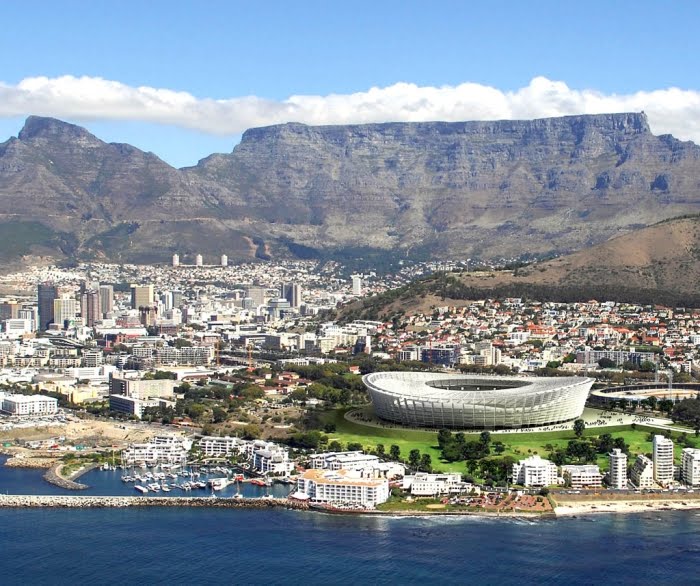
In 2008, I was part of the Development Works creative team to write content for the Western Cape 2010 website, containing information relevant to the 2010 FIFA World Cup (TM).
Please visit: http://www.wcape2010.co.za/ to view the site.
Development Works Newsletters
In 2007, 2008 and 2009, I worked for Development Works as a writer, editor and content manager. I wrote and edited articles for Development e-News, a bi-monthly e-newsletter. I also edited research papers, tender proposals and annual reports for clients of Development Works.
Here are examples of Development e-Newsletters composed in 2007, 2008 and 2009. Click on the edition you would like to view to open a newsletter:
- DEVELOPMENT e-News, Edition 1 (May 2007)
- DEVELOPMENT e-News, Edition 2 (October 2007)
- DEVELOPMENT e-News, Edition 3 (December 2007)
- DEVELOPMENT e-News, Edition 4 (April 2008)
- DEVELOPMENT e-News, Edition 5 (July 2008)
- DEVELOPMENT e-News, Edition 6 (September 2008)
- DEVELOPMENT e-News, Edition 7 (October 2008)
- DEVELOPMENT e-News, Newsflash (November 2008)
- DEVELOPMENT e-News, Edition 8 (December 2008)
- DEVELOPMENT e-News, Edition 9 (June 2009)
Kick-start your immunity!

It’s almost time to pull out those Winter woollies from the back of your closet as the days get a little nippier. Not only do you have to rearrange your wardrobe, but you also need to stock up on the usual cold and flu remedies such as Echinacea, ginger and fruits or supplements laden with vitamin C. However, starting today, you could stave off those seasonal complaints and boost your immunity with these nine easy steps to keep you fighting fit and healthy.
1. Count sheep for up to eight hours a day
“Lack of sleep lowers your immune system response and makes you more prone to infections and diseases,” says Brian Govender, Sleep Services Manager at the Cape Sleep Centre, located in the Gatesville Medical Centre. “Not only that, but too little sleep has an effect on concentration, memory and mood. It is also a major cause of accidents and keeps people from being fully present and enjoying social relationships.” Govender also points out that a lack of sleep also results in gastro-intestinal distress, headaches and aching muscles. Sleep he says, at least six to eight hours a night, in a darkened room without disruptions, is vital to our increasingly stressful lifestyles, to keep us in the pink.
2. Cultivate a razor-sharp mind
Certain kinds of thinking may improve your immunity. This is according to the neuroscientist, Marian Diamond of the University of California, Berkeley, who claims that the immune system is directly linked to the part of the brain that handles planning, memory, initiative, judgement and abstract thinking. President of the South African Creativity Foundation and best-selling author, Dr Kobus Neethling, agrees. “If you can stimulate the thinking which is connected to each of these dimensions, you give your brain a better chance of staying sharp, which will in turn affect your health,” he says. Professional coach and Author of the Pretty Powerful 90-Day Life Makeover program, Samantha McMurtrie, adds that it’s all about maintaining a positive outlook on life. “It we replace negative thoughts with positive thoughts – we reinforce a message in our subconscious that we actually want for our lives, – so, always affirm that you have a healthy immune system and your subconscious mind will help that become your reality!”
3. Laughter is the best medicine
A few years back, Megan Furniss, owner of Improvision, a company performing the show TheatreSports in Cape Town for the past 16 years, attended a Laughter Yoga workshop. “Laughter oxygenates the blood, reduces stress and releases endorphins – all processes which give your immune system a lift,” she says. Research conducted by Loma Linda University in California claims that brain chemicals linked to the immune system increase when we laugh – or even think of something funny. With TheatreSports, the nature of the laughter is not centred on making fun of others – rather it is wholly positive – and focused on on-the-spot improvisation games. “The laughing is utterly contagious – and that is all you’ll be catching if you laugh abundantly this season,” she adds.
4. Eat and exercise between your forty winks
“Eating well-balanced healthy meals decreases the amount of toxins made by your body – and increases the anti-oxidants necessary to clean up the free-radicals, which strengthens the immunity,” says Kim Hofmann, Adventure Bootcamp resident and registered dietitian. “Eat more fresh fruit and vegetables for vitamins, yoghurt for the gut and immune function, and honey for its anti-microbial activity.” Fitness consultant and Adventure Bootcamp trianer, Irini Simitci-Green points out that exercise works hand in hand with nutrition. “Exercise boosts the production of macrophages, the warriors responsible for fighting off bacteria in the system,” she says. “Always aim towards a healthy regime of combining nutrition and exercise – as this benefits your body on so many levels.”
5. Meditation everyday keeps the doctor away
The founder of Buddhism, Gautama Siddharta (563-483 B.C.) once said, “Every human being is the author of his own health or disease.” Louis van Loon, founder of the Buddhist Retreat Centre, located in the village of Ixopo in KwaZulu-Natal, concurs. “It has been recognised for decades in the West and millennia in the East, that your physical well-being is intimately linked to your psychological health,” he says. “The deep contentedness that comes from being at peace in the world of your experiences, no matter what they are, affects the whole of your being.” Van Loon encourages nurturing the self through Mindful Meditation practice through which you learn to pay close attention to your most immediate, ‘Here-Now’ reality, whilst staying calm, yet fully engaged. American research into Mindfulness Meditation in 2003 found that this type of meditation positively affected the brain and immune system functioning.
6. Music for health and well-being
The Music Therapy Community Clinic is the only one of its kind in South Africa. Of the 38 qualified music therapists in the country, seven are located in Cape Town. Explaining the function of music therapy is author Leslie Bunt, (Art Beyond Words) who writes that “music therapy is the use of sounds and music within an evolving relationship between client and therapist, to support and encourage physical, mental, social and emotional well-being.” According to Karyn Lesley Stuart, music therapist and Music for Health project manager for The Music Therapy Community Clinic, music has a profound effect on our brain structure and anatomy. “On an immunological level, listening to certain music can influence the levels of stress hormones, like cortisol, in our bodies, as well as the number of anti-bodies in our system. This in turn has a positive effect on our immune system,” she says. “Music and being involved in music-making can help even the most ill person celebrate the healthy, able side of themselves.”
7. Meet and greet for good health
“Human beings are intrinsically social animals. We thrive on the interaction with others at both conscious and sub-conscious levels,” says Danny Tuckwood, convenor of Great Conversations. “Our minds are not separate from our bodies and so, by forming relationships, friendships, simply connecting with other human beings, we will inevitably have an effect on our physical form and immunity – and of course, laughing always lifts the spirits and feeling of well-being.” Great Conversations, launched in 2009, creates a safe, comfortable space for individuals to meet, share a good meal and interesting conversation with new people and friends alike – all without the pressure created by dating clubs or business networking events. “Through relationships and interactions with others in a stress-free environment, you create a feeling of belonging, which places you in the feel-good state, which furthermore impacts on your health,” he adds.
8. Orgasm, what’s not to love?
Usually anything that causes pleasure isn’t always considered good for us. Just look at the pleasures of alcohol, chocolates or even koeksusters – obviously these are not good for you. But, what about sex? Finally, researchers and physicians are revealing the fact that orgasms ARE good for you – body, mind and soul. “Through orgasm, the hormone dehydroepiandrosterone (DHEA) is released, which according to Dr Theresa Crenshaw, author of The Alchemy of Love and Lust may be the most powerful chemical in our personal world,” says clinical sexologist, Professor Elna McIntosh. “It helps balance the immune system, improves cognition and promotes bone and tissue, growth and repair. Wilkes University in Pennsylvania says those who have sex once or twice a week show 30% higher levels of an anti-body called immunoglobulin A, which is known to boost the immune system.”
9. Donate blood
In ancient times, the medical practice of ‘bloodletting’ was commonplace, where for over 2000 years until the 19th century, blood was withdrawn from the patient to help cure or prevent illness and disease. Thankfully, due to more research and technological advancements, bloodletting as a practice has been refined and now, in the form of donating blood, benefits someone beyond yourself, in need of your blood type. “The evidence for a direct benefit from blood donation is not extensive, although a large retrospective study in Italy in the 1980’s found a large survival advantage in donors,” says Dr. Arthur Bird, CEO and medical director for the Western Province Blood Transfusion Service (WPBTS). According to Dr. Juanita Makan, Medical Officer at the WPBTS, another interesting direct effect of giving blood is that the donation of one pint of blood burns 650 calories!
Seven signs and symptoms that you’re out of sorts
- You sweet tooth takes over…
- Too much sugar hampers the ability of your white blood cells to kill nasty influenza-friendly bacteria.
- You don’t drink enough water…
- Water helps to clean out your body and release toxins.
- You can’t seem to shed those extra kilo’s…
- Carrying extra weight prevents the immune system from fighting off infection effectively.
- Your nose is dry and uncomfortable…
- Sounds icky, but the mucous in your nose helps to trap viruses which can cause illness.
- You’re always stressed out…
- Long-term stress weakens your immune system, so take time out to chill!
- You’re always nursing a cold…
- If you are catching more than three colds in the wintry season then it’s clear that your resistance is low.
Click here to see another version of this story at the Longevity Magazine online portal.
Author: Charlene Yared-West. Published in Longevity Magazine, April 2010, p. 11.
Declutter your Mind

It’s only the third month of the year, but it feels like you never had a break away from it all – just when did life get so busy anyway? Modern life is moving you away from being the superwoman you know you are and instead, making you forgetful, flustered and stressed out. Here are nine easy steps to help you clear out the clutter clouding your mind, and navigate your way through the chaos.
1. Achieve harmony through yoga
The entire system of Hatha Yoga, comprising breath-work and postures, is designed to bring balance and harmony to the body on all levels – including the intellect, says qualified yoga instructor, Deevya Vasson. “When you’re stressed, you start thinking of a million different things on your to-do list,” she says. “It’s at those times when you’ll find it most difficult to be still and quieten your mind.” Vasson recommends doing yoga and practising various breathing techniques as a way to relax the body. “Once the body has released tension through physical exertion, stored toxins are freed from the body – and the mind becomes silent,” she says. Independent Marketing and Communications strategist and author, Clive Simpkins, agrees. “We can’t become entirely stress-free and escape the clutter, but what we can do is develop strategies for managing it,” he says. “Because I start my day in a place of calm and peacefulness, I’m able to go back ‘inside’ to that quiet place and re-group, consolidate and remind myself that this is all a game played on the stage of life.”
2. Connect with horses to live in the now
At the Mizpah Farm Retreat, it’s the horses that bring life back into equilibrium. Nestled between two rivers, the retreat in the Kwa-Zulu Natal Midlands has been running since 2007 as a sanctuary for anyone feeling fragmented, stressed-out, tired, traumatised or just looking to get away. Visitors are given the opportunity to experience a guided interaction with one or more of the six horses, where the focus is on personal development, emotional healing and becoming more aware of the present moment. “Horses partner with us in this journey of exploration to help us become more aware and more connected with ourselves, each other and the environment,” says social worker, Equine Facilitated Psychotherapist and Certified Horsemanship trainer, Liesl Jewitt, who runs the retreat. “We spend so much of our energy reliving past moments and worrying about future ones that we lose the only opportunity to really live in the here and now – and these majestic animals help bring us back to the centre, stripped away of what’s superfluous.”
3. Karate stills the waters of the mind
In martial arts literature, there is a phrase; Mizu No Kokuro, which literally means, ‘mind like water’. According to the founder of Black Sword Aikido, Joseph Caulfield, the phrase implies making the mind calm when facing an emergency or an adversary. He writes; “The calm mind, like still water, accurately reflects all that comes before it.” Chief instructor of the Karate Academy of South Africa, Soon Pretorius agrees; “The hard, physical training in karate demands the mind to focus, which not only improves brain capacity, but also helps to increase concentration and memory,” he says. “I believe that a healthy, peaceful mind requires a healthy body – and karate can help with all this, as well as learning about self-defence.” Pretorius points out that we often underestimate the capabilities of our minds. “We wrongly think that the mind is disorderly and has limited space – but through regular, focused training in martial arts, the mind’s capacity increases,” he adds.
4. A few minutes for meditation
Gillian Barton, who coordinated the January level 1 Shambhala meditation course, takes time everyday out of her busy schedule to meditate, even if it’s just for ten minutes a day. “Meditation is incredibly simple, but it is not easy. Once you get a taste of the benefits though, you’ll want to explore this practice further,” she says. “The Shambhala vision is a fresh expression of the spiritual journey for our time and since the 1970s, over 200 centres have been set up all over the world.” Developed by Tibetan lama Chögyam Trungpa Rinpoche, these techniques help to bring clarity, discipline and a sense of spaciousness, helping to free the restless, troubled and crowded mind. “If you find it difficult to meditate by yourself, join a meditation group in your area,” she says. “Importantly, don’t be too hard on yourself if the methods come to you slowly. Don’t get caught up in perfection or the ideal way to meditate – just keep practising everyday – and things can only get better from there.”
5. Eliminate the extras
Make the space you live in more habitable by keeping it clear of clutter, which will have an effect on your mind, explains Simpkins. “Leading edge neuro-science indicates that ‘mirror neurons’ in our brain reflect what we see outside and it has an impact on how we think and feel on the inside,” he says. “For example, when you see someone in pain, you empathise and ‘experience’ some of their pain or discomfort. In the same way, cluttered, messy external surroundings will have a reciprocal effect on the mind. It’s not accidental that in Zen gardens, pottery, sculpture and philosophy are minimalist, concise, pristine and uncluttered.” Surrounding yourself with a lot of stuff only serves to further clutter your mind, without your fully realising it. By letting go of the objects which no longer serve a purpose to your life, he says, you make space for new and more useful things.
6. Eat food for thought
For nutritional chef and owner of the acclaimed Fresh Earth Food Store in Johannesburg, Matthew Ballenden, it’s simple: supply your body with good food and your brain will function optimally. “Our bodies are designed to maintain homeostasis at all times, providing that we look after it properly. A foggy mind or the inability to concentrate can easily be rectified by a well-balanced holistic eating plan,” he says. “Foods like steamed fish, raw nuts and seeds, freshly squeezed juices with ginger, Gingko Biloba and Ginseng, loads of raw salads and whole grains, will all help to achieve a sharper mind.” Ballenden recommends that refined foods high in carbohydrates and fat, as well as caffeine, sugar and alcohol, be avoided as far as possible. “Sometimes these types of foods offer a temporary solution, but will almost always leave you feeling exhausted, non-productive and somewhat scattered. They also use up valuable resources in the body that otherwise could have gone elsewhere to help you cope with daily challenges,” he adds.
7. Paint the town red!
“Sometimes we think we’re robots, forgetting that we can only do so much in one day. If it’s not grocery shopping, then it’s car-pooling the kids, burning the midnight oil at work, or walking the dogs,” says sexologist and president of the Sub-Saharan Africa Society for Sexual Health Advisors, Educators, Researchers and Therapists, Professor Elna McIntosh. “It’s important to take part in at least one activity every week where you do nothing but enjoy yourself.” McIntosh suggests different activities such as a book club with the girls, a pedicure and lunch with a friend — anything, as long as you take advantage of some chore-free time, while also fostering friendships, which are indispensable to one’s mental health. Says McIntosh; “Remember what made you you before the to-do list took over!”
8. Think positive to achieve results!
To live a less harried lifestyle, uncluttered by the unnecessary, Simpkins talks about a solution offered in his book, Change Your Thinking, Change Your Life; “Bad habits consume valuable time, filling your life up with something that does not add value – but instead only adds to the clutter. Habits are nothing more than old thought-pathways we’ve trodden many times, so they’ve just become automated,” he says. “We don’t have to destroy or uproot them. We just need to start walking different neural pathways more frequently. In time, these new thinking patterns of the brain will become the default.” Quantum Neuro-Linguistic Programming Master Practitioner, Warren Munitz, also believes that the mind can easily be changed and that the thoughts we think create our experiences. “Many of us focus on what we don’t want, filling our minds with pointless worry and negativity, and yet, we are surprised when our lives go pear-shaped,” says Munitz. “The secret is about increasing your awareness of the filters you use to gauge incoming information – and these can be anything from core human needs, language, memories and even attitude. Once you’ve realised that these perceptions are only a filter, you can start by changing them to suit your goals.”
9. Escape the media once in a while
In addition to all the responsibilities of your daily life, you end each day watching the television, checking emails or interacting online on a social network. According to Simpkins, choosing to unwind in this way only serves to do the opposite and stress you out even more. “Sensory overload is one of the biggest challenges we face as a society. Feeling strung out has become the norm for many people who don’t know how to take time out for themselves,” he says. “My motto is to reduce or eliminate activities and relationships which are not adding value to my life. So, instead of lying awake in bed thinking about an email you should’ve sent or wondering about the afternoon’s soapies, examine yourself and ask: is the world a better place because I was in it today? Your answer will help you to focus and direct you towards the right things.”
Bonus tips for your peace of mind
- Get that niggling thought out and onto paper for dealing with later, instead of letting it cloud your mind.
- Let go of the idea of multi-tasking; you are a human being, not an automaton.
- Get more sleep and regulate your sleeping patterns, as it might be affecting you adversely.
- Remember, when it comes to finding stillness and calm in your life, less is more – so let go of things you no longer need, whether its emotional, physical or mental.
- Get some physical exertion as it helps to relax the body and release stress from the mind.
- Talk to a friend about what’s on your mind, letting them know all you need is an ear to listen to your ramblings to help clear your head.
- Find out what your passions are and make an effort to pursue them, whether it’s an art workshop or mountain-climbing.
- The best things in life are free – so instead of spending the day shopping for useless things, have a picnic in nature’s great outdoors with someone special.
Useful Contacts
- Clinical Sexologist, Professor Elna McIntosh, http://www.sextherapy.co.za, 011-787-1222
- Clive Simpkins Strategic Communications, http://www.imbizo.com, 0861-462-496
- Fresh Earth Food Store, http://www.freshearth.co.za, 011-646-4404
- Hatha Yoga Instructor, Deevya Vasson, 083-954-7695
- Karate Academy of South Africa, http://www.karateacademy.co.za, 012-460-2096
- Mizpah Farm Retreat, http://www.mizpahretreat.co.za, 033-330-3408
- Quantum Neuro-Linguistic Programming Master Practitioner, Warren Munitz, http://www.thecentre.co.za, 021-418-1663
- Shambhala Meditation, http://www.shambhala.co.za, gilly.barton@gmail.com, sdvanstaden@hotmail.com
Click here to see another version of this story at the Longevity Magazine online portal.

Author: Charlene Yared-West. Published in Longevity Magazine, March 2010, p.12.
 Charlene Yared West