Letting Go of My Inner Fat Girl


These four women decided enough is enough. After years of struggling with weight issues, they found the courage to make the change, returning their bodies to optimum health. They talk to us about their journey to finding happiness, confidence and regaining their self-esteem.


After years of struggling with their weight, these four women finally found the courage to turn their lives around, making peace with food and returning their bodies to optimum health and well-being. 
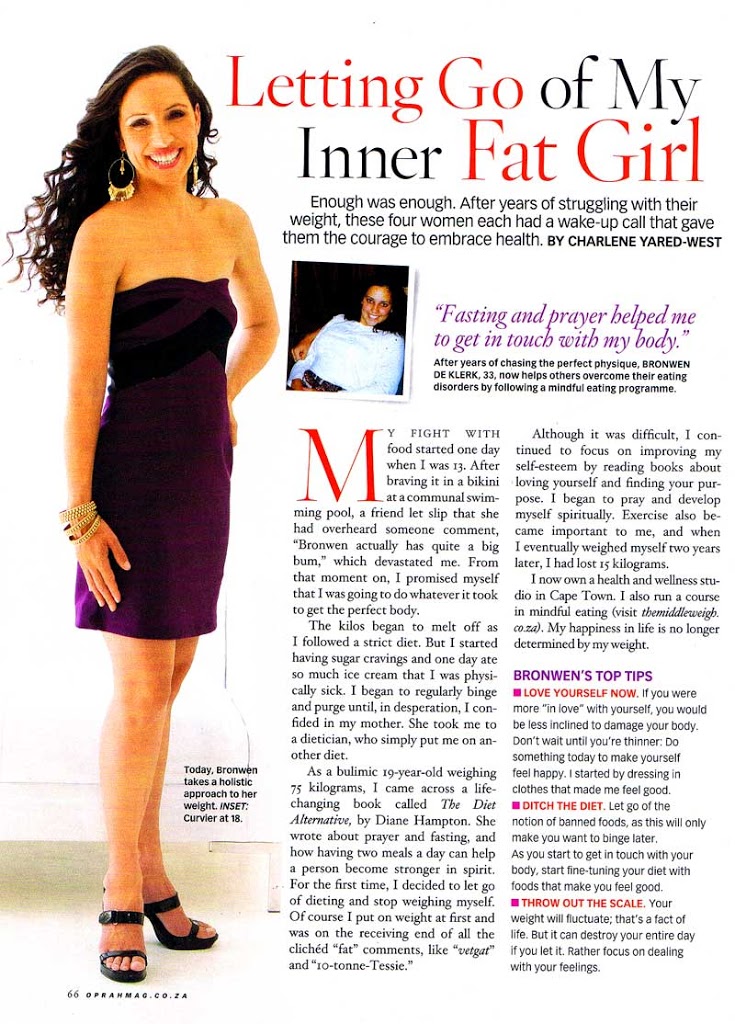
(Bronwen de Klerk, 33)
“Fasting and prayer helped me to get in touch with my body and find my life’s purpose.”


After years of chasing after the perfect body, Bronwen de Klerk, has come full-circle, now helping others overcome their eating disorders through a mindful eating programme she’s developed. 


My fight with food started when I was 13. After braving it in a bikini at a communal swimming pool one day, a friend informed me that one of our friends had commented: “Bronwen actually has quite a big bum,” which devastated me!


From that day, I promised myself that I was going to do whatever it took to get the perfect body.


At first, I cut out fat completely and it wasn’t until I started getting white blotches on my skin that somebody said I might have a deficiency. I was then given a diet, which I followed religiously and watched the kilos just melt off, but I started having sugar cravings. I decided to start baking and rationalised that if I ate the cake or biscuit mixture before I baked it, it didn’t count as eating sweets. Soon, my weight started to climb again and I was terrified that people would notice . . . and that’s when I discovered laxatives. One tablet could erase a whole binge session – or so I thought! 


Then, one day I ate so much ice-cream that I actually felt ill and had to physically get sick. I thought this would be a much better way to erase a binge!


This is when things really spiraled out of control. After confiding in my mother, she took me to a dietician, who simply put me on another diet. Diets were easy. I could follow them, but no one seemed to touch on the deeper issues that were causing me to binge and purge. 


Even though I was Bulimic, my weight continued to soar.  At age 19 and weighing 75kg, I came across a life-changing book, called The Diet Alternative by Diane Hampton that spoke about prayer and fasting – and how having two meals a day can help to become stronger in spirit. Somehow, this spoke to me. For the first time, I decided to let go of dieting. I started to put on weight and got all the clichéd ‘fat’ comments aimed at me like ‘vet-gat’, ‘Little Lotta’ and ‘Ten-ton-Tessie.’ Although difficult, I ignored most of these comments and continued to focus on how I was feeling and dealing with the roots of my emotional eating. I did this through reading books on improving my self-esteem, loving yourself and finding your purpose. I also took time out to pray and started developing more spiritually. When I eventually did weigh myself two years later, I had lost about 15 kilograms.  


As I started getting in touch with my inner self, I changed careers, from being a computer programmer to working as a personal trainer, which lead to the discovery of yoga, shiatsu and pilates. I now run my own health and wellness studio in Tamboerskloof, Cape Town and run a course in mindful eating (www.themiddleweigh.co.za). My happiness in life is no longer determined by my weight. 


What worked for Bronwen
Love yourself now. If you are more ‘in love’ with yourself, you are less inclined to damage your body. Do something today to make yourself feel good – don’t wait until you’re thinner. This will take the focus off your weight and body issues. I used to dress in clothing that made me feel good about myself – and I also stopped all negative self-talk.  
Ditch the diet. Let go of the notion of banned foods, as this will only make you want to binge on them later. As you start to get in touch with your body, you can begin to fine-tune the foods which make you feel good and those which don’t. 
Throw out the scale. Your weight will change all the time – it is a fact of life. It has the power to destroy your entire day – if you allow it to. Focus on how you feel inside and when you take care of what’s inside, the outside will take care of itself. 
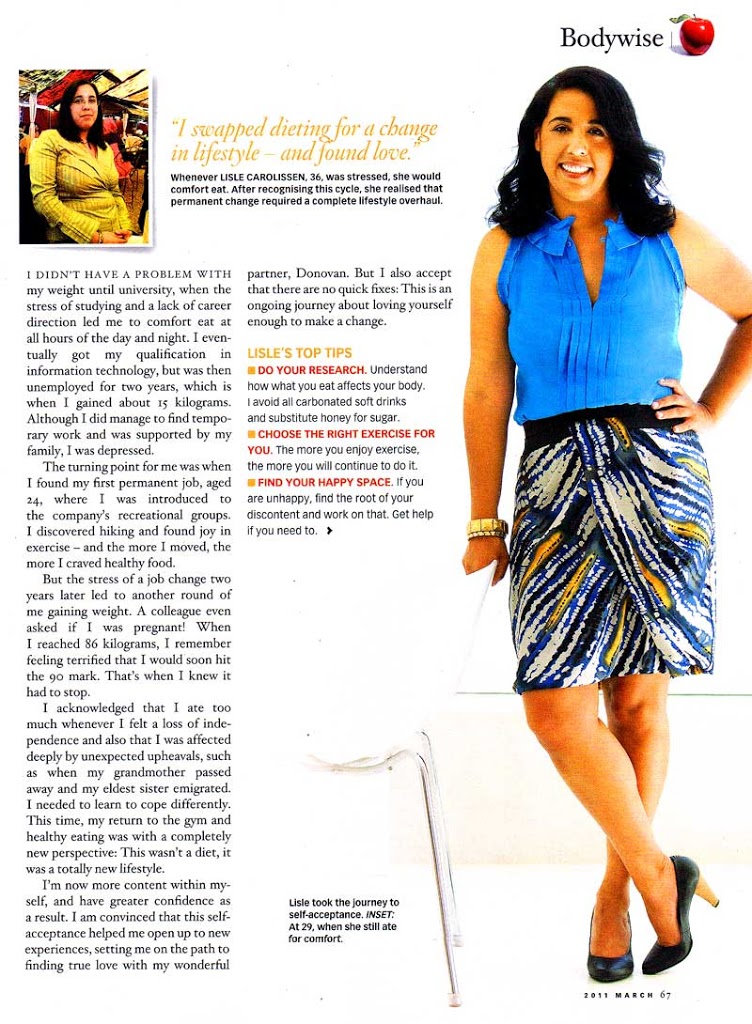
(Lisle Carolissen, 36)
“I swapped yo-yo dieting for a change in lifestyle and found love in the process.”


Every time Lisle, an IT support specialist from Kenilworth in Cape Town, faced a challenge, her tactic was to comfort eat to ease the stress. After repeating this cycle a few times, she realised that in order to make a permanent change, she would need to adopt a new lifestyle. 


I never had a problem with my weight until university. This is when the late nights and the stress of studying lead to comfort eating at all hours of the day and night. I remember how we as a group would go to the local campus tuck shop and ‘de-stress’ by eating a few chocolate doughnuts. While other students would be going to the gym to unwind, we would be bingeing on junk food!


On another level, I was also struggling to decide upon the direction my life would take – as I had changed my mind so many times with regards to my university courses. I wanted to go into teaching – and applied for an honours course in Environmental and Geographical Science, but unfortunately, I didn’t get into the course. I felt directionless. I then had to change my career path and focused on pursuing a career in Information Technology instead. 


It took me ages to find a permanent job – and I was unemployed for two years, when I was 22 years old, where I gained about 15 kilograms. Although supported by my family and doing odd jobs, I felt hopelessly depressed that I couldn’t find permanent work.  


In 1998, the turning point for me was when I got my first job and my circumstances changed. The job exposed me to the company recreational groups which entailed some outdoor group activities, such as hiking and I found joy in the movement of exercise – and started working out more. I found that the more I exercised, the more healthy food I craved – which helped with weight loss. 


I then changed jobs in 2000 – and with it came new stress… which meant I picked up weight again. Someone made a comment at the new place and asked me if I was pregnant – and this really hurt, although I doubt it was intentional. Feeling unhappy in my body and having to wear a bigger size also contributed to my depression. I quit my healthy habits and my weight climbed to 86 kilograms. I remember weighing myself and feeling terrified about reaching 90 kilograms. I realised I had to do something before I got there!


I started going to gym again and eating healthily. I viewed what I was trying to do as a lifestyle change – and not a diet.


I also learnt what my triggers were for overeating and bingeing on the wrong foods. For me, it was an emotional issue about being unhappy with my life at the time – and not being as independent as I wanted to be. Also, having to deal with unexpected life changes and upheavals, such as the death of my grandmother, who I was very close to, and my eldest sister leaving to work in New Zealand – all made me feel that I had lost my main support system, which affected me a great deal. 


Being content in myself has also given me more confidence – and I am convinced that this also contributed to me finding love and my partner Donovan. It is an ongoing journey about loving the self enough to make a change. There are no quick-fixes. 


What worked for Lisle
Do your research. Be knowledgeable of what you are eating and how it affects your body – because everyone is different. I avoid all carbonated soft drinks such as coke which is high in sugar. Also, I don’t take sugar in my tea and cereal and substitute it with honey instead. I avoid crisps and any form of junk food, but I do allow myself to have a fast food take away once a week if I am really craving it. 
Exercise. This releases the happy hormone serotonin that can help with stress-relief. I suggest finding the exercise form that works for you. Personally, I love hiking and being in the outdoors. Not only does it provide me with physical exercise but I feel a sense of inner peace when surrounded by nature.
Find your happy space and be content with yourself. If you are unhappy, find the root of your sadness and work on that. Get help if you need to. 
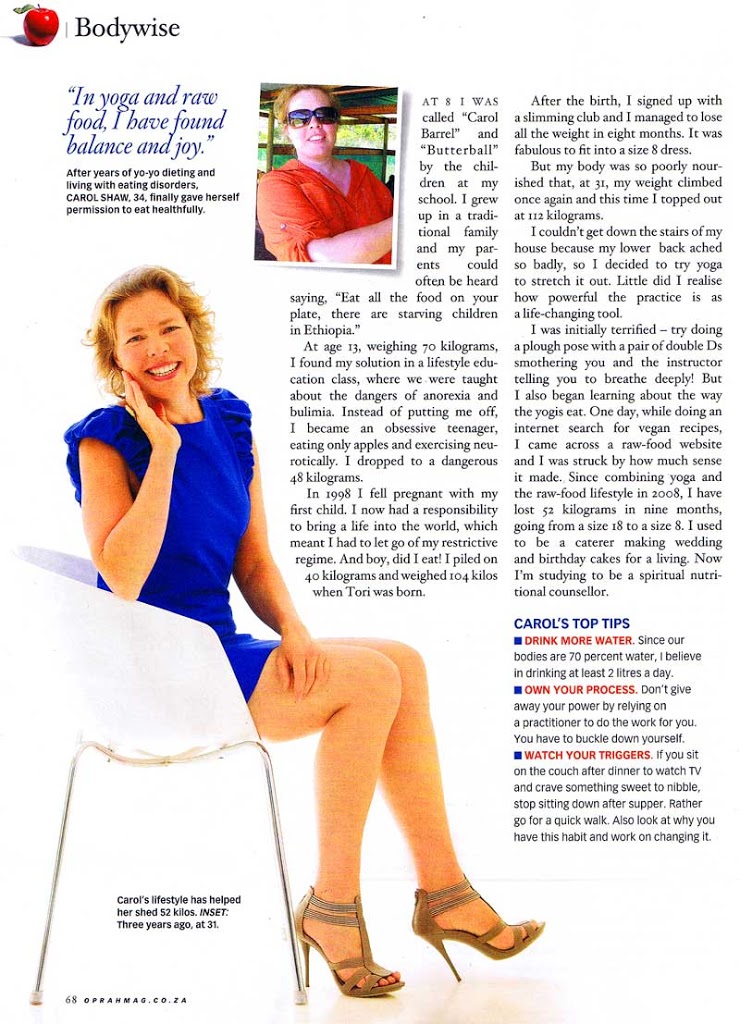
(Carol Shaw, 34)
“In yoga and the raw food lifestyle, I have found balance and real joy.”

When Carol fell pregnant at the age of 21,  she realised she had a responsibility to the life inside her to eat healthily. After years of yo-yo dieting, anorexia and bulimia, she finally gave herself permission to eat. 

At eight, I had been nicknamed ‘Carol Barrel’ and ‘Butterball’ by some children at school. I also grew up in a very traditional family and my parents could often be heard saying; “eat all the food on your plate, there are starving children in Ethiopia!” Food was not something to be loved in our household – it was just a means to survival – and often eaten under duress. 

Then, at age 13, weighing 70 kilograms, I found my solution in a lifestyle education class, where we were taught about the dangers of anorexia and bulimia. Instead of putting me off, I happily became an anorexic, bulimic teenager, obsessively living on bags of apples. I was also gymming neurotically and dropped to a dangerous 48 kilograms. 

It was in 1998 that I fell pregnant with my first child. Suddenly I now had a responsibility to bring a life into the world, which meant I had to let go of my restrictive regime – and simply eat. And boy, did I eat! I managed to pile on 40 kilograms and weighed 104 kilograms when Tori  was born. It was the first time since my teenage years that I had to give in to nourishing myself and my baby. 

I joined a slimming club afterwards and managed to lose all the weight I had gained in eight months, following a strict diet. It was fabulous to fit into a size 8, but I was so poorly nourished and at 31, my weight climbed back up again and this time I topped out at 112 kilograms. I had to rock and roll myself out of bed in the morning – it was agony. 

I couldn’t get down the stairs of my house because my lower  back ached so badly, so I decided to try yoga to stretch it out. Little did I realise how powerful yoga is as a life-changing tool. 
Initially terrifying, there were some poses that at my bulk were downright life-threatening. Try doing a plow pose with a pair of double D’s smothering you and the instructor telling you to breathe deeply!


Yoga lead to my food aha! moment in that I began learning about the way the yogis eat and why – and how it improved one’s practice of the modality. It was while searching on the internet for more Sattvic vegan recipes that I came across my first RAW website and it smacked me between the eyes. Since combining yoga and the raw food lifestyle in 2008, I have lost 52 kilograms in nine months, going from a size 18 to a size 8. 

I used to be a caterer making wedding and birthday cakes for a living and sitting on my couch in front of the TV at any opportunity – and now I am studying to be a spiritual nutritional counselor. 

What worked for Carol
Drink more water. I firmly believe in drinking at least 2 litres of water a day. I drink up to 3 or 4 litres on most days. Once you increase your water intake, the weight loss will be far more dramatic – after all, we are 70 percent water! 
Own your process. Take responsibility and don’t give your power away by relying on a practitioner to do the work for you. Practitioners are wonderful sources of information and provide guidelines, but you have to be brave and do it for yourself. 
Watch your programming, look at your eating patterns and see where the triggers are. If you sit down on the couch after dinner to watch TV and crave something sweet to nibble, stop sitting down on the couch after dinner! Rather go for a quick walk instead, you will enjoy the double benefit of not nibbling and getting some exercise. You can also take a good look at why you do that, what is the root of the behaviour and work on changing it.

Author: Charlene Yared-West, Oprah Magazine, March 2011, p66. (Please note that the copy posted above is the unedited version of what was published in the magazine and will differ slightly. To read the edited version of the article, please click on the images for an expanded view.)
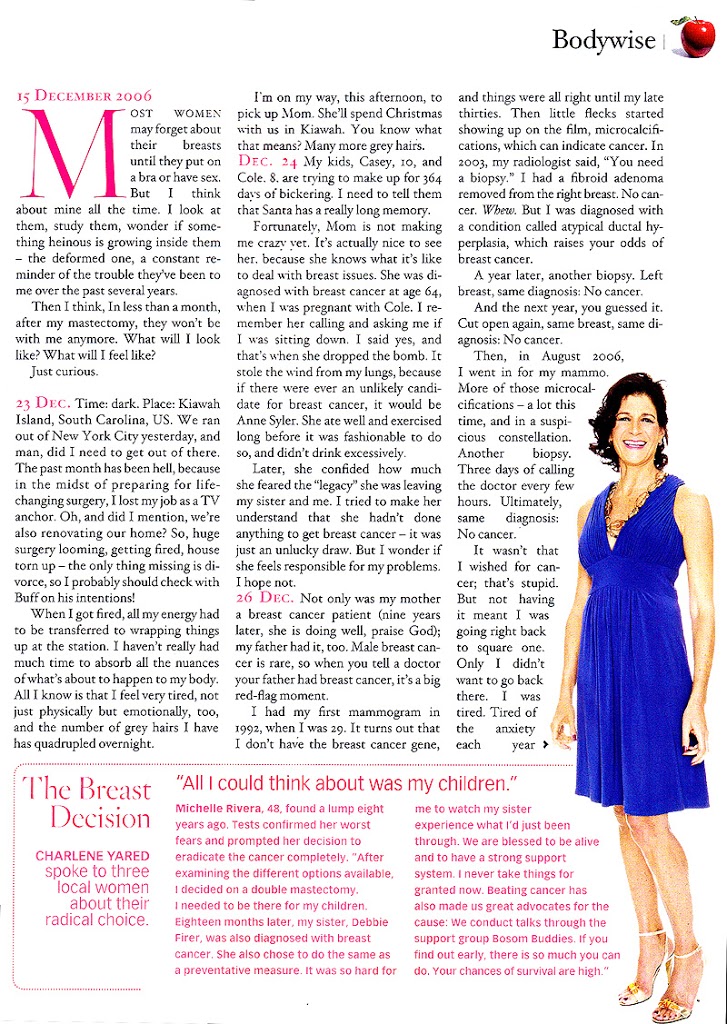
Defending My Life


BLESSED WITH A STRONG SUPPORT SYSTEM: Michelle Rivera (48), diagnosed at 40
“We are blessed to be alive and to have overcome cancer, with such a strong support system. I never take things for granted now.”


After finding a lump in her left breast, Michelle plucked up the courage to go for a check-up. “When the doctor confirmed my worst fears, I was in complete denial,” she says. In shock, she made another appointment for a second opinion, but this time with a specialist in breast cancer. “I tell everyone to seek out a second opinion – and to have treatment with a doctor you trust completely,” she says. After explaining the different options available to her, she took some time to herself and decided upon a double mastectomy with immediate reconstruction, to eradicate the chances of the cancer returning in the other breast. “All I could think about were my children – and that I needed to be there for them as they grew up – and so, a bilateral mastectomy was an obvious choice,” she says. Eighteen months later, her sister, Debbie Firer, was also diagnosed with breast cancer and subsequently also chose to have a double mastectomy as a preventative measure. “It was so hard for me to watch my sister face the same battle I had just been through,” she says. “We are blessed to be alive and to have overcome cancer, with such a strong support system. I never take things for granted now.” Michelle explains how it has made them closer as a family, but has also made them great advocates for the cause, conducting talks through the support group, Bosom Buddies, raising awareness in their area about going for check-ups on a regular basis. “These days, with all the medical advances available, there is no excuse to be an ostrich with your head stuck in the sand!” she says. “Fact is; if you find out early, there is so much you can do and your chances of survival are high.”

BEING OPEN ABOUT CANCER: Nthabiseng Nkache (52), diagnosed at 49
“Before the breast cancer, I was just Nthabiseng. Now, I am so much more – and I try every day to make the most of the time I have been given to value life.”


Nthabiseng Nkache took painkillers to dull the pain she felt in her breasts in the hope that it would just go away. However, when the pain became chronic, she decided she would go for a mammogram. “When the tests confirmed that I had cancer in both breasts, I thought I was going to die – and the pain of leaving my three young children, who had also lost their father in 1999, was just too much,” she says. Her oncologist explained that a bi-lateral mastectomy was the best option for survival for a woman of her age. “Even though I had the support of my colleagues at work, I still felt isolated, because I didn’t know of anyone who had breast cancer in my community in Katlehong,” she says. “There is so much ignorance around this topic. No one ever spoke about cancer because of the stigma attached to it and because it is considered a ‘white person’s disease’.” Nthabiseng decided to get reconstructive surgery after her mastectomy, but last year, the left breast became inflamed with cellulitis and had to be removed. She now uses a prosthesis in place of her left breast. “Before the breast cancer, I was just Nthabiseng. Now, I am so much more – and I try every day to make the most of the time I have been given to value life.” As a nurse, Nthabiseng is passionate about dispelling stigma and often helps other women overcome the initial shock of their diagnosis by sharing her own experiences with them. She encourages others to get tested regularly, not just once every few years. “I don’t have breasts – so what? I am alive – and this is what matters the most to me. If I can survive, then so can anyone else – just take it one day at a time.”

STAYING POSITIVE TO BEAT CANCER: Victoria Pansegrouw (29), diagnosed at 27 
“I have conquered so much and no longer fear all the small things in life. I have also learnt that my friends and family, especially my mom, truly are the amazing people I always suspected they were.”


No one in her family had ever had breast cancer before. When Victoria Pansegrouw discovered the lump in her left breast in November 2008, her whole life changed. “Tears immediately started rolling down my face and I went straight into shock,” she says. “After a while, I decided that considering so many people had dealt with cancer and were just fine today, I would follow in their footsteps and deal with whatever curveballs were to come my way. I was going to beat it and give it the best I could.” Further tests confirmed that she had an aggressive ‘strain’ of cancer and that she was HER2-positive. Her oncologist recommended a double mastectomy, because, even though only one breast was affected by the cancer, there was a 30% chance of recurrence in the right side. “I thought it through on the way back from the appointment and told my mom that it wasn’t as bad as losing an arm or leg or something I really needed to function every day,” she says.”I made peace with it then and there and it was an easier decision knowing that I would have immediate reconstructive surgery.” Victoria attributes her survival to being positive and “getting selfish” with her life, instead of being a people-pleaser, which meant avoiding negative people, situations and conversations. “I have conquered so much and no longer fear all the small things in life. I have also learnt that my friends and family, especially my mom, truly are the amazing people I always suspected they were,” she says. “There is just so much love and support out there if you just open yourself up to receive it.” 


Author: Charlene Yared-West, Oprah Magazine, October 2010, p74. (Please note that the copy posted above is the unedited version of what was published in the magazine and will differ slightly. To read the edited version of the article, please click on the images for an expanded view.)
The power of one

“How I regained my speech after suffering a stroke.” – Liesl Mocke, 44, Cape Town

The 7th of July 2002 was the last day of my life as I knew it. I was 36-years old; a psychologist, a mother and a wife. I had been living in London for two and a half years working for the Red Cross in an administrative position, whilst waiting to be registered as a Psychologist with the British Psychological Society, as I had practised in Pretoria before moving overseas. I could speak six languages – English, Afrikaans, Hebrew, Greek, Xhosa and German – and was successful in my career, and specialised in helping school pupils suffering from dyslexia and other learning difficulties. 


After experiencing a severe migraine one Wednesday morning, and then daily until the Sunday afternoon, I collapsed and was found paralysed and unable to speak on the bed, by my husband, Daniel. I had been lying there for about one and a half hours after going to lie down. I had suffered a rare type of stroke, where an artery in my neck had ruptured – the same artery that carried blood to my brain. 

Suddenly, I could no longer do what I had so often taken for granted; I couldn’t swallow, I couldn’t move the right hand side of my body, I could not read or produce any sound. I was numb, emotionless and in a state of emptiness. My first step was to get out of bed and walk around the hospital. With the help of a physiotherapist, this took me a few weeks to accomplish. Then I had to learn how to produce sound. On the 22nd day after the stroke, a speech therapist spent an hour with me in hospital, showing me how to press my lips together and then to release them, after which I eventually could say a short ‘mah’, with a little voice. I was shown how to touch my throat over the larynx, while breathing out simultaneously with a push of the breath, to make a sound. It was very difficult and extremely exhausting, and all I wanted to do was sleep, which is not uncommon for stroke patients. 


After more practice, I could eventually say my first word; mamma. However, I still felt devoid of emotion and did not even know what ‘mamma’ meant. This was when my mother, Mari Mocke, a speech and drama teacher took over with teaching me to speak, practically from scratch, as I only spent two sessions with the speech therapist at the hospital. She began coaching me to speak and write again in English and Afrikaans, immediately after my discharge. 


It was not easy-going. I had absolutely no words in my mind, only pictures. For instance, I could picture a fork and a knife and know their function, but I had no idea what they were called. Only after practising with my mother to articulate every speech sound with the tongue and the lips and the outgoing breath, was I able to learn the names of things as she showed them to me, and named them. With the aid of a hand mirror I had to learn to press the tip of my tongue against the palate of my mouth, behind the teeth, to get it into the right position for articulating, for example, the letter ‘n’, before I could eventually say the word ‘knife’.


I practised every morning and afternoon, at first for about ten minutes, then about twenty minutes at a time during the first week at home. Fatigue was the greatest problem, not frustration, because I had very little emotion. Sometimes I was actually too tired for the practices, but then I forced myself to do it, because I wanted to speak.


Once I had mastered the ability to utter a speech sound, I learnt to identify and say ‘pappa’, Daniel (my husband) and Johan, my son’s name. With my mother, I practised saying short sentences, the first of which was, ‘Johan likes juice’. 


Eventually, six months after my stroke, I was able to speak full sentences more spontaneously, but sometimes, naming common objects lodged my mind, was difficult. I still experience this challenge, where the name for an image or object gets lost in my mind. I find that a helpful way of getting around this is to use hand gestures, while describing the object. Some days are better than others. 

About a year after the stroke, I used to draw the pictures of the items on my shopping list, if I could not bring the word to the fore! 


Roughly three years after the stroke, my emotional seat started functioning again. Then, besides working closely with my mother, I went for intensive therapy to help me express the anger and frustration I felt about my situation, but had been unable to communicate verbally as I used to, before the stroke. Especially abstract thoughts. This was hard for me as just three years previously; I had been the one sitting in the psychologist’s chair, helping people overcome their challenges. Now I needed the help.  


I used to define myself by what I did, now, free of those constraints, I do what I love – baking, gardening, singing and making bath-salts and soaps. I also love reading and helping my nine-year old son with his homework, which brings me great joy. I live life fully, because I have much to be thankful for. My husband, Daniel is the rock in my life and he has been supportive throughout.


I now understand what a gift communication is – and every day I make progress. I am Liesl, I have a speech difficulty, but I am not the speech difficulty. I have talents and abilities that are unique to me, but they do not make me who I am as a soul or a spirit. We are all so much more than that.


Author: Charlene Yared-West, The Oprah Magazine, August 2010. (Please note that the copy posted above is the unedited version of what was published in the magazine and will differ slightly. To read the edited version of the article, please click on the images for an expanded view.)

Right Now, You Are…

… making the most of the recession

While we’re not suggesting that unemployment is good for you, according to the Canadian Medical Association Journal (2009), smoking, drinking alcohol and over-indulgence in rich foods decline during a recession. Interestingly, the study also showed that during the Great Depression, life expectancy rose from 57.1 in 1929 to 63.3 years in 1932. Moral of the story? What we knew all along: there’s so much more to life than money!


… being pro-active about your health…


“Women are taking more preventative measures to maintain their health, like talking to pharmacists about alternatives to medication that can be detrimental to them in the long run.” So says Leslie Green, senior pharmacist at PharmaCross in MediCross Cape Town.


… single and want a baby? Oh, go on then!


Women are doing it for themselves according to the 2009 Female Nation Survey (FNS). The study, representative of more than 600 000 South African females, showed that 65% of women have never been married, yet, 57% have children. According to sexologist, Professor Elna McIntosh, single women can buy sperm from literally anywhere in the world – on-line or in person. At pacrepro.com, semen can be purchased and shipped in from California and locally, you can talk to your gynae, or visit the Cryobank in Johannesburg or the Cape Fertility Clinic. “She can choose from any of the sperm available on-line, or at a clinic, all without a man in her life.”

… not shy to take control in the bedroom


Searching for something a little saucy? Good news, shopping for something sexy has never been easier – or less cringe-inducing. “Women young and old are talking more openly about sex, being more assertive about their sexual needs, and are feeling free to buy erotic products like sex toys,” says owner of Whet Sensuality Emporium in Cape Town, Marina Green.


… loving connecting online


Thought cyberspace was filled with geeky guys bonding over the latest iPhone app? Think again. The bloggosphere has erupted with women creating on-line communities providing a space for comfort, consolation and support. In the US, according to a social media survey by BlogHer.com, over 40-million women participate in blogs every week, with about 15.1-million publishing at least one post a week and 21.1-million reading and commenting weekly. “Blogging gets people in touch with each other that would not have ever communicated before,” says Sue Maude, author and blogger of caffeinefreaks.co.za.


… caring and sharing


Local NGO, MaAfrika Tikkun has noticed an increase in the number of women volunteering for their community outreach programmes over the last year. “Generally, women provide so much compassion to people in crisis,” says Amanda Blankfield, marketing manager for the organisation. “There is nothing that can compare to the satisfaction gained from volunteering,” says Susannah Clarke a Master’s student and researcher who volunteers for People Against Suffering, Suppression, Oppression and Poverty in her spare time. “My passion is to make a difference to people’s lives.”


… no victim


“South African women have been through so much pre- and post 1994, that they have built exceptionally high levels of resilience,” says Tony Dovale, Chief Resilience coach at LifeMasters.co.za. “Mindsets have also shifted from a victim mentality to taking far more responsibility for the self and ownership of their self-worth.”


… embracing your grey


Have a think about who in Hollywood is greying gracefully – George Clooney, Clint Eastwood, possibly even Brad Pitt come to mind? Now add a luscious line-up of ladies to your list because Jamie Lee Curtis, Emmylou Harris, Helen Mirren and Meryl Streep are all sporting silver and looking confident, graceful and stunning while they’re at it. Before going grey in her late 30s, Jackie Burger, Elle fashion director was honey-blonde. “It’s a waste of time to cover up something that happens naturally,” she says. “I’ve made a pact with myself to embrace what age brings – and I encourage all women to do the same.”


… a dashing beauty


With life moving as fast as a runaway train, more women are turning to permanent make-up, fake tans and even hair extensions as a way to save time on beauty procedures, says Cape Town make-up artist and hair stylist, Candice Harker. “Because of all the technological advancements and continued research into the ever-booming beauty and health market, beauty procedures are safer than ever before,” she says. Even with these new treatments available, Harker still believes that less is more. “A good lip gloss and a solid eight hours of sleep can do wonders to your look.”


… putting family first


What we look for in a man has changed radically since the 1930s according to a study from the University of Iowa. Researchers compared studies from the 1930s with ones conducted in 2008. In the early part of the 20 century we wanted a man who was kind, dependable and ambitious but these days we favour a man more interested in having a family and a home, ambition be damned! Men too have changed their thinking: back then prowess in the kitchen and chastity were the stuff of true romance, these days it’s love and brains. We can live with that.

Author: Charlene Yared-West. Published in The Oprah Magazine, April 2010, Vol.9, No. 4, p. 126.(Please note that the copy posted above is the unedited version of what was published in the magazine and will differ slightly. To read the edited version of the article, please click on the images for an expanded view.)
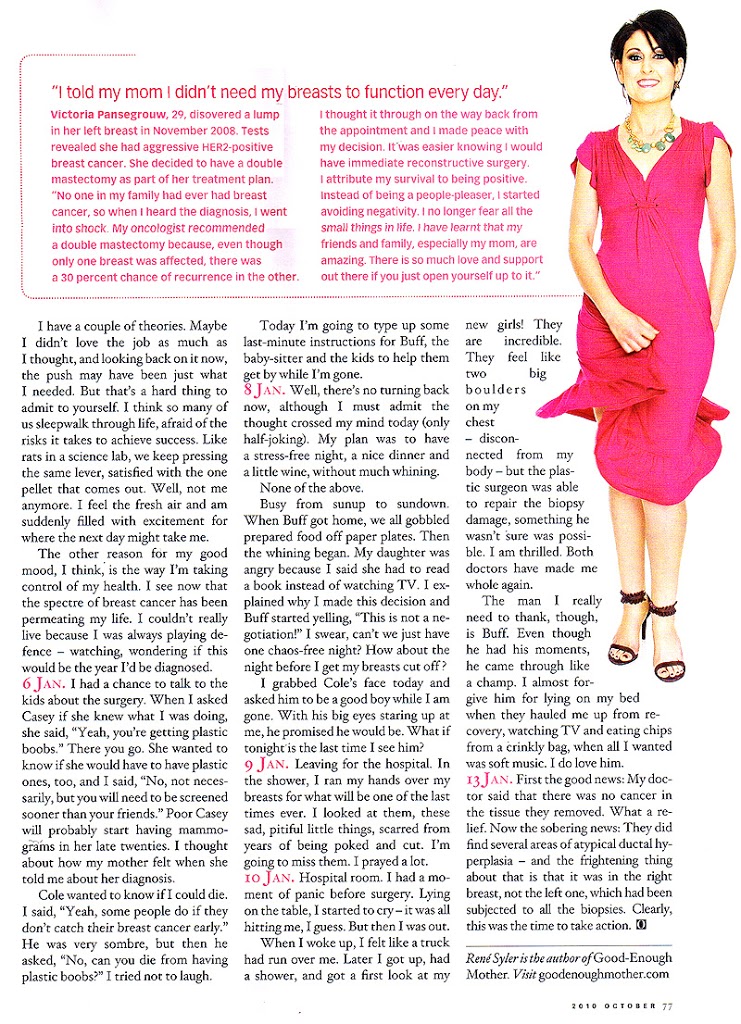
Make Something Out Of Nothing

The joy that comes from creating something from nothing can be deeply fulfilling. Charlene Yared speaks to ordinary South Africans about how they transformed the ordinary into the extraordinary.


Backyard holiday fun
No matter where they are, the Alberts manage to make an exciting adventure for their children, even if it’s just at home. Transforming their backyard into a campsite, the family often haul out their tents, pillows and duvets for a night under the stars.


“It’s much better than being indoors watching television,” says mom of two, Venessa. “When you go out, you have to pay for petrol and accommodation, and being home allows you to save money and be more spontaneous, whilst still getting that holiday feeling.”


Craig, her husband, agrees, recalling a memory, where they held a camping birthday party for their eldest son, Jordan. “We had a treasure hunt, games and roasted marshmallows,” he says. “It’s about taking an ordinary space and transforming it into something fantastical. Apart from it being economical, it’s also a safe environment for the children to play in.”


Venessa says Jordan (9) and Michaela (6) often build their own tent with garden furniture, balanced beneath blankets and pillows from inside the house. “Sometimes they even pretend to be on Survivor,” she laughs. “It’s so good for developing an imagination, growing a love for the outdoors, and is a way for us, as parents, to relax.”


Top tips for holiday enjoyment without leaving your home:

  • Have an intimate family picnic or braai in the backyard, instead of booking lunch at a restaurant.
  • Rent out a day’s worth of National Geographic DVDs and spend the day marvelling at nature’s beauty from the comfort of your favourite sofa.
  • Have a cook-up evening, where friends each bring along an interesting dish.
  • Tell some friends to bring over their choice of board game and set it up in the garden, where a round of each game can be played in succession.
  • Choose a hot day and make your own backyard water park with an ordinary water sprinkler. Add to the fun by tying an old tyre to a tall tree and create a swing for the kids to enjoy.

Changing lives from one seed

In 1999, Sizathu Thango realised in desperation that her family was starving. “I cried everyday worrying about how I could put food on the table,” she says. It was when she was sitting in a taxi one day when she listened to a radio programme about food security gardens. Deciding to use the monthly child-support grant she received of R60.00, Sizatho bought packets of vegetable seeds – an act that would not only change her life, but the lives of people in her community.


Seeing the improvement at home as a result of the food garden, Sizathu shared what she had learnt with other women in the area, encouraging them to plant food in their backyards. “The Ilanga Women’s Organisation Permaculture project started from just one small seed. We are now 38 women and altogether we feed over 700 people from our community garden,” she says.


Food & Trees for Africa intervened and managed to secure funding for the project from Anglo American, South African Breweries and the Urban Greening Fund. The women now also run a sewing group, an early-learning child development facility, and a ‘drop-in’ centre, where 361 orphans and other vulnerable children can eat two nutritious meals per day.


“We had nothing when the project started in 2001, but now we are fully-funded and are able to feed, as well as teach people about how to make a food garden in their own backyards,” says Sizathu. “Sometimes I don’t believe that this has all happened – but then I look around and see all the healthy faces and I realise just how much it’s changed our lives. We are also doing our bit to green the environment.”


Her message to South Africans, she says, is Vukuzenzele! [Rise up and do something good for others.]


Top tips for helping big with very little:

  • Offer to take an elderly person shopping for groceries as they often find it difficult to get around.
  • Find out about a charity in your area and invest as little as R20 in baking ingredients and make something delicious for those less fortunate.
  • Make a concentrated soup filled with nutritious vegetables and donate this to your local soup kitchen, where it can be further diluted to feed the homeless.
  • Clean out the clutter in your home and donate old or unused household items to someone in need.
  • Help address the national crisis of blood shortage in the country and donate blood to make a difference.

Bread tags for wheelchairs

With the surname of Honeybun, 75-year old Mary lives wholeheartedly up to her name. When she isn’t helping her 10-year old grandson do his homework, or knitting jumpers for the women at the local maternity unit, Mary collects bread tags for wheelchairs.


“I am always looking around for things to do to help those in need and this just seemed like such a good idea,” she says. “This is not just about getting wheelchairs for people, it is also about helping the environment by saving space in the landfills with the plastic that is collected and then recycled.”


For one chair to be secured, 50 kilograms or 141,400 bread tags need to be collected, which pays for a R1550 wheelchair. Mary distributes boxes for collecting bread tags to restaurants and shops in her area, creating awareness around the value of the plastic material. Since starting in 2006, Mary has managed to distribute 17 wheelchairs, four of which were donated as second-hand chairs.


“People need to be aware that what’s considered rubbish can be utilised for another function – and bread tags give so much to people living with disabilities,” she says. “Service to other people is the rent we pay for our room on earth and this is what makes living worthwhile.”


Contact Mary Honeybun on 021-789-1831 for more information.


Top tips for turning something old into something new:

  • Save old scraps of material and sew it all together to make a colourful quilt.
  • Collect empty toilet rolls, wrapping paper and sweets and create funky Christmas crackers for the festive season.
  • Cut off the top half of a 2L plastic bottle and use the bottom section as a pot for growing seedlings. Decorate with paint and ribbon. 
  • When your washing machine gives in, rescue the inside drum and transform it into an attractive chair by topping it with a round cushion. 
  • Bake old wax crayons into a muffin tin allowing them to melt down to create fun new crayon shapes for the kids to use.

From junk to paycheque
After seven years of interior design and working with fabric and furniture, Katie Thompson found an old broken chair buried in her back garden, which she decided to transform with pieces of perspex. “I took it home to my parents and told them I wanted to start a business fixing old junk that I could find, with odds and ends,” she says. “My father told me to take a hike and come back with a real business plan – and not an old broken chair.”


Surprising herself, her idea skyrocketed into a successful venture called Recreate, which was launched at the 2009 Decorex Cape Town at the Cape Town Convention Centre.


From old suitcases that have been transformed into chairs, to an old Hoover, recreated into a lamp, her unique pieces are not merely revamped furniture, but are objects that have been given a new function.


“The products relate to everyone, from a nostalgic 80-year old who recognises objects from her past, to a trendy 20-something guy, looking for retro objects,” she says. “I am a hoarder at heart and have a passion for junk. I love wiggling my way to the back of furniture storerooms, finding objects that have expired and recreating something new and beautiful with them.”


Contact Katie Thompson on 079-989-0871 or katie@recreate.za.net or visit http://www.recreate.za.net for more information.


Top tips to turn your passion into your paycheque:

  • Be brave, take the plunge and break down the dream you have into manageable goals, setting each step against realistic timelines.
  • Know your niche and increase the confidence in your ambition, by taking on extra classes to learn new tricks of the trade. 
  • Take a course in marketing yourself and learn about the different platforms to increase the awareness of your offering.
  • Find a mentor who has done something similar to you and get advice on business and finance if you are not so inclined, to ensure future success. 
  • Avoid the inevitable naysayers and stay positive about changing your idea into your monthly salary.

Author: Charlene Yared-West. Published in The Oprah Magazine, December 2009, Vol. 8, No. 12, p. 119.(Please note that the copy posted above is the unedited version of what was published in the magazine and will differ slightly. To read the edited version of the article, please click on the images for an expanded view.)
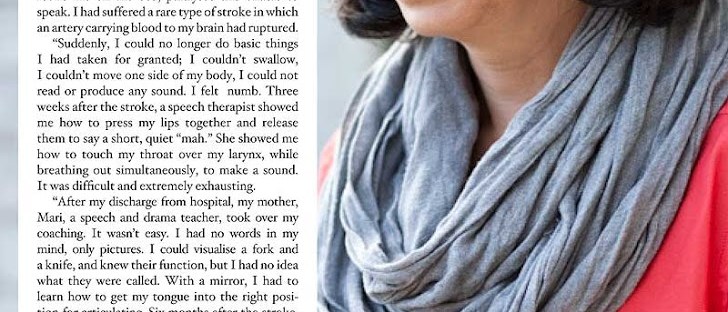
The Proud Survivors

Charlene Yared talks to three strong women who share what they did to overcome breast cancer and how it changed the way they lived their lives, forever.

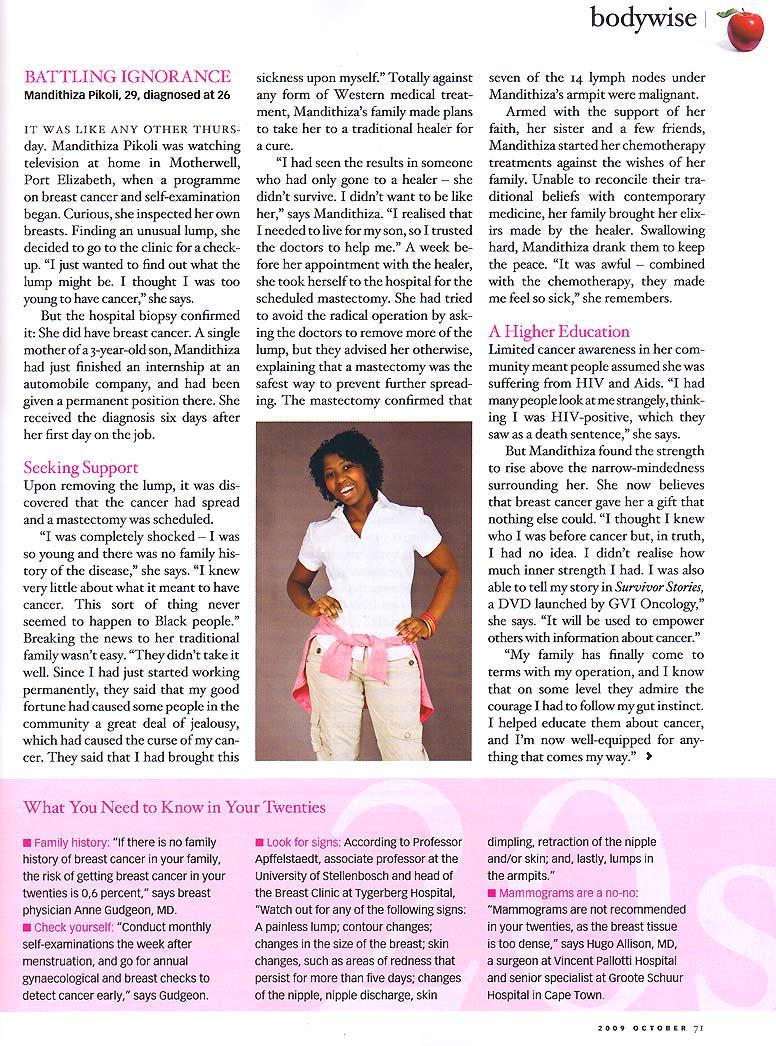
BATTLING IGNORANCE: Mandithiza Pikoli (29), diagnosed at 26
“I thought I knew who I was before cancer, but in truth, I had no idea. I didn’t realise how much inner strength I had and what I could truly accomplish.”


It was like any other Thursday. Mandithiza Pikoli was watching television at home in Motherwell, Port Elizabeth when a programme about breast cancer and self-examination began. Curious, she went to her room and immediately started inspecting her own breasts. Finding an unusual lump in her left breast, she decided to go to the clinic on the following Monday for a check-up. “I was simply curious, not frightened, to find out what the lump might be, because I thought I was too young to have anything as serious as cancer,” she says.


The hospital biopsy confirmed it: she had breast cancer. Upon removing the cancerous lump, it was discovered that it had spread and a mastectomy was scheduled.


As a young single mother of Iviwe, her three-year old son, Mandithiza had just finished an internship for an automobile company, where she had recently taken up a permanent position. Six days after her first day at work, she was diagnosed with cancer.


Seeking support
“I was completely shocked, because I was too young for cancer and there was no family history of the disease, as far as I knew,” she says. “I knew very little about what it meant to have cancer, because no one in my community had ever mentioned it. As far as I knew, this sort of thing never happened to black people.” Breaking the news to her highly traditional family wasn’t easy. “They didn’t take it very well at all. Since I had just started working permanently and was the only one earning an income for the family, they said that my good fortune had caused some people in the community a great deal of jealousy, which caused the curse of my cancer. They said that therefore I had brought this sickness upon myself.”


Totally against any form of medical treatment, they immediately made plans to take me to a traditional healer for a cure,” she says.


Although, Mandithiza continued paying visits to the hospital, her family persisted and set up an appointment with a healer against her wishes. “I had seen the results of someone who had only gone to the traditional healer for treatment and the doctors confirmed that there was nothing they could do for her. I didn’t want to be like her,” says Mandithiza. “I realised that I needed to live not just for myself, but for my son – and I trusted the medical doctors to help me.” So, a week before her appointment with the traditional healer she took herself to the hospital for the scheduled mastectomy. The mastectomy confirmed that seven of the fourteen lymph nodes under her armpit were malignant. She had tried to avoid the radical operation by asking the doctors to remove more of the lump, but they advised her otherwise, explaining that a mastectomy was the safest way to prevent further spreading. “I called my family just before I went in for the operation and they were furious with me,” she says. “It was difficult to go through everything alone, but I was left with little choice and had to find the strength within me to survive it.”


Armed with the support of her faith, her younger sister Lhose (21 at the time) and a few friends, Mandithiza started her chemotherapy treatments against the wishes of her family. Says Mandithiza, “I needed them to be at my side through the journey I was about to take, but they just weren’t there for me.” Unable to reconcile their traditional beliefs with contemporary medicine, her family brought her elixirs made by the healer after the operation. Swallowing hard, Mandithiza drank the mixture to keep the peace. “It was awful – and combined with the chemotherapy made me feel so sick,” she says.


Higher Education
Limited cancer awareness in her community meant people assumed she was suffering from HIV/AIDS. “I had a lot of people looking at me strangely, thinking I was HIV positive. When I told them I had cancer they would act surprised and some would say that I was going to die, comparing my illness to AIDS. They saw it as a death sentence,” she says.


But Mandithiza found the strength to rise above the narrowmindedness of her community. She believes now that breast cancer gave her a gift that nothing else could. “I thought I knew who I was before cancer, but in truth, I had no idea. I didn’t realise how much inner strength I had and what I could truly accomplish. I was also able to tell my story in the DVD launched by GVI Oncology in August, called Survivor Stories. This documentary will be used to empower others with information about cancer,” she says. “As human beings we realise our greatness only when we are faced with our mortality.”


She and her son are still living at home with her mother and sister. Mandithiza is living a healthy lifestyle, eating wisely, going to the gym often and regularly gives herself breast self-examinations. “I am looking after myself far better than I ever have. I have a positive attitude and dreams for the future, which gives me the strength to wake up and face everyday with gratitude. I beat cancer because I wanted to see myself in ten years time,” she says.


“My family has finally come to terms with my operation and I know that on some level they admire the courage I had, to go ahead with my gut instinct. I helped empower and educate them about cancer, sharing what I learnt with them, so that they also understood. I am now well-equipped for anything that comes my way,” she says. “I will never regret the decision I made – even if I had to do it all over again. If I let anyone else decide what was best for me, I would not be here today.”


What you need to know in your 20s:

  • Family history plays a role. “If there is no family history of breast cancer in your family, the risk of getting breast cancer in your 20’s is 0.6%,” says breast physician, Dr Anne Gudgeon “The impact of the diagnosis is the fear of rejection by partners and infertility after treatment.”
  • Check yourself regularly. “In your 20s, conduct monthly self-examinations in the week after your menstruation and begin going for annual gynaecological and breast examinations for early cancer detection,” says Dr Gudgeon.
  • Look for signs. According to Professor Apffelstaedt, Associate Professor of the University of Stellenbosch and head of the Breast Clinic at Tygerberg Hospital, “Watch out for a painless lump, contour changes, changes in the size of the breast, skin changes such as areas of redness that persist for more than five days, changes of the nipple, nipple discharge, skin dimpling, retraction of the nipple and/or skin and lastly, lumps in the armpits,” he says.
  • Mammograms are not recommended. “Mammograms are not recommended in the 20’s as the breast tissue is too dense,” says Dr Hugo Allison, a surgeon for Vincent Pallotti and a senior specialist for Groote Schuur Hospital.

TAKING RESPONSIBILTY: Sue Maude (39), diagnosed at 36
“As the radiation burnt away any stray cells of cancer that remained, I visualised it also burning away the old me to make way for the new.”

Lying on her stomach in bed one morning, Sue Maude noticed a pain in her left breast. When she touched the breast to investigate, she felt a lump. Cancer was the last thing she had anticipated having to face in her thirties and the thought of it left her cold. She put it out of her mind and continued daily life running her freelance business. However, the breast remained uncomfortable and after two months, she realised that she could not avoid it any longer – she made an appointment at the clinic.

A mammogram and biopsy confirmed the existence of a lump 2 centimetres in diameter that contained oestrogen receptive cancer cells.

Getting Real
“I think I was in denial about the state of my health. It took me so long to go to the clinic. Cancer was such a distant thing, especially at my age, I never considered it happening to me. I convinced myself that the lump I found would be benign,” says Sue. After the biopsy, she was given the choice between having a lumpectomy with intensive radiation therapy, or a mastectomy. After reading and researching every avenue, she decided to have the lump removed. “The thought of having a mastectomy was just too drastic. I could not consider losing an entire breast, a source of my womanhood, for a small lump of just 2 centimetres. Luckily my risk factors were relatively low, so I felt comfortable with my decision to save the breast,” she says.


Healing Herself
After reading books by authors Brandon Bays (The Journey) and Louise Hay (You Can Heal Your Life), Sue realised she needed to take responsibility for her health, as a personal goal.


“Louise Hay and Brandon Bays are both living examples of how one can overcome cancer by dealing with your psychological issues,” says Sue. “I believe in the mind/body link and know that my cancer was partly caused by my low self-esteem and because of my tendency to bottle up my feelings. You need to face up to this kind of baggage, because it tends to manifest itself physically.”


After the lump was removed, Sue returned to hospital to have more of her breast removed. “I then had to go for radiation treatment once a week for six months. As the radiation burnt away any stray cells of cancer that remained, I visualised it also burning away the old me to make way for the new. It helped me grow on so many levels.”


Sue says her lifestyle took a 360 degree turnaround. Now she was focused on improving her health by eating correctly, getting more exercise and making informed decisions about her treatment. Today she only buys organic fruit and vegetables, never fries her food, because heated oil is carcinogenic, and always drinks filtered water. She also notes how she let go of “immature pleasures” such as excessive drinking of alcohol. “All these things I had to start taking into consideration, because my life depended on it,” she says. “Your natural instinct is to put your health and well-being in the hands of doctors around you, when you really should be taking on the responsibility of your own wellness by educating yourself.”


After her treatment was concluded, she focused her energy on building a nest. For years she had felt the need for security and to settle down in one place. Says Sue, “Cancer made me focus on what was important to me – I got my dream house six months later.”


She regularly goes for check-ups and breast examinations and has remained in the clear since 2007. “An ideal life is not one without adversity, because then you learn nothing. You have to know the bitter to know the sweet in life and cancer came along to teach me to value myself,” she says. “I don’t label myself as a breast cancer survivor, because I have moved beyond that point.”


What you need to know in your 30s:

  • Family history plays a role. “If there is no history of breast cancer in your family, the risk of getting breast cancer in your 30s is 4.8%,” says breast physician, Dr Anne Gudgeon. “In your 30s, the main concern women have is dying and leaving their children without a mother and worrying how they will react to your change in appearance.” According to Professor Apffelstaedt, statistics from Western Countries show that 6% of all breast cancer occurs in women under 40 years of age. “This may be quite different in our country with a young population structure and the well documented earlier onset of breast cancer in non-white populations. In our practice about 15% of patients are diagnosed below age 40.”
  • Exercise more regularly. “Some studies suggest that exercise reduces the risk for breast cancer mortality by 40% to 55%, which is as much as standard treatments. These studies vary in their recommendations for exercise — some aimed for 90 minutes a week, others for two to three hours a week, but the Health, Eating, Activity and Lifestyle (HEAL) Study conducted by the American Society of Clinical Oncology in 2008, showed a benefit from any amount of exercise,” says Dr Rika Pienaar, Clinical oncologist of GVI oncology for the Panorama Medi-clinic.
  • Alcohol increases your risk. According to Dr Pienaar, there have been dozens of studies done showing the increase in the risk for breast cancer, even with very low levels of consumption, which indicate an established relationship. “There is strong evidence that even one glass a day can cause a small, but significant increase in the risk of breast cancer,” she says.
  • Have a clinical breast exam every year. “Apart from conducting breast self-examinations, make sure that you go for an annual clinical breast exam,” says Professor Apffelstaedt.
  • Avoid prolonged use of oral contraceptive. “This is especially true into your 30s and early 40s, where alternative measures are available,” says Dr Allison.

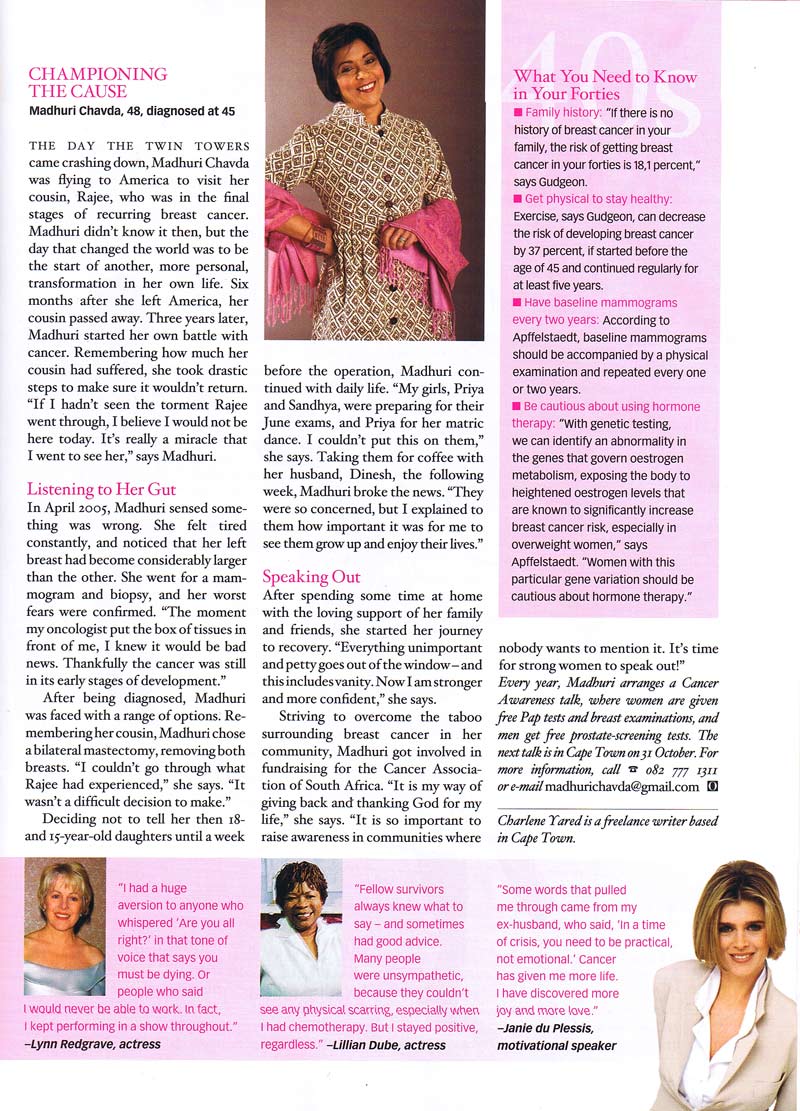
CHAMPIONING THE CAUSE: Madhuri Chavda (48), diagnosed at 45
The day the twin towers came crashing down, Madhuri Chavda was flying to America to visit her cousin, Rajee, who was in the final stages of recurring breast cancer. Madhuri didn’t know it then, but the day that changed the world was to be the start of another more personal transformation in her own life. Six months after she left America, her cousin passed away, then four years later, Madhuri started her own battle with cancer. But remembering how much her cousin had suffered, she took drastic steps to make sure it wouldn’t return.


Listening to Her Gut
“If I hadn’t seen the torment Rajee went through, I believe I would not be here today. It’s really a miracle that I went to see her,” says Madhuri.


In April 2005, Madhuri sensed something was wrong. She felt constantly tired and noticed that her one left breast had become considerably larger than the other. Immediately, she went for a mammogram and biopsy, and her worst fears were confirmed. Says Madhuri, “The moment my oncologist put the box of tissues in front of me, I knew it would be bad news. Thank God the cancer was still in its early stages of development.”


After being diagnosed, Madhuri was faced with a range of options which included having a lumpectomy with radiation treatment for each breast and then monitoring the progress closely, but was told that this route would not guarantee that the cancer wouldn’t return. Remembering her cousin, Madhuri opted for the last option; a bilateral mastectomy, which would remove both breasts entirely. “I couldn’t go through what my cousin had experienced,” she says. “It wasn’t a difficult decision to make.”


Deciding not to tell her then 18 and 15-year old daughters until a week before the operation, Madhuri continued with daily life. “My girls Priya and Sandhya were both preparing for their June exams and the eldest, Priya, for her matric dance. I just couldn’t put this on them,” she says. Taking them for coffee with her husband, Dinesh, the following week, Madhuri broke the news to them. “They were so concerned, but I explained to them how important it was for me to see them grow up and enjoy their lives, into my old age.”


Speaking out
After spending some time at home with the loving support from her family and friends, she started on her journey to recovery. “Everything unimportant and petty goes out the window – and this includes vanity. Now I am stronger, more confident and I live life to the fullest,” she says.


Striving to overcome the taboo in her community surrounding breast cancer, Madhuri got involved in fundraising for the CANSA Association. In 2006, she raised R15,000 for the annual event Cuppa-for-Cancer and later in 2007, raised R35,000 for refurbishing the Eikehof Interim Home, situated in Athlone. “It is my way of giving back to the community and for thanking God for my life,” she says. “It is also so important to raise awareness around cancer, especially in communities where nobody wants to even mention the word. It shouldn’t be something that is whispered. It’s time for strong women to speak out loud about cancer!”


Every year, Madhuri arranges an awareness talk in her community on the different forms of cancer. All women attending the talk are given free pap smears and breast examinations, and men are given free prostate screening tests. “You never know what will happen tomorrow, so I use today to its fullest capacity. I know my purpose now is to help people become aware of cancer and to know that it’s not a death sentence – it can be cured.”


The next Cancer Awareness Talk organised by Madhuri to be held in Cape Town this month is on the 31st of October. For more information, email her at madhurichavda@gmail.com or call her on 082-777-1311.

What you need to know in your 40s:

  • Family history plays a role. “If there is no family history of breast cancer in your family, the risk of getting breast cancer in your 40’s is 18.1%,” says Dr Gudgeon. “In your 40s, worries and concerns centre on the early onset of menopause and reduced sexuality, relationship issues and work-related discrimination.”
  • Get physical to stay healthy. Exercise, says Dr Gudgeon can decrease the risk of developing breast cancer by 37% if started before the age of 45 years and continued regularly for at least five years.
  • Have baseline mammograms every two years. According to Professor Apffelstaedt, baseline mammograms should be accompanied by a physical examination and repeated every one or two years in your 40s.
  • Be cautious about using HRTs. “With genetic testing, we can identify an abnormality in genes that govern the estrogen metabolism and expose the body to heightened estrogen levels that are known to significantly increase breast cancer risk, especially in overweight women,” says Professor Apffelstaedt. “Women with this particular gene variation are advised to be cautious about hormonal replacement therapy.”

What – and What Not – to Say:
Remember the old adage, think before you speak? It’s especially important when trying to make a friend with cancer feel better. What you say can really make a difference. Charlene Yared asked some famous survivors of cancer what they heard that was most helpful.


“One of the most practical things said to me about looking beyond illness and treatment was you don’t go back to normal; rather, you move on to a ‘new normal.’ I thought this was a great way of acknowledging what a tremendous ordeal you are going through, that life will never be the same again, and yet, life will go on.” -Kylie Minogue, singer


When you are ill, many people feel that they identify with you and then they make the big mistake to share all their illnesses and suffering with you. I cannot bear listening to people who wallow in their misery. I feel that it is unhealthy. Some words that really pulled me through my ordeal came from my ex-husband who said ‘in a time of crisis, you need to be practical and not emotional.’ Cancer has given me more life than health. I have discovered more joy and more love through it. -Janie du Plessis, SA television presenter


“I had a huge aversion to anyone who whispered the dreaded ‘Are you all right?’ in that tone of voice that says you must be going to die. Or people who said I would never be able to work during treatment. In fact, I kept performing in a show my entire six months of chemo and radiation.” -Lynn Redgrave, actress


“I found that fellow survivors always knew what to say – and sometimes had good advice. However, I found many people to be unsympathetic, because they couldn’t see any physical scarring, especially when I was going for chemotherapy. They would say – ‘you look fine, you’ll be ok.’ If only they knew how I really felt, or what I was going through at the time, but I always stayed positive, regardless.” -Lillian Dube, actress


“I loved how my friends supported me. Sometimes one would just pop in to ask if she could pick the kids up from school or have a cup of tea. Just being there during the ordeal is enough and is more valuable than giving advice on how to cope. Sometimes you just don’t feel like talking about your cancer – all you want is happy company and a good chat.” -Wilma van der Bijl, ex-Miss SA 1987

Author: Charlene Yared-West. Published in The Oprah Magazine, October 2009, Vol. 8, No. 10, p. 70.(Please note that the copy posted above is the unedited version of what was published in the magazine and will differ slightly. To read the edited version of the article, please click on the images for an expanded view.)

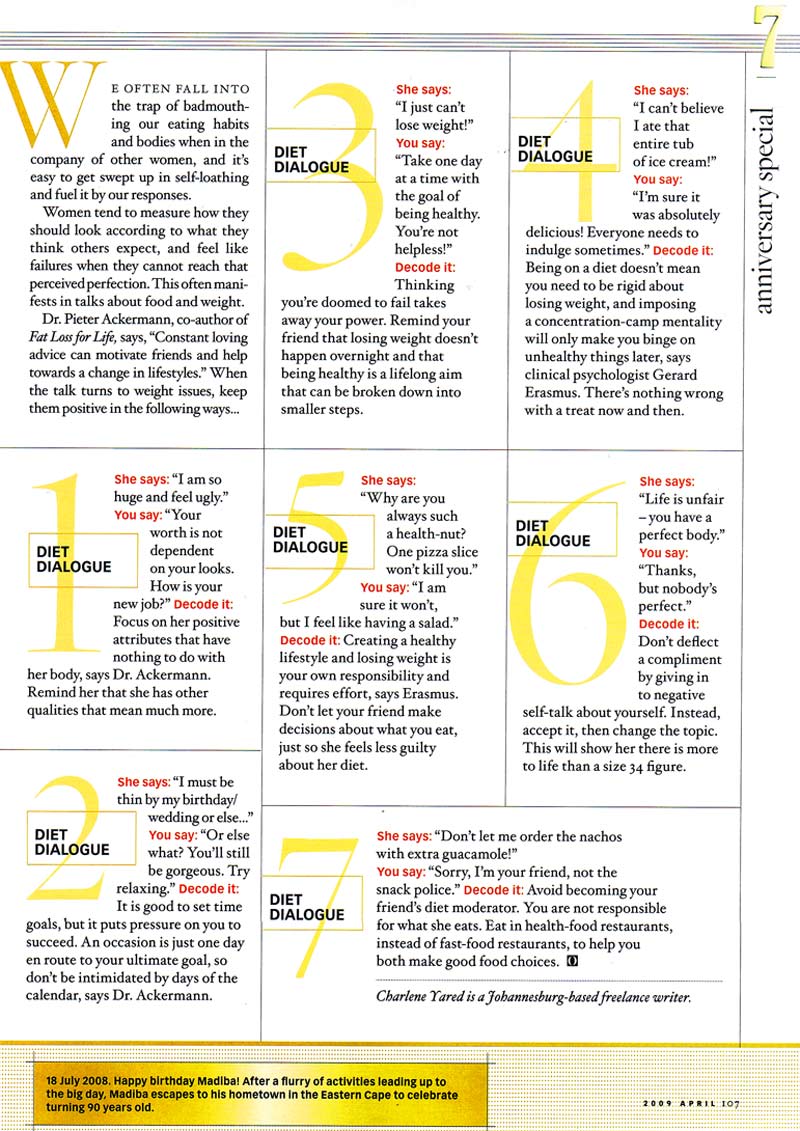
Seven Diet Dialogues Decoded

We’ve all been there when a friend bellows; “I’m so fat!” Or, “OMG, I’m such a pig, I can’t believe I ate all the chocolate pralines!” We often fall into the trap of badmouthing our bodies and eating habits when in the company of other women. It’s easy for us to get swept up in this self-loathing and fuel it by our response. Charlene Yared explores easy ways to diffuse the situation instead, and explains why reacting this way benefits you both.

“Negative self-talk may be a ploy to elicit encouragement from others, while it could also be a sign of low self-esteem, which may be related to weight and size issues,” says clinical psychologist, Gerard Erasmus. Women measure how they should look according to what they think others expect, and so feel like a failure when they cannot reach that level of perceived perfection. These feelings are often manifested in conversations about food and weight issues.


According to Dr. Pieter Ackermann, co-author of Fat Loss For Life, support from family and friends is paramount to success. “Constant, subtle and loving advice can motivate your friend to reach her goals and help her towards a change in lifestyle.”


So, when your girlfriend starts beating herself up, here are some clever ways to keep the tête-à-tête positive and help your friendship thrive.

Seven Diet Dialogues Decoded

1. She says: I must be thin by Valentine’s Day or else…

You say: Else what? You’ll still be your gorgeous self. Try relaxing a little!

Even though it’s good to set time goals, it puts too much pressure on you to succeed. Any special occasion is just one day en route to your ultimate goal, so don’t be intimidated by days of the calendar, says Dr. Ackermann.


2. She says: It is impossible to diet!
You say: Take one day at time with the goal of being healthy. You’re not helpless!

Thinking you’re doomed to failure takes away your power. Remind your friend that losing weight doesn’t happen overnight and that being healthy is a lifelong aim that can be broken down into smaller steps.


3. She says: I can’t believe I ate that entire tub of ice-cream! I feel disgusting.
You say: I’m sure it was delicious! Everyone needs to indulge sometimes.

Being on a diet does not mean that you need to be compulsive or rigid about losing weight, and starving yourself from the pleasures of eating, or imposing a concentration camp mentality on yourself will only make you binge on unhealthy things later, says Erasmus. Tell your friend that there’s nothing wrong with a treat now and then – everything in moderation.

4. She says: I am so fat and hate how huge I look. I feel so ugly.
You say: Your worth is not dependent on your looks! How’s the volunteer work going?

When she starts bashing herself, emphasise some of her positive attributes that have nothing to do with her body, says Dr. Ackermann. Remind her that size is not the only thing that counts and that she has other qualities as a person that mean much more.


5. She says: Why are you always such a health-nut? One pizza slice won’t kill you.
You say: I am sure it won’t, but I feel like having a salad.

Creating a healthy lifestyle and losing weight is your own responsibility and does not happen without effort, Erasmus says. Don’t let your friend make decisions about what you eat, just so that she feels less guilty about chomping on pizza. Peer pressure is for children!


6. She says: Life’s so unfair, you have a perfect body.
You say: Thanks! But nobody’s perfect – me included!

Don’t fob off a compliment by giving into negative self-talk about some other part of your body, instead, politely accept it and then chat about something else. Doing this shows her that there is more to life than having a size 6 figure.


7. She says: Please, don’t let me order the nachos with extra guacamole!
You say: Sorry, I’m only your friend, not the snack police.

Avoid becoming your friend’s personal diet moderator. You are not responsible for what she eats; only she can make that choice. Support each other by hanging out in healthy food eateries, instead of fast-food restaurants, to help with making good food choices.

Author: Charlene Yared-West. Published in The Oprah Magazine, April 2009, Vol. 8, No. 4, p106.(Please note that the copy posted above is the unedited version of what was published in the magazine and will differ slightly. To read the edited version of the article, please click on the images for an expanded view.)
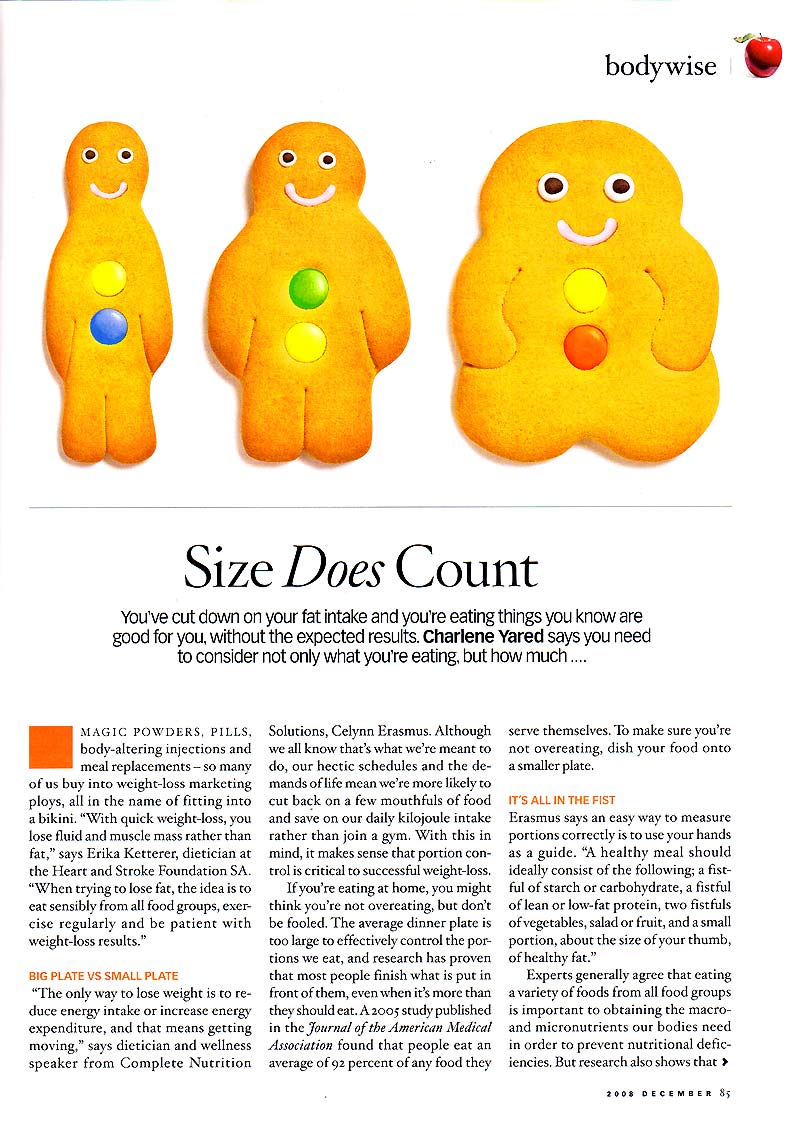
Size Does Count

So you’ve cut down on fat intake and are eating things you know are good for you. So why are those jeans still a bit too snug around the hips? Charlene Yared says it may not be what you’re eating that’s stopping you from dropping a dress size, but how much you’re eating that is.

Magic powders, miracle pills, body-altering injections and meal replacements. So many of us buy into weight-loss marketing ploys, all in the name of fitting into a bikini. “With quick weight loss, it’s not the fat that’s lost, but rather fluid and muscle mass,” says Erika Ketterer, dietician of the Heart and Stroke Foundation SA. “The real idea when trying to lose fat is to eat sensibly from all food groups, exercise regularly and be patient with weight loss results”.


Big plate vs. Small plate
“The only way to lose weight is to reduce energy intake or increase energy expenditure, and that means getting moving!” says dietician and wellness speaker of Complete Nutrition Solutions, Celynn Erasmus. Although we all know that’s what we’re meant to do, our hectic schedules and the demands of real life mean we’re more likely to cut back on a few mouthfuls of food and save on our daily caloric intake rather than join a gym. With this in mind it makes sense that portion control is critical to successful weight loss. If you’re eating at home, you might think you’re not overeating, but don’ be fooled. The average dinner plate is actually too large to effectively control the portions we eat and research has proven that most people finish what is put in front of them, even when it’s more than they should eat. A 2005 study published in the Journal of the American Medical Association found that people eat an average of 92% percent of any food they serve themselves. To make sure you’re not overeating, dish your food onto a smaller plate and, even if it is filled to the edge, you’ll automatically be eating less.


It’s all in the fist
Celynn suggests an easy way to measure portions correctly, using your hands as a guide. “A healthy meal should ideally consist of the following; a fistful of starch or carbohydrate, a fistful of lean or low-fat protein, two fistfuls of vegetables, salad or fruit and a small portion, about the size of your thumb, of healthy fat.”


Experts agree that eating a variety of foods from all the food groups is important to obtaining the macro- and micro-nutrients our bodies need, in order to prevent nutritional deficiencies, but research also shows that when presented with more variety, we eat more. “Variety encourages you to taste more things, so try and keep your meals simple, but ensure that your overall diet is diverse,” says Celynn.


Second helpings can also be damaging to weight loss efforts. “Before wolfing down seconds, wait 15 minutes to signal to your brain that you are satisfied,” she says. “Start learning the difference between feeling hungry and just wanting to eat something because it’s there.”


Eating for the sake of it
Why do we so often find ourselves eating oversized portions and still having space for dessert? Our relationship to food is complex and goes beyond the mere satisfaction of a physical need. According to clinical psychologist, Gerard Erasmus, there are factors which trigger certain eating behaviours, even when we are not hungry. “Eating has become a social activity rather than a physical need for many people,” he says. “Many people associate certain situations with eating, such as going to the movies and having popcorn or eating a rusk with your coffee in the morning.”


Emotions, low self-worth, lack of self-control and not paying attention to the body’s cues are some of the other factors which play a role. “Being lethargic and lacking energy may well be a sign that our bodies need fuel, but the solution could be to simply recharge the batteries by doing some physical activity,” he says. “As we know, this takes effort and being human, we often opt for the easy way out – eating.”

Getting Out
Eating out can be great but the large portion sizes, endless variety and tasty sauces can be a dietary disaster. “Many foods served outside the home, particularly traditional takeaways, are high in saturated fat, trans-fatty acids, cholesterol, added sugars and sodium, and are low in fibre and micro-nutrients,” says professor Marius Smuts, of the North West University in Potchefstroom. “As a result, adverse health consequences may emerge.”


According to the American Heart Association, there is a definite correlation between the frequency of eating out and total energy intake, weight gain and insulin resistance. Therefore, irrespective of the restaurant you choose to spend the evening, try and make healthy food choices combined with acceptable portions to keep the flab at bay, and your health in check.


Snack on nuts or some fresh fruit before leaving home, so that you don’t arrive feeling ravenous, recommends Celynn. “Also, think about what you’d like to eat before arriving at the restaurant.” She suggests drinking more water than alcohol, and asking for meat, chicken or fish to be dry grilled. Hidden fats can be found in sauces and dressings, so order those separately in order to control the amount you add to your meal. Because restaurant portions are usually oversized, eat less than you are served and take the rest home. The alternative is to order starter portions rather than main meals, or ordering separate items, like grilled chicken, baked potatoes and vegetables, rather than combined dishes such as lasagne, curries or stews. These combination dishes often contain added sauces and many hidden fats.

Snack Amnesia
Research indicates that people generally eat more when listening to fast-paced music in a restaurant, or when watching television. “You want to avoid snack amnesia,” says Celynn. “This happens when you are so busy watching TV or answering emails that you don’t register what you are eating, and consequently, you still feel hungry. Eating mindfully and slowly and chewing each mouthful properly can help you consume smaller portions, no matter where you are.”


Read before you ravish
Always read the label on any food item you buy. Paying attention to the amount of energy in the food you’re eating will help you achieve a natural, healthy weight. On average, women should consume about 6000kJ (1500 calories) per day, and men, about 8500kJ (2000 calories) per day. Energy intake should ideally be calculated by a dietician, according to the individual’s body mass index, gender, age and physical activity level.

Author: Charlene Yared-West. Published in The Oprah Magazine, December 2008, Vol.7, No. 12, p85.(Please note that the copy posted above is the unedited version of what was published in the magazine and will differ slightly. To read the edited version of the article, please click on the images for an expanded view.)
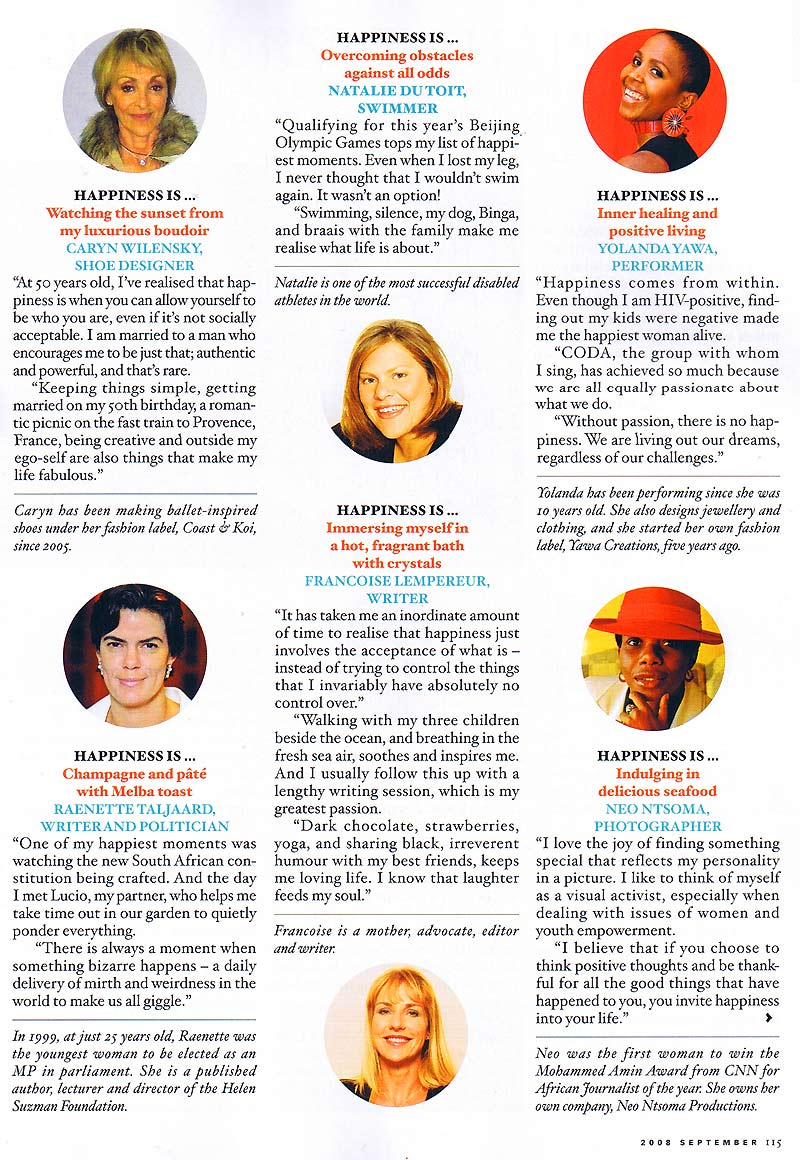
What Makes South African Women Smile?

Wide open spaces, warm hugs, gorgeous underwear and laughing out loud. We ask eleven South African women what gives them that happy, fuzzy feeling.

Caryn Wilensky, Shoe Designer
Happiness is…watching the sunset from my luxurious boudoir
“At 50 years old, I’ve realised happiness is not something static. Rather, it’s organic.” says Caryn. “Happiness is when you can allow yourself to be authentic, even if it’s not socially acceptable. I am married to a man who encourages me to be just that; authentic and powerful, and that’s rare.

“Keeping things simple, getting married on my 50th birthday, a romantic picnic on the fast train to Provence, being creative and being outside of my ego-self are also all things that make my life fabulous.”


In 2005, Caryn started making ballet-inspired shoes under her fashion label, Coast & Koi, which has spread like wildfire across South Africa and abroad.


Raenette Taljaard, Author
Happiness is… champagne and pate with melba toast
“One of my happiest moments was watching the new South African constitution being crafted,” says Raenette. “And the day I met Lucio, my partner who helps me take time out in our garden to quietly ponder everything.


“I recently said that I’m building beautiful bridles for my cynicism. There is always the inevitable moment when something bizarre will happen – a daily delivery of mirth and weirdness in the world to make us all giggle.”


In 1999, at just 25 years old, Raenette was the youngest woman to ever be elected as an MP in parliament. A published author, lecturer and director of the Helen Suzman Foundation, she says that a daily debriefing with loved ones over wine is what makes her happy.


Lindy Briginshaw, Businesswoman
Happiness is…travelling to unusual destinations
“Developing countries draw me especially and I’m happiest exploring somewhere or something completely different – a camel ride in the desert from M’hamid to Mzouga, talking to strangers, or even bargaining with traders for a special memento,” says Lindy. “I love winter morning walks in the forest with Jezebel, my energetic German Shepherd. Being surrounded by the crisp, fresh air helps me connect to the spirit – giving me inspiration.


“Then there are wide open spaces like the rugged Karoo landscape, my beloved boyfriend Jacques and home-cooked food that have the power of bringing in the sunshine too – even on rainy days.”


Always interested in the development sector and politics, Lindy established her own creative consultancy, Development Works, in Cape Town in 2003.


Yolanda Yawa, Performer
Happiness is…inner healing and positive living
“Happiness comes from within – and what’s left in its wake is a bed of roses,” says Yolanda. “Roses have thorns, but you need to go beyond that. Even though I am HIV-positive, finding out my kids were negative made me the happiest woman alive.


“Coda, the group with whom I sing, has achieved so much because we are all equally passionate about what we do. Without passion, there is no happiness. We are all living out our dreams, regardless of challenges.”


Performing since she was ten years old, Yolanda is a vocalist for Coda – a SA band of home-grown contemporary sounds. She is is also a jewellery and clothing designer, with her own fashion label, Yawa Creations that she started in 2003.

Francoise Lempereur, Writer
Happiness is…immersing myself in a hot fragrant bath with crystals
“It has taken me an inordinate amount of time to realise that happiness involves acceptance; acceptance of what simply is – instead of trying to control things I invariably have no control over,” says Francoise. “Walking with my three children beside the ocean and breathing in the sea air soothes and inspires me. I usually follow this up with a lengthy writing session, which is my greatest passion.


“Dark chocolate, strawberries, yoga and sharing black, irreverent humour with my best friends keeps me loving life, because I know laughter feeds the soul.”


Mother, advocate, author and editor, Francoise recently published a short story in ‘Breaking the Silence’, an anthology by People Opposing Women’s Abuse (POWA), published in 2008.


Neo Ntsoma, Photographer
Happiness is…indulging in delicious seafood
“Good imagery is my passion. I’m at my happiest when I’ve done something worthwhile, artistically and creatively. I love the joy of finding that special something that reflects my personality in a picture,” says Neo. “I’d like to see myself as a visual activist, especially when dealing with issues of women and youth empowerment.


“I believe that if you choose to think positive thoughts and be thankful for all the good things that have happened in your life, it invites happiness into your life.”


In 2004, Neo was the first woman to win the Mohammed Amin Award from CNN for African Journalist of the year. Today she owns her own company, Neo Ntsoma Productions, specialising in music, dance, fashion portraiture, film and television stills and reportage.


Andile Gaelesiwe, Presenter
Happiness is… awesome, fitting, flattering underwear
“Founding Open Disclosure for rape victims in 2002 showed me what happiness was. It was a purging for me to impart my life lessons to fellow South Africans, especially young people, helping them to realise the reason for their own existence,” says Andile. “Happiness is a state of mind – if you take care of yourself, you start to feel good and it rubs off on those around you.


“Sometimes when I feel down, I reach inside to that place where I can reside at soul level. There is always joy there – where I can smile, even if it hurts.”


Kwaito singer, songwriter, sexual rights campaigner and television presenter, Andile is always on the forefront of fighting social injustices, especially sexual abuse and violence.


Natalie du Toit, Swimmer
Happiness is… overcoming obstacles against all odds
“Qualifying for the 2008 Beijing Olympic Games tops the list of happiest moments because it’s been my dream since I was six years old,” says Natalie. “Even when I lost my leg I never once thought ‘I won’t get into a pool again’. It wasn’t an option – nothing could stop me from reaching my goal!


“Swimming, silence, my dog Binga and braais with the family make me realise what life is really about. You have to take the good out of the bad, and remember that everything happens for a reason.”


SA swimmer, Natalie is one of the most successful disabled athletes in the world and is also a motivational speaker, inspiring people to reach for their dreams.

Teya Goven, Layout Artist
Happiness is…Fudge and Muffin, my Jack Russell and miniature Daschund
“Walking is a process of meditation for me and when I’m doing it outside I feel like I can connect with God. It’s like the nature around me absorbs all the worries and everyday concerns that prevent me from actually hearing my spirit,” says Teya. “Laugh-til-you-cry moments make life worth living, but also making sure you are doing something that’s in alignment with your spirit – even if it’s baking cupcakes! “Happiness comes in the letting go of all your preconceived ideas about when and how you will be happy and realising that you have the choice to be happy right now.”


After freelancing for a year, Teya now works as the art director for Essentials Magazine in Johannesburg.

Devi Sankaree Govender, Journalist
Happiness is…the funny things my children say
“In my job I see the worst of South African life, but it’s not all doom and gloom. Conclusively nailing someone to the wall by asking questions the victim wasn’t able to gives me great satisfaction. I know that at some level the work makes a difference to someone’s life – even if it’s small.


“When I get home, I am wife and mommy, and everything else gets filed away somewhere else. It’s where I can be myself ¬– cooking South Indian dishes for my family, playing games with my kids and snuggling under my soft duvet to read.”


From being a radio talk show host, newspaper columnist and investigative journalist for Carte Blanche, Devi juggles her public and private life with a smile.


Tebogo Kgobokoe, Dancer and Coach
Happiness is…spoiling myself to a luxury weekend away
“Life has its ups and downs. It’s like a dance – just go with the flow and let your life be rhythmical,” says Tebogo. “I no longer worry about what people think – especially about my body. I was constantly reminded that my body was not right for dancing but I did it anyway, and became a world renowned dance champion.


“Cooking, travelling and dancing – and watching my husband try out my dance moves – makes me laugh! It doesn’t take much to make me happy. A good warm hug usually does the trick.”


From six times undefeated SA Latin American and Ballroom Championships to being a World Professional finalist, Tebogo has her own entertainment consulting company, Moribo Promotions that she started in 2001. She travels the world as a dance lecturer, adjudicator and coach.


Where Are the Happy People?
• Out of 178 countries, the happiest nation in the world is Denmark followed by Switzerland and Austria.
• The least happy people live in the Democratic Republic of Congo, Zimbabwe and Burundi.
• South Africa took 109th place, just before Cambodia and after Libya.
(According to a 2006 study conducted by Adrian White, social psyhcologist at the University of Leicester.)


Don’t Worry, Be Happy
Happiness and business coach, Jo-Anne MacKay explains that factors of crime, the economy, the general future of the country and job opportunities are the main causes of unhappiness in South Africans.


“Actively make your dreams a reality, practice the skill of happiness, find purpose in your life and create support structures for yourself,” Jo-Anne suggests. “Explore your passions and even if you feel fear creeping in – just do it! And, worry less about what others think of you.”

Author: Charlene Yared-West. Published The Oprah Magazine, September 2008, Vol. 7, No. 9, p114.(Please note that the copy posted above is the unedited version of what was published in the magazine and will differ slightly. To read the edited version of the article, please click on the images for an expanded view.)

Unwinderies: A Guide to SA’s Stress-Free Zones

A mountainside massage with spectacular views and sea air. An elephant-back safari through lush vegetation. From the heart of the Drakensberg and Magaliesberg mountains to the edge of the Atlantic ocean, here are 10 places to release, uplift and rejuvenate your spirit.
Snow-white escape
Swiftly zigzag down the slope at high-speeds while you absorb the beauty of the stark white mountain range around you. Set at a staggering 3001m above sea-level, Ben McDhui is the Cape’s highest mountain peak and is home to the only ski resort in Southern Africa, Tiffendell. After a magnificent day indulging snowy adventures, warm up with sundowners of Shnapps and Gluhwein at South Africa’s highest pub, the Ice Station. Gaze at the stars through your window and curl up beside a roaring fire in your luxury wooden chalet, or go for a sophisticated bite to eat, cooked up by world-class chefs. For the less daring, explore the surrounding forests, taking a walk to see the frozen waterfalls and make a snowman to accompany you home. (From R2222 per package, 086-178-7909, http://www.snow.co.za)


Wild Horses
Experience a silence so complete in this idyllic corner of the Drakensberg, where life seems to stop in its tracks, only to be reawakened by the sound of a galloping horse. Sprawling the foothills of the Drakensburg escarpment, Wild Horses 5-Star Mountain Guest Lodge offers the perfect African-style getaway of breathtaking sunrises, lazy sunsets and activity-filled days to inspire you body and soul. Explore the mountains on one of the lodge’s specially-bred horses, or pamper yourself with a massage and facial in the luxurious surroundings of your sandstone suite or secluded hillside gazebo. Too horizontal for your liking? Go down to the riverside to learn the art of fly-fishing, or go for a game-viewing boat ride with a glass of bubbly in hand. (From R950 per person; 058-622-7000; http://www.wildhorses.co.za)


Wonder of Nature
Ever dream of flying high over pristine forests and swooping over cascading waterfalls in a helicopter or hot-air balloon and then enjoying a traditional English breakfast with sparkling wine, while you ponder your next adventure: an elephant back safari? At Cybele Forest Lodge and Health Spa, nestled in the forests of Mpumalanga, adventure safaris and body pampering, fit for a king, are dreams that do come true. A sumptuous granite hydrotherapy bath awaits you in a private courtyard, after your captivating morning game drive adventure, viewing SA’s Big Five. Limited to 28 guests at a time, the lodge ensures personal attention and privacy, with heated pools accompanying six of the luxurious suites. (From R1265 per person; 013-764-9500, http://www.cybele.co.za)


Country Meander
Watch the countryside pass you by as you lounge in one of the world’s most opulent trains: the Pride of Africa of Rovos Rail. Beautifully restored wood-panelled coaches offer spatious accommodation as you embark on your romantic rail safari, meandering throughout South Africa, Namibia, Vic Falls and Dar Es Salaam. Feel nostalgic, as though you’ve stepped back in time and sense how the opulent furnishings and period décor create an ambience of pleasurable grandeur. Dine on the five-star cuisine and the finest SA wines aboard the train and then retreat to your luxury suite, decked out with a private lounge, en-suite bathroom and Victorian bath. (From R4540 per journey; 012-315-8242; http://www.rovos.com)

Heaven and Earth
Surround yourself with the essentials: an experienced masseuse, blue sky, azure ocean and indigenous fynbos on the slopes of the Twelve Apostles Mountain Range in Cape Town. Breathe in the fresh air as the strains of the day are soothed away in the outdoor glass-enclosed gazebo spa. Recognised by the Conde Naste Traveller as the 3rd best in the 2008 Reader’s Spa Awards, the Twelve Apostles Hotel and Spa offers exclusive packages where guests can experience a helicopter ride from the V&A Waterfront to the spa, where they eventually slip into fluffy gowns and indulge themselves in holistic relaxation therapies. Stay the evening and try some of the finest meals at the Azure restaurant, created from the freshest ingredients grown at the spa. (From R995 per person; 021-437-9000; http://www.12apostleshotel.com)


Quiet Time
Eyes closed and sitting in lotus position, is the largest hand-carved Buddha statue outside the East, quietly overlooking the exquisite Zen raked sand gardens, pagoda and winding Umkomaas river. Perched on a ridge at the head of a valley in Ixopo, KwaZulu-Natal, the Buddhist Retreat Centre invites you to contemplate life, forget the outside world, meditate in manicured gardens, and at night, slip into the silent slumber of your en-suite cottage. Learn about Buddhist philosophy and meditation, or try your hand at Japanese brush painting, drumming or kite flying. Paring the freshest organic lacto-ovo-vegetarian cuisine with a retreat offered at the centre, will leave you feeling detoxed and peaceful: a recipe for tranquility. (From R95 per day; 039-834-1863, http://www.brcixopo.co.za)


Release the Artist in You
Paint, play with clay, draw with chalk pastels, charcoal or create your own collage, simply put: let your creativity run riot! Discover and explore your inner and outer worlds through art mediums and writing at art retreats run throughout the year at Cedar Guesthouse and Stanford Valley B&B in Baviaanskloof and Overberg, respectively. Spend the night in comfort, dreaming up fantastical creations and manifest them in a medium of your choice the next day. And if you’re worried about your skills as an artist – don’t! Absolutely no experience is necessary to create a masterpiece that you can be proud of, whilst relaxing into the moment of art-making. (From R3300 per person; course co-ordinator: Elaine Millen; 021-788-6493; http://www.elainemillin.com)


Sanctuary of Stillness
Honouring the great paths of Christianity, Buddhism, Judaism, Hinduism and Islam, Temenos in McGregor, brings religion and spirituality together in one sacred space, like a monastery of old. Welcoming all who seek refuge from the pressures of the outside world, Temenos, meaning sacred space, was in ancient Greece a temple dedicated to Gaia. Winding paths leading to secret gardens of spiritual upliftment and meditation abound, including a well, chapel, Baraka shrine and Zen garden. Indulgent body therapies are offered during your stay, as well as yoga retreats, wellness weeks and a workshop on emotional freedom technique. Sleep peacefully in the self-catering cottages equipped with fireplaces for chilly nights. (From R420 per person; 023-625-1871; http://www.temenos.org.za)

Wine, Sweet Wine!
The day is perfect: blue skies, a green vineyard as far as the eye can see and wine to whet your pallet. Arrive at Stellenrust wine farm in the Stellenbosch region of the Western Cape, at 10am sharp and meet the owners over a tantalising glass of Cap Classique, as they share some of the history of the farm with you. After finishing your last sip of wine, a tractor-pulled wagon will escort you deep into the vineyards, where you’ll pick from a selection of grapes using scissors and a traditional basket. Back at the cellar, you will stomp the grapes and brew your own wine and enjoy a full wine-tasting presentation. Magnifique! (From R500 per person; 021-880-2283; http://www.stellenrust.co.za)


Into the Wilderness
The Karoo: a sprawling expanse of grassy landscape, dotted by little towns, which welcome the weary traveller. Situated in the world renowned hamlet of Nieu Bethesda, Ganora Guest Farm is perfect for star-gazing, canyon hikes, mountain biking, 4X4 trails, picnicking and above-all, unwinding. Not only does the farm have its own collection of fossils dating back 240 million years, but it also conducts guided tours to see San rock art, Khoi shelters and Bushmen artefacts, discovered on the land. The farm’s cosy accommodation is full of rustic charm, with its wooded roofs, stone walls and downy duvets that will have you ready for another day of wherever the mood takes you. (From R260 per person; 049-841-1302; http://www.ganora.co.za)

I do Believe in Fairies!
Fairies and goblins come alive at the fantasy dining and accommodation experience at Goblin’s Cove, situated in the Magaliesberg Mountain range. Decorated by well-known artist and sculptor, Charles Gotthard, Goblin’s Cove is a magical place to explore, as it twinkles with fairy lights at night and by day, is alive with shoppers browsing the Fairywinkle shop and Gobble ‘D Gook Coffee Nook. Guests can stay at the converted luxury train coach on the property and are served a scrumptious dinner basket with silverware and crisp cotton napkins. After stepping outside to bid the fairies goodnight, be lulled to sleep by the sound of birds in the aviaries close by, whilst you enjoy your midsummer nights dream… (From R376 per person; 014-576-2143; http://www.goblins.co.za/)

Author: Charlene Yared-West. Published in The Oprah Magazine, July 2008, Vol. 7, No. 7, p. 101.(Please note that the copy posted above is the unedited version of what was published in the magazine and will differ slightly. To read the edited version of the article, please click on the images for an expanded view.)