Polycystic Ovarian Syndrome: A lifestyle-related disease?

Polycystic Ovarian Syndrome (PCOS) is common in South African women and affects about one in 10 women globally. It is caused by a complex imbalance of hormones in the ovaries.  Charlene Yared West spoke to Life Kingsbury endocrinologist, Dr Jocelyn Hellig and gynaecologist Dr Philip Zinn to find out more about this condition. 

So what is PCOS?

In a woman’s body, the ovaries release eggs each month as part of a healthy menstrual cycle.  However, with PCOS the egg is not released as easily, which leads to irregular ovulation and menstruation and can impact fertility. “The ovaries are described as polycystic because there is an excess of the fluid-filled, egg-containing sacs called follicles, all of a similar size, when seen on an ultrasound image,” says Dr Zinn. “This excess occurs due to disturbance of the growth of follicles – to the size required for ovulation.”

It’s all about the hormones… or is it? 

Dr Hellig explains that the exact cause of PCOS is unknown. “There is no one singular factor which causes PCOS. It is considered to be a complex trait arising from the interaction of genetic and environmental factors, usually first presenting when mature gonadotropin levels (hormones essential for reproduction)are achieved at puberty. It occurs naturally in primates as well as humans,” she says. “The disorder arises clinically by the presence of two out of three criteria: irregular periods or the absence of ovulation, features of high androgen levels (acne or excess hair growth) and a certain appearance of polycystic ovaries on ultrasound,” she says. 

You could be predisposed to PCOS if…

  • You have insulin resistance.
  • You have Type 2 diabetes.
  • You have unhealthy eating habits.
  • You do not exercise regularly.
  • You are overweight or obese.

Trying to fall pregnant?

If you are trying to fall pregnant, but it is proving difficult, PCOS might be the culprit, says Dr Zinn. “Many women are unaware that they even have PCOS until they start trying to have a baby. Once they start treatment and their symptoms are managed, then their chances of conceiving are increased.”

QUIZ: ✓Tick the boxes below to see if you might have symptoms of PCOS

  •  Irregular menstrual cycle 
  • Thinning hair or hair loss on the scalp (male-pattern baldness).
  • Acne on the face, back and chest. 
  • Too much hair on the face or areas where men usually have hair (hirsutism affects up to 70% of women with PCOS). 
  • Weight gain and difficulty losing weight. 
  • Darkening of skin pigmentation, along the neck, groin and under the breasts. 
  • Skin tags in the armpits or neck area. 

How is PCOS diagnosed? 

“If you think you have PCOS, make an appointment with your gynaecologist. There is no single test to diagnose PCOS, but we take your medical history and can conduct a physical exam with a pelvic ultrasound and do some blood tests,” says Dr Zinn.  Dr Hellig adds: “Of utmost importance is that PCOS is a diagnosis of exclusion and it is important for your medical professional to look for other causes of your symptoms before ascribing it to PCOS.”

  • Physical exam: Checks your blood pressure, BMI and waist size. Also checking for extra hair on the body, skin discolouration, hair loss and any other signs of excess testosterone such as an enlarged clitoris. It is important to exclude other health conditions. 
  • Pelvic ultrasound: A sonogram will examine the lining of the uterus and check the ovaries for the polycystic features. 
  • Blood tests: To check your androgen hormone levels, as well as other hormone checks, including your thyroid. 

Can I be cured from PCOS?

8Dr Hellig explains that there is no cure for PCOS, but symptoms can be effectively managed and therefore treated. “We take into account if you want to conceive, your risk of long-term health problems, especially diabetes and cardiovascular disease, and will help formulate an effective treatment plan through lifestyle changes and medication where necessary,” she says. 

What can I do to alleviate my symptoms?

Dr Hellig and Dr Zinn agree on the following steps that women can take to treat PCOS: 

  • Lose weight: This will help to stabilise your blood glucose levels and alleviate insulin resistance. Even a 5 – 10% loss in body weight can improve your chances of conceiving. 
  • Remove hair: Using facial hair removal creams, laser hair removal or electrolysis. Medication is not very effective for permanent hair removal. 
  • Hormonal birth control for women not wanting to conceive: Can help to regulate  menstruation cycles, stabilise weight, improve acne and reduce new hair growth on face and body. 
  • Anti-androgen medicines: Although not safe for pregnancy, can help reduce PCOS symptoms. 
  • Metformin: A drug used to treat type 2 diabetes and may help some women with PCOS symptoms in certain circumstances. 
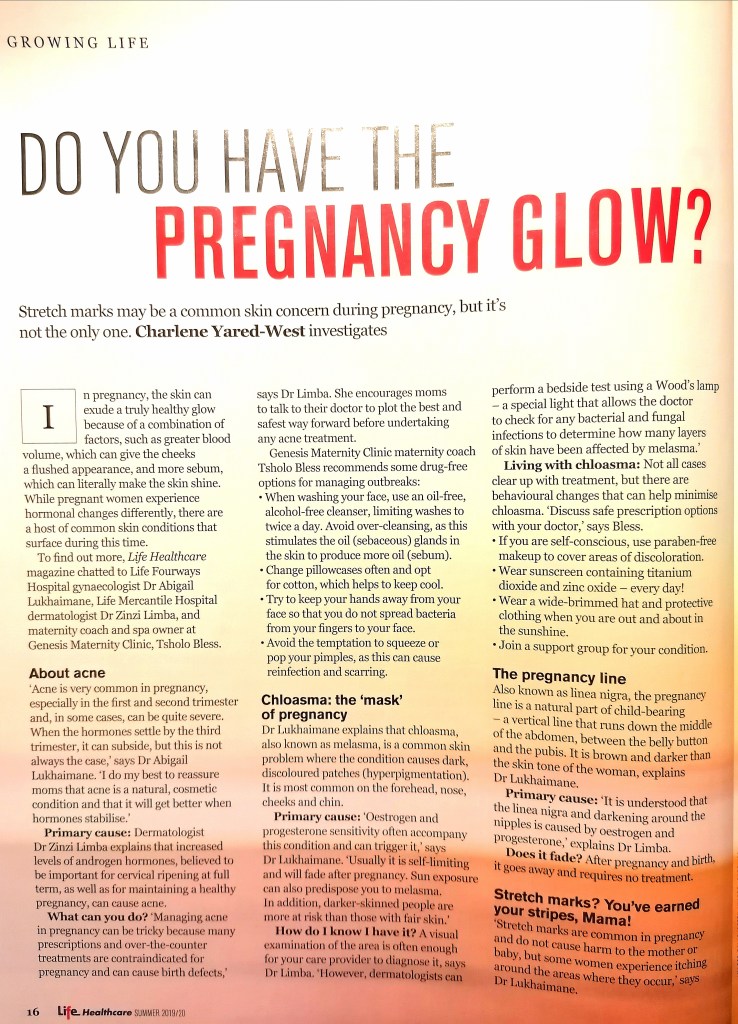
Do you have the pregnancy glow?

In pregnancy, your skin can exude a truly healthy glow because of a combination of factors, such as greater blood volume, which can give the cheeks a flushed look and more sebum on the skin, which can make the skin shine. While every woman experiences hormone changes in pregnancy, not every woman will get that pregnancy glow. It is well-documented that pregnancy brings with it a whole new set of skin concerns – not just the most common of problems, namely stretchmarks. Charlene Yared West spoke to Life Fourways Hospital Gynaecologist, Dr Abigail Lukhaimane, Life Mercantile Hospital Dermatologist, Dr Zinzi Limba and Genesis Maternity Clinic Maternity Coach & Spa owner, Tsholo Bless, to find out more about skin conditions in pregnancy.

Acne-oh-no!

What is it? “Acne is very common in pregnancy, especially in the first and second trimesters and in some cases can be quite severe. When your hormones settle by the third trimester it can subside for most women, but this is not always the case” says Dr Abigail Lukhaimane. “I do my best to reassure moms that it is a natural , cosmetic condition and that it will get better when hormones stabilise.” 

Primary cause: Dr Zinzi Limba explains that increased levels of androgen hormones, believed to be important for cervical ripening at full term, as well as for maintaining a healthy pregnancy, can cause acne. 

What can you do? “Managing acne in pregnancy can be tricky because many prescriptions and over the counter treatments are contraindicated for pregnancy and can cause birth defects,” says Dr Limba.  She encourages moms to talk to their doctor to plot the best and safest way forward before taking any acne treatment. 

Tsholo Bless recommends some easy drug-free options for managing zit outbreaks:

  • When washing your face, use an oil-free, alcohol-free cleanser, limiting washes to twice a day. Avoid over-cleansing as this stimulates the oil glands in the skin to produce more oil.
  • Change your pillowcases often – use cotton pillow cases which encourage the skin to breathe.
  • Keep your hands away from your face so that you do not spread bacteria from your fingers to your face. This goes for your mobile phone too – a device dripping in bacteria, even on the best days!
  • Avoid the temptation to squeeze or pop your pimples, as this can cause re-infection and scarring.
  • If you have clogged pores, treat yourself to a professional salon facial.

Chloasma: The Mask of pregnancy

Dr Lukhaimane explains that chloasma, also known as melasma, is a common skin problem where the condition causes dark, discoloured patches on your skin (hyperpigmentation).  Most common on the forehead, nose, cheeks and chin.  According to the American Academy of Dermatology, 90% of people who develop this condition are women.
Primary cause: “Estrogen and progesterone sensitivity often accompany this condition and can trigger it,” says Dr Lukhaimane. “Usually it is self-limiting and will fade after the pregnancy. Sun exposure can also predispose melasma. In addition, darker skinned people are more at risk than those with fair skin.” 

How do I know I have it? A visual exam of the area is often enough for your care provider to diagnose it, says Dr Limba. “However, dermatologists can perform a bed-side test using a Wood’s Lamp – a special kind of light that allows the doctor to check for any bacterial and fungal infections to determine how many layers of skin the melasma has affected.”

Living with melasma: Not all cases clear up with treatment, but there are methods of behavioural changes that can help minimise the worsening of the condition.  “Visit your doctor to discuss prescription options that are safe to use for pregnancy,” says Tsholo.

  • Use Paraben-free makeup if you are self-conscious to cover up areas of discolouration.
  • Wear Sunscreen containing Titanium Dioxide & Zinc Oxide – every day!
  • Wear a wide-brimmed hat and protective clothing when you are out and about in the sunshine.
  • Seek out support groups for your condition.

The Pregnancy Line

The pregnancy line is also known as linea nigra and is a normal and natural part of pregnancy. It is brown and darker than the skin tone of the woman and is a vertical line running down the middle of the belly, between the belly button and the pubis, explains Dr Lukhaimane. 

Primary cause: “It is understood that the linea nigra and the darkening around the nipples is caused by the hormones estrogen and progesterone, which stimulate the production of melanin, the pigment which darkens and tans the skin in pregnancy,” says Dr Limba. 

Does it fade? After pregnancy and birth  it goes away on it’s own – you do not need treatment. 

Stretchmarks? You earned your stripes mama! 

“Stretchmarks are very common in pregnancy, affecting about 8 out of 10 women –  and do not cause harm to the mother or baby, but can cause itching on the area for some women,” says Dr Lukhaimane. 

Primary cause: Dr Limba explains that skin is highly adaptable and can stretch and contract, but during pregnancy, the skin does not have enough time to adjust, which causes the skin to tear, which in turns results in a scar that forms – and this is known as a stretchmark. 

Who gets stretchmarks? “Lighter skinned women often get pink stretchmarks forming, while darker skinned women will have lighter stretchmarks than the surrounding skin area.  Stretchmarks can occur anywhere; on the hips, thighs, belly breasts, lower back and buttocks,” says Dr Limba. 

Treatment: Tsholo says that there is no absolute treatment for stretchmarks, but that women can be comforted to know that they will fade into paler scars and sometimes become less noticeable, but will not go away completely. “The best advice would be to make sure that you keep the skin well nourished and a cream or oil made from plant oils rich in Omega 3,6, & 9 can be very useful. A study published in International Journal of Molecular Sciences by T.Lin et al showed that the topical application of some plant oils can have anti-inflammatory and skin barrier repair effects. This also means that the itching is reduced. So it is wise to seek information from your skincare therapist,” she adds. 

TOP TIPS

Sunscreen is imperative. 

When pregnant, all medication should be cleared by your physician / gynaecologist. 

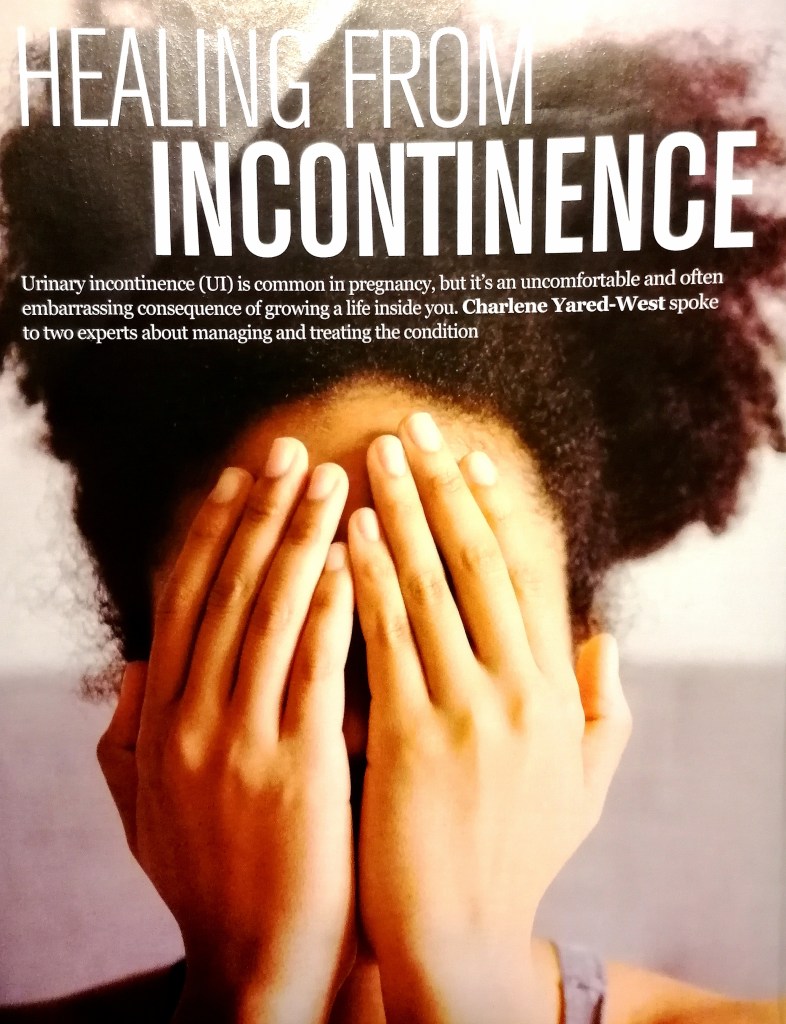
Healing from incontinence

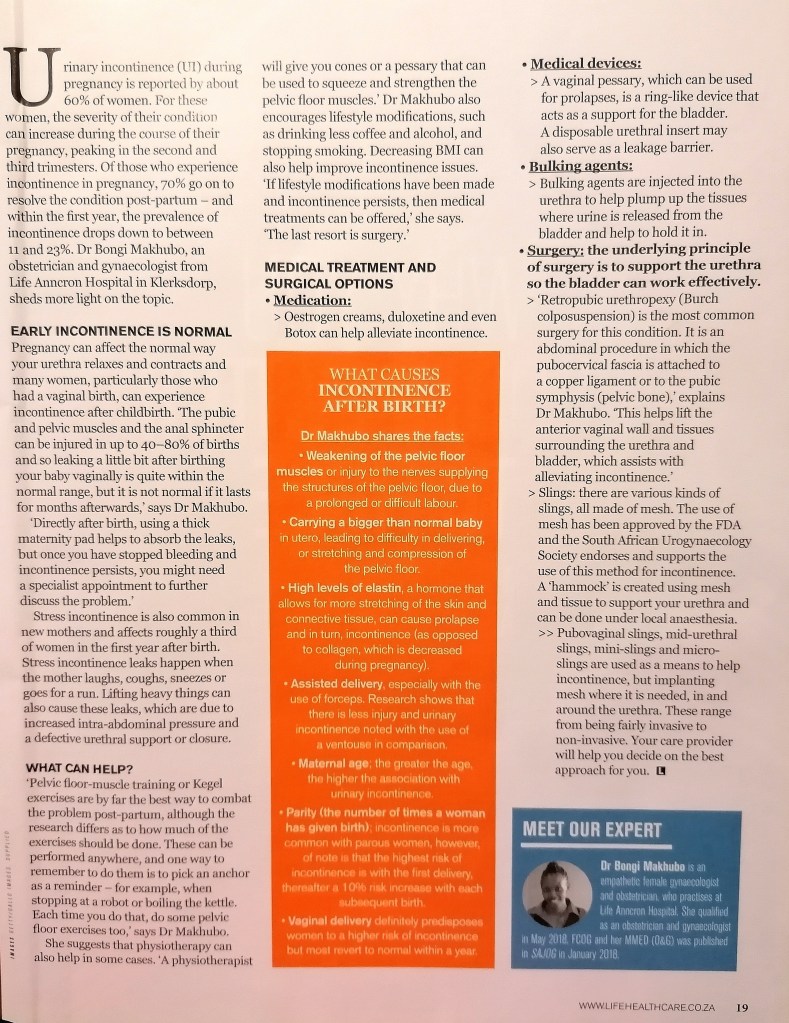
Urinary incontinence is common in pregnancy and is reported by about 60 percent of women. For these women, the severity of their condition can increase during the course of their pregnancy, especially peaking in the second and third trimesters. Of these women who experience incontinence in pregnancy, 70 percent go on to resolve the condition postpartum – and within the first year, the prevalence of incontinence drops down to 11 to 23 percent. Dr Bongi Makhubo, obstetrician gynaecologist from Life Anncron in Klerksdorp sheds more light on the topic. 

Early incontinence is normal

Pregnancy can affect the normal way your urethra relaxes and contracts and many women, particularly those who had a vaginal birth, can experience incontinence after childbirth. “The pubic and pelvic muscles and the anal sphincter can be injured in up to 40-80% of births and so, leaking a little bit after birthing your baby vaginally is quite within the normal range, but it is not normal if it lasts for months afterwards,” says Dr Makhubo. “Directly after birth, using a thick maternity pad helps to absorb the leaks, but once you have stopped bleeding and incontinence persists, you might need a specialist appointment to discuss the problem further.” 

Stress incontinence is also quite common in new mothers and affects roughly a third of women in the first year after birth. Stress incontinence leaks happen when the mother laughs, coughs, sneezes or goes for a run. Lifting heavy things can also cause these leaks,  which are due to increased intra-abdominal pressure and a defective urethral support or closure.

<FACT BOX>What causes incontinence after birth? Dr Makhubo shares the facts: 

  • Weakening of the pelvic floor muscles or injury to the nerves supplying the structures of the pelvic floor, due to a prolonged or difficult labour. 
  • Carrying a bigger than normal baby in utero, leading to difficulty in delivering or stretching and compression of the pelvic floor.
  • High levels of elastin, a hormone which allows for more stretching of the skin and connective tissue, can cause prolapse and in turn, incontinence (as opposed to collagen, which is decreased during pregnancy).  
  • Assisted delivery, especially with the use of forceps. Research shows that there is less injury and urinary incontinence noted with the use of ventouse in comparison. 
  • Maternal age; the higher the age the higher the association with urinary incontinence.
  • Parity; incontinence is more common with parous women, however of note is that the highest risk of incontinence is with the first delivery, then 10% risk increase with each subsequent birth.
  • Vaginal delivery definitely predisposes women to a higher risk of incontinence and most women will be incontinent for a few weeks; however most will be normal within a year.

What can help?

“Pelvic floor muscle training or kegels exercise are by far the best way to combat the problem postpartum, although the research differs as to how much of the exercises should be done. However, these can be done anywhere, and one way to remember to do them is to pick an anchor which will remind you to do them. For example, when stopping at a robot or boiling the kettle: each time you do one of these activities, do some pelvic floor exercises too,” says Dr Makhubo. 

She suggests that physiotherapy can also help in some cases. “A physiotherapist will give you cones or a pessary that can be used to squeeze and strengthen the pelvic floor muscle.” Dr Makhubo also encourages lifestyle modifications, such as drinking less coffee and alcolhol and stopping smoking. Decreasing BMI can also help improve incontinence issues. “If lifestyle modifications have been made and incontinence persists, then medical treatments can be offered,” she says. “The last resort is surgery.”

Medical treatment and surgical options

  • Medication:
    • Estrogen creams, duloxetene and even botox can help to alleviate incontinence. 
  • Medical devices:
    • A vaginal pessary, which can be used for prolapses. It is a ring-like device and acts as a support for the bladder. A disposable urethral insert may also be prescribed and serves as a leakage barrier. 
  • Bulking agents:
    • Bulking agents are injected into the urethra to help plump up the tissues where urine is released from the bladder and help to hold it in. 
  • Surgery: The underlying principle of surgery is to support the urethra, so that the bladder can work effectively. 
    • “Retropubic urethropexy ( Burch’s Colposuspension ) is used most common surgery for this condition. It is an abdominal procedure, where the pubocervical fascia is attached to a copper ligament or to the pubic symphysis (pelvic bone),” explains Dr Makhubo. “This helps lift the anterior vaginal wall and tissues surrounding the urethra and bladder, which helps to alleviate incontinence. 
    • Slings: There are various kinds of slings and they are all made of mesh. The use of mesh has been approved by the FDA and the South African Urogynaecology Society endorses and supports the use of this method for incontinence. A ‘hammock’ is created using mesh and tissue to support your urethra and can be done under local anaethesia.
      • Pubovaginal slings, mid-urethral slings, mini-slings and micro-slings are used as a means to help incontinence, but implanting mesh where it is needed, in and around the urethra. These range from being quite invasive to non-invasive. Your care provider will help you decide on the best approach for you. 

Healing… after miscarriage

Miscarriage is the most common type of pregnancy loss and according to the American College of Obstetricians and Gynaecologists, 10-25% of all recognised pregnancies end in miscarriage and about 80% of all pregnancy loss occurs in the first trimester. Unrecognised pregnancies, which are also known as ‘chemical pregnancies’ account for 50-75% of all miscarriages, where the pregnancy is lost shortly after implantation, where bleeding occurs around the time of the woman’s expected period. Charlene Yared West unpacked the topic with Dr Francis Maleka from Life Mercantile Hospital. “In short, miscarriage is more common than we think,” he says. 

Why does miscarriage happen?
“Not every miscarriage has a clear cut reason and often the cause isn’t identified. Women will ask themselves why – and often blame themselves, but the truth is, there is very little you can do to prevent a miscarriage,” says Dr Maleka. Reasons include chromosomal abnormality, hormonal problems, infections, maternal health problems, maternal age, maternal trauma, lifestyle (smoking, drugs, malnutrition) and implantation of the egg that does not occur properly. “Things that do not cause miscarriage are sex, working outside of the home and moderate exercise,” he adds. 

Men – the forgotten grievers

Women are the ones who have to cope physically and emotionally after the loss of a baby. Often, the grief men experience goes unacknowledged. According to research carried out in 2014 by Dr Petra Boynton at the University College London, dads said they felt happy, excited, thrilled or delighted about the pregnancy before the miscarriage – and 55% of those men had already picked out a name for the baby. After the loss, many fathers reacted with feelings of sadness (85%), grief (63%) and shock (58%), but nearly a quarter didn’t share their feelings with their partner, usually for fear of upsetting her more or saying the wrong thing. “I encourage couples to talk about what happened and also to see a therapist if they find it difficult to access those emotions,” says Dr Maleka.

Getting pregnant after miscarriage

Deciding to have another baby after miscarriage can cause mixed emotions for both parents. “On one hand they want a baby, but the next time around is often fraught with fear of another loss. We have to pay special attention to the next pregnancy even more carefully,” says Dr Maleka. Parents may choose to delay falling pregnant again due to surgery from the miscarriage, a delay in menstrual cycles, genetic testing and autopsy reports, and emotional issues and readiness. “Seek support from family and friends, as well as your doctor or midwife and professional support groups, to help you heal after miscarriage,” he says. “Remember that you are still grieving the loss of your baby while attempting to get pregnant again. Be gentle on yourself.” 

A case study: “How I moved forward”

We fell pregnant for the first time in 2011 and were so excited. We decided not to wait until the 12 week time period to share our news with friends and family – as for us, a life is a life and we told everybody! I had all the pregnancy symptoms; sore breasts and bouts of nausea. Then I was at work one day and started bleeding heavily. The doctor confirmed the miscarriage and we were distraught. I was so heartbroken and this heaviness weighed down on me for weeks. My husband and I went away on a relationship workshop weekend camp and for me that was the turning point. The camp was situated in a beautiful place in nature, which brought me a lot of comfort. There was also a small chapel there that my husband and I would visit. In the quiet of this tranquil place, I came to the realisation that I had to give her a name as I sensed she was a girl and that I needed to somehow name her. So, we named her Faith and I think just the act of giving her a name gave me such a sense of relief. I was much better afterwards and  fell pregnant soon after… and gave my baby the second name of Faith, so that I would never forget the first little life that came to me. I think a lot of people after miscarriage tend to want to close it off and not talk about it – and try their best to forget about it. I somehow embraced the experience as painful as that was and named her, letting myself to feel the loss that occurred. This is what gave me closure. We have two daughters now, but have never forgotten baby Faith.