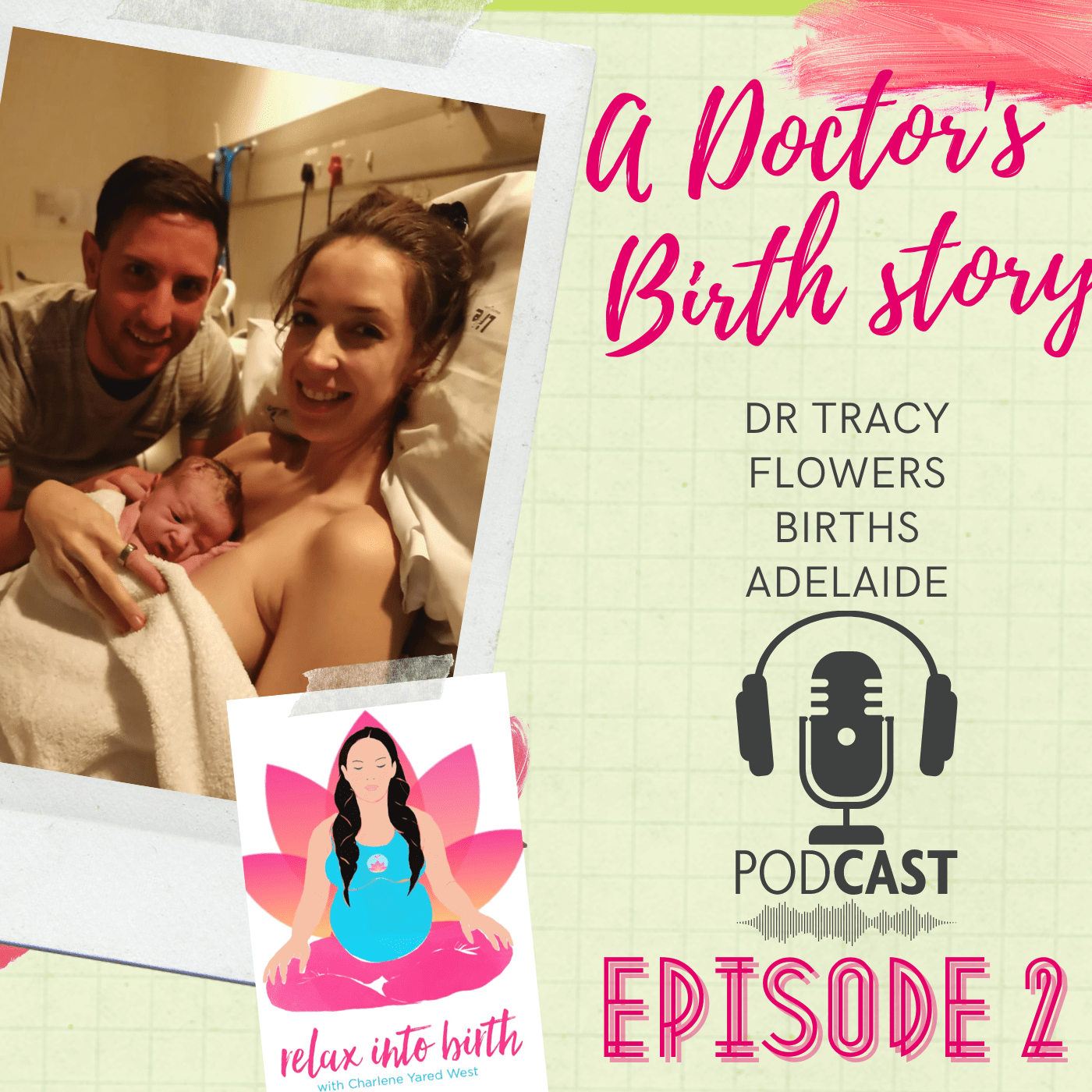
Tracy shares her birth story… Listen to the podcast above, or watch her tell it below.
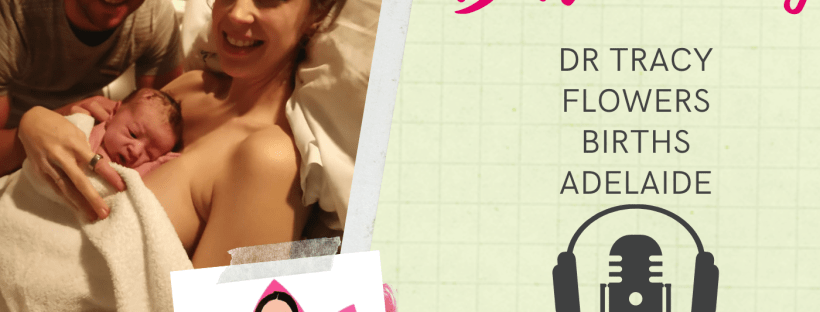
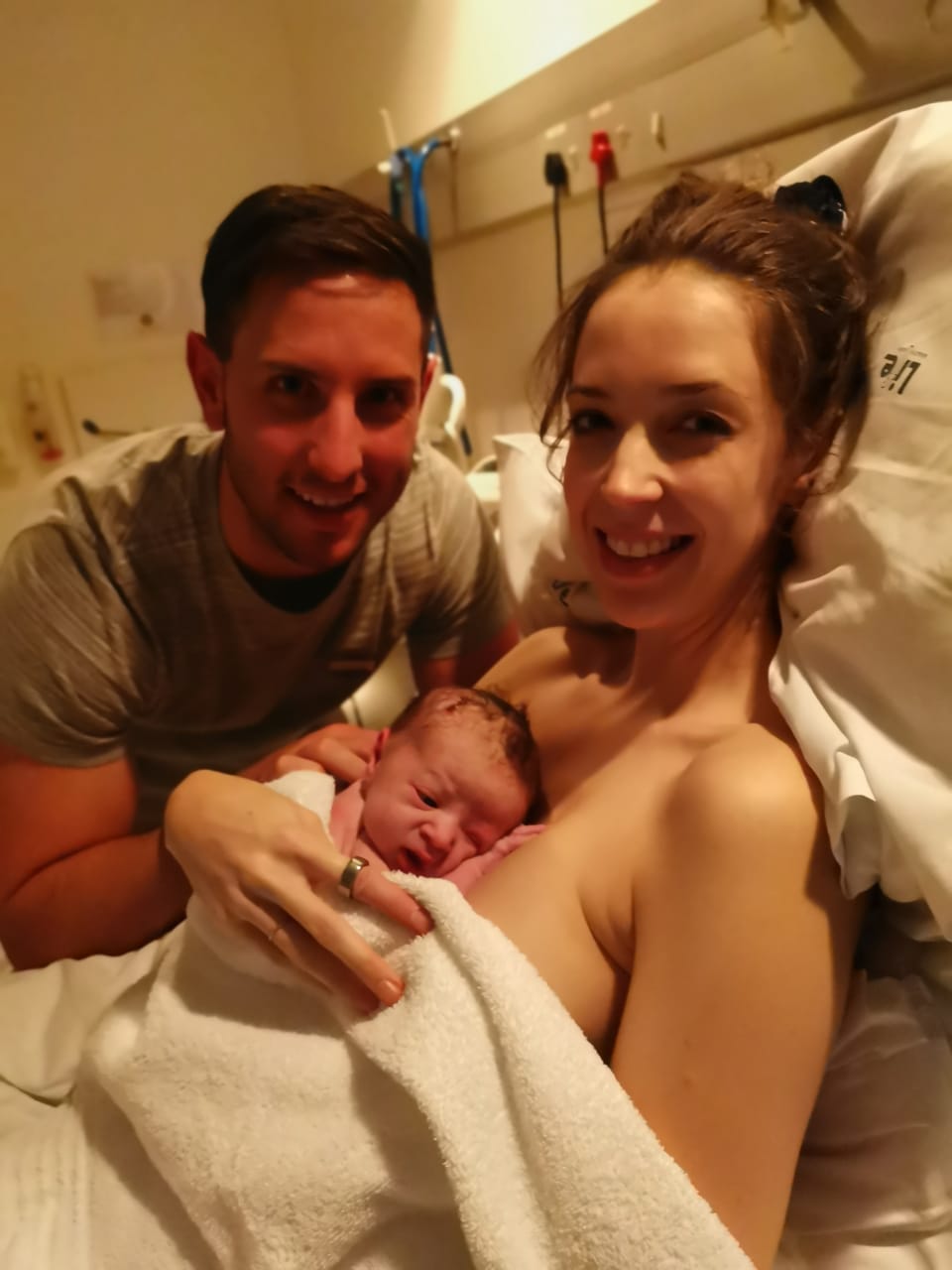
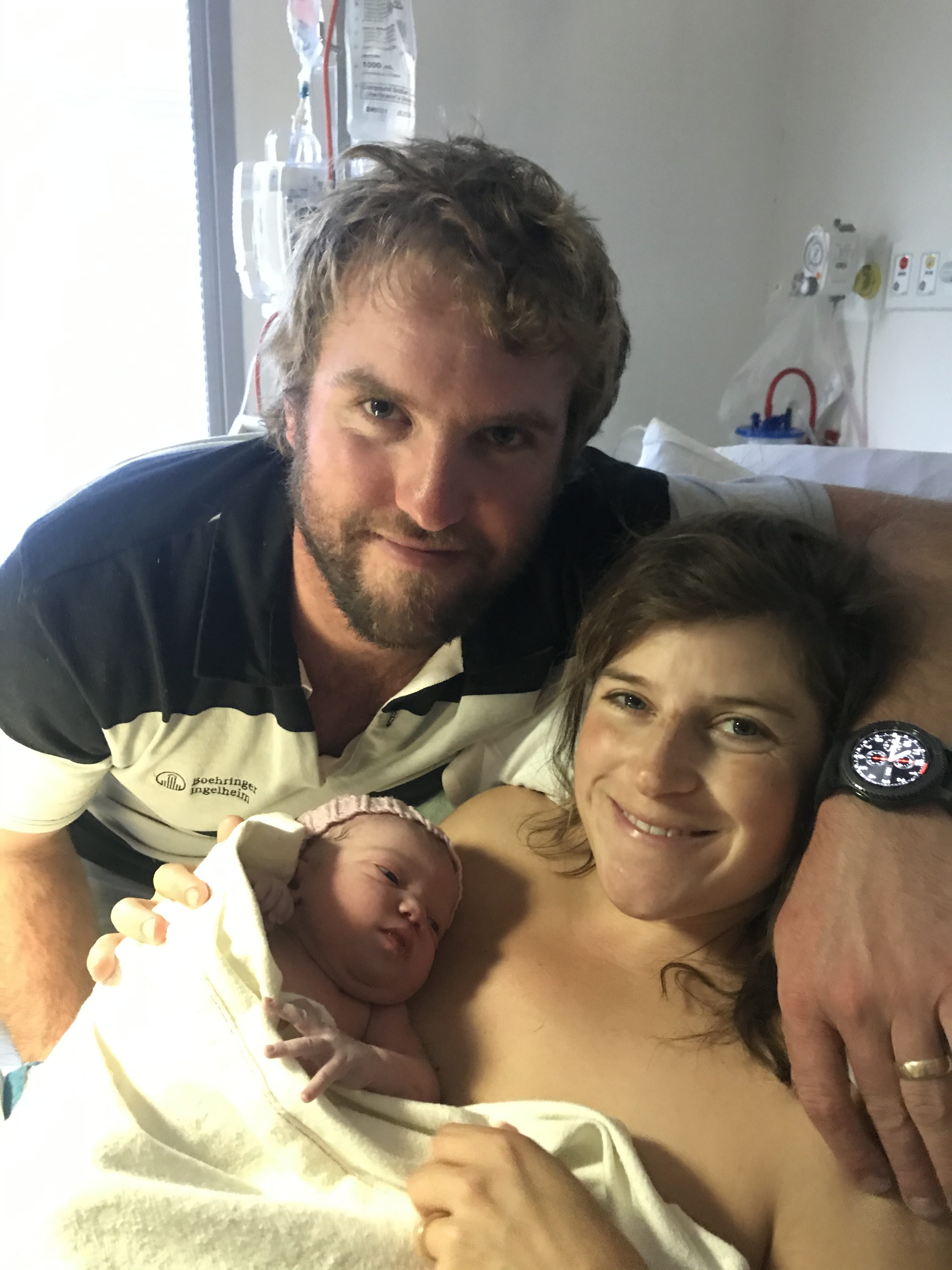
Dr Tracy Flowers (of Médecins Sans Frontières) shares her birth story. Here’s an excerpt… “”As a doctor, I always imagined I would want a caesar, but then I fell pregnant and everything changed. There’s no doubt that the Relax Into Birth course and the preparation really made it such a wonderful event for us. We went into the birth feeling confident, calm and peaceful despite doing all this through Covid-19. Relax Into Birth helped me to normalise birth through daily listening to the hypnobirthing tracks. When I was in labour, I used the tools I had learnt about breathing, relaxation and visualisation, which all helped me keep calm. The surges felt so manageable and the techniques helped us both so much,” says Tracy.
Her husband Ryan Flowers, adds; “As a very inexperienced dad, the course gave me ultimate confidence and preparedness for the birth. I found the partner tracks handy, which helped me know what was to come and I enjoyed learning massage techniques too. I also used the course as a resource I could go back to anytime. Speaking to other dads who hadn’t done the Relax Into Birth course, I realised they had quite a different mindset on birth than me.”
Just how easy is it to stimulate milk supply after stopping or induce lactation as an adoptive mother? Charlene Yared West explores the topic of relactation and induced lactation to find out more.
Firstly, what is relactation?
According to Leana Habeck, La Leche League Leader (llli.org/southafrica), there is a difference between relactation and induced lactation. “Relactation is about re-establishing of milk secretion after weaning baby from the breast,” says Leana. “Adoptive breastfeeding, also called induced lactation in a woman who was not pregnant with the current baby, may involve hormonal preparation (oestrogen and/or progesterone – simulating a pregnancy) followed by sudden cessation of the hormones (simulating a birth) and then the commencement of pumping or suckling and a galactagogue that increases prolactin secretion.” Internationally Board Certified Lactation Consultant, childbirth educator and midwife Emma Numanoglu explains the protocols for inducing lactation, developed by Dr. Jack Newman and Lenore Goldbarb, as involving a regime of taking the contraceptive pill together with domperidone. “A few weeks before the expected arrival of the baby the mother stops taking the pill, continues with domperidone and starts expressing milk (this mimics the process of pregnancy and lactogenesis after birth). This method has been used successfully and safely for three decades by many women who induced lactation,” she says. “A mother who is planning to apply one of the protocols will need to find a doctor who is supportive of breastfeeding, can explain risks and benefits of taking the medication, and is willing to take responsibility for prescribing domperidone in doses that exceed guidelines for licensed use.”
Commitment to breastfeeding is key to success
Relactation, explains Emma, is also an option for those mothers who have have decided to bottlefeed and have then changed their minds and wish to go back to breastfeeding, or even for those mothers whose babies are not tolerating formula well. “In my practise, this is the most common reason for relactation and the reasons are important as it requires quite a commitment from the mother. For example, if the baby is intolerant to the breast milk substitutes being given, the mother may be more committed to resuming breastfeeding,” she says. “It is important not to place emphasis only on her milk as evidence of success, as this can cause anxiety and thereby inhibit her milk production and ejection reflex. For these reasons it is important to discuss with the mother the benefits, the concerns and problematic elements of relactation.” Emma sees the most success in relactation with babies under three months, but older than that is not impossible, it may just take more effort. “Induced or adoptive lactation is becoming more popular. Mostly adopting couples and lesbian couples seek assistance in breastfeeding their adoptive baby.”
The aim is bonding and creating a milk supply
“For both adoptive breastfeeding and relactation, the aim is to bring about (or back) a milk supply and bring the baby back to the breast. These two are interconnected endeavours, as the best thing for a milk supply is to have a baby breastfeeding frequently and a baby is more likely to breastfeed or return to the breast if there is plenty of milk there,” says Leana. “The difference between the two is such that with a natural pregnancy the milk making tissues are built, whereas with adoptive breastfeeding (if a mother has never been pregnant) she may need hormonal preparation. For many adoptive mothers it may be more about connecting deeply with the new baby through breastfeeding, than producing large volumes of breastmilk.” Emma adds that relactation can fail if mothers are not given the correct support and professional advice preferably from an IBCLC or SACLC trained consultant and La Leche League leader. “Success also depends on quite a few other factors, such as the determination of the mother, no underlying medical conditions and the baby’s age.”
How the breasts work
Leana describes the anatomy of the breast as 10 to 20 branches (milk ducts), heavy with clusters of grapes all intimately bound together by interweaving vines and vegetation. Each single grape an alveoli or milk sack where milk is made and each alveoli is surrounded by a basket of muscle cells that squeezes the milk out into the ducts when it contracts. The 10 to 20 branches are all rooted in the nipple, though each nipple has only between four to nine openings through which the milk is excreted. “Baby’s suckling acts as a stimulus to mom’s body – sending a message to the brain to release the milk producing hormones, prolactin and oxytocin into bloodstream,” she says. “Prolactin, released with the Milk Ejection Reflex (MER), acts on the alveoli to produce milk and Oxytocin, released with the MER, acts on the muscle cells around the alveoli causing them to contract and squeeze out the milk towards the nipple.” It is important to note that large amounts of milk are not stored in the ducts before the MER and that the rapid sucking action of the baby stimulates the let down of milk. The most important thing is to ensure a good latch to help the MER during breastfeeding as well as a good breast pump to stimulate the production of milk too.
Methods of relactation
Emma recommends holding your baby skin to skin as often as you can, in a calm relaxed environment such as lying in your bed, in a comfy chair or even carrying them around in a sling at home. Directly feeding your baby from the breast is the most effective way to increase your supply or relactate. Offer your breast to your baby frequently when they are happy! Do not try breastfeeding when your baby is upset or irritated as it will be nearly impossible to latch them on. “This is an extremely important step. Although it sounds so simple, often this is how babies get interested in breastfeeding again.You can start pumping if you find your baby does not want to breastfeed for very long, or is not interested in taking the breast. Since you are trying to build your supply back up or induce lactation again, it is important to pump frequently,” she says. “If you can pump every two to three hours, that would be ideal. At night you can go for longer between pumping but try to get at least one pumping session in per night. When you start pumping you might not get any milk at all or just small amounts, just keep on going! Some women find it takes a couple of months to really get their supply going again, especially if their babies are not breastfeeding or are only occasionally breastfeeding.” She adds that women who have had an extended period of time since breastfeeding might find they do not build up enough of a supply to exclusively breastfeed, but most women will at least be able to partially breastfeed their babies and many women will eventually be able to exclusively breastfeed their babies.
What is a supplemental nursing system?
A nursing supplementer is a device that allows a baby to receive extra milk at the breast rather than by bottle and teat. It consists of a container that is worn on a cord around the mother’s neck. Fine tubing carries expressed breastmilk or artificial baby milk from the container to the nipple. When the baby sucks at the breast, milk is drawn through the tubing into his mouth, along with any milk from the breast. “Most mothers who have problems getting breastfeeding started will solve them without using a breastfeeding supplementer. Often all some mothers need is information and support. Talking the problem over with someone who understands and supports your wish to breastfeed and who knows a lot about breastfeeding can help you work through any problems. Often they will be able to suggest new ideas to try,” says Emma. “Sometimes, you can solve your own problems by learning more about how breastfeeding works. It is important that the baby is able to suck well at the breast, even if he tires easily, in order for the breastfeeding supplementer to work. A baby with a poor or abnormal suck may not be able to get the milk through the tubing any better than from the breast itself.”
I breastfed my adopted babyDanielle Bischoff is a photographer and storyteller and lives and works in Cape Town with her husband comedian, Rob van Vuuren and their six-year-old adopted daughter, Bijou. “Rob and I both have adoption in our families and when falling pregnant became increasingly difficult and a cause of huge distress for us, the doctors said the only option was to go the IVF route. We both felt like we needed to take a breather from the whole thing and put the baby plans aside for a few months. We didn’t want to rush into a whole IVF mission. We felt that we had been through enough of a wringer just trying to figure out what the problem was. So we left it for a while. After a couple of months we both felt that adoption was the best way forward. I can’t describe it in any other way than I just new our baby was coming to us through adoption. I felt a deep connection and I had even chosen her name before our first meeting with our social workers. There was just this indescribable knowing that baby was on the way and I had to get ready. I didn’t even know that inducing lactation was a thing, but I was so determined to make it happen. So you can imagine the relief I had when contacting Internationally Board Certified Lactation Consultant Jean Riddler, who immediately promised she could help me. It was important to me for two reasons, because I didn’t get to experience a pregnancy I felt like I didn’t want to miss out on the experience of breastfeeding. I had also done some reading on all the amazing benefits. Strengthening the bond was a huge reason and because Bijou was adopted I felt like I had some catching up to do as I hadn’t carried her.I started on the birth control pill to mimic a pregnancy. I wasn’t really happy about going on the pill but as I mentioned before I was pretty determined about it. Once we got the news that a birth mother had chosen us and we had Bijou’s due date, we sped up the process by taking the vomidom (domperidone) and using a double breast pump to stimulate the breasts. This was honestly the hardest part of the whole business. There were moments while sitting there with pumps on my breasts with nothing happening where I really questioned my sanity. Anyway just over a week later the milk started coming out! I was totally amazed and in awe of the human body. I wasn’t able to produce enough milk to purely breastfeed which I was initially quite sad about, but after sometime I was just grateful for the opportunity. I soon realized that being able share the feeding duties with my husband was beneficial for all of us. So in the end we mainly bottle fed her and did top ups with breast milk. I breastfed Bijou until she was about two-years-old. It was a bit of a roller coaster ride to be honest. I felt emotions that I didn’t know I would have. The feelings of inadequacy I felt when I realized that I wasn’t able to purely breastfeed did overwhelm me. I felt like I had let her down and how could I be a mother if I couldn’t feed her. Obviously in retrospect I realize how irrational all that thinking was. Luckily my husband was there to help me through all that. It was totally worth every second on my mothering journey with my precious daughter.”
<Sidebar> PATIENCE AND PERSEVERANCE!Many women who keep persevering and gently encourage their babies to breastfeed while doing heaps of skin to skin with their babies do get results, says Emma. “Don’t give up. It just takes a lot of patience, perseverance and time. It will not happen overnight. Support helps too and is very important. Ask for help with cleaning, laundry, cooking and other household chores, while you focus on just being with your baby. Rest and just “hang out” with your baby.”
<Sidebar>Amazing motherhood hormonesAt every stage of motherhood there are hormones present to facilitate the changes taking place. In addition to a very long list of natural ingredients, breastmilk also contains the following amazing hormones: Prolactin is the hormone of milk production. The suckling newborn increases prolactin levels which physically works in creating more milk, and emotionally, prolactin encourages the mothering instinct of nurturing and selfless devotion to the baby’s health and well being. Oxytocin is known as a shy hormone and is present in orgasm, labour, birth and breastfeeding and causes the Milk Ejection Reflex (MER). Emotionally it is a bonding hormone, also known as the love hormone because it occurs at intimate, private moments of family bonding and love. Physically it is a contracting hormone and as such contracts the uterus in orgasm, facilitates contractions in labour and birth and allows for the milk let down as the milk ducts are contracted and squeezed to allow for milk to flow. Endorphins are the body’s own natural painkiller and can create euphoria and are released during sex and breastfeeding.
<Sidebar> A word on galactagoguesGalactogogues are medications or other substances believed to assist initiation, maintenance, or augmentation of the rate of maternal milk production. Human milk production is a complex physiologic process involving physical and emotional factors and the interaction of multiple hormones, the most important of which is believed to be prolactin, explains Leana. “One should caution against inappropriately recommended galactogogues prior to emphasizing the primary means of increasing the overall rate of milk synthesis, such as frequent feeding and regular draining of the breasts.”A galactagogue may be helpful to speed up the process but are not magic bullets, she adds. They provide building blocks for milk production but effective removal of milk is essential since milk supply seem to be calibrated based on how well the breasts are drained. “If baby is not breastfeeding (well) yet, it is advisable to double pump with a good quality electric pump using the hands-on method.” According to Leana, the currently available pharmaceutical galactogogues are all dopamine antagonists and will increase prolactin levels. Herbal remedies have been used throughout history to enhance milk supply. Some herbs mentioned as galactogogues include fenugreek, goat’s rue, milk thistle (Silybum marianum), oats, dandelion, millet, seaweed, anise, basil, blessed thistle, fennel seeds, marshmallow, and many others. “Although beer is used in some cultures, alcohol may actually reduce milk production. A barley component of beer (even non-alcoholic beer) can increase prolactin secretion, but there is no hard evidence supporting this,” she says. “Mothers wanting to make use of a galactogogues should contact their doctor for a prescription since La Leche League Leaders or International Board Certified Lactation Consultants are not allowed to prescribe any medication be it natural or pharmacological.” Emma points out the most important thing to remember is that an herbal or prescribed galactogogue will only work if you take it while actively trying to build your supply at the same time. “You will not see an increase if you do nothing but take a galactogogue.You should only take a galactogogue if your doctor is in agreement and all side effects and contraindications have been discussed,” she says.
The birth plan: a tool pioneered by childbirth activist and midwife, Sheila Kitzinger in the 1970s, who believed that women and not their caregivers, should be the focus of childbirth and be able to advocate for themselves with this document, which detailed their wishes for the delivery. In the wake of birth plans, the Better Births Initiative was formulated as a way of educating caregivers on the general care of women in labour. The initiative was also rolled out in South Africa and expected to be adopted by all hospitals by 2015. Amongst the guidelines, it encourages respect, privacy and companionship for women in labour, pointing out that women should be able to labour and birth in whatever position they feel most comfortable, with as many birth companions as they choose to have. By Charlene Yared West.
Birth plans inform and educate
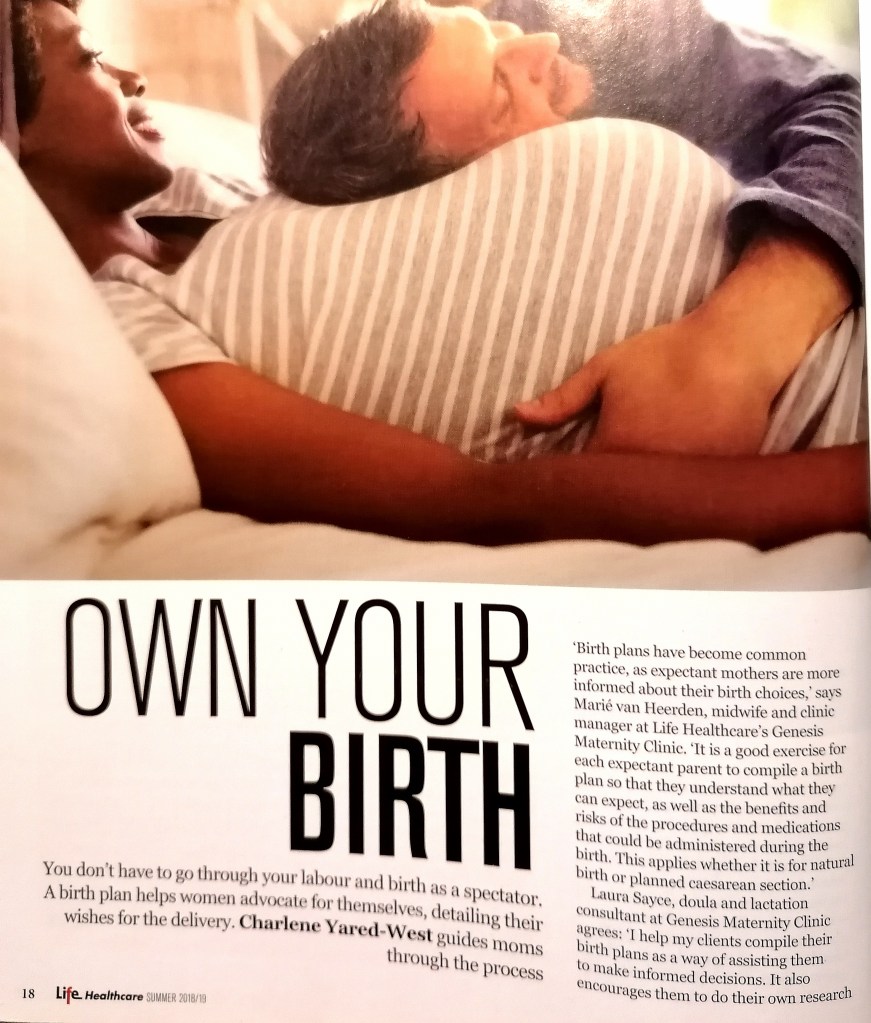
“Birth plans have become common practice now, as expectant mothers are more informed about their birth choices,” says Marié van Heerden, midwife and hospital manager at Genesis Maternity Clinic. “It is a good exercise for each expectant parent to inform themselves of their options through compiling a birth plan, so that they understand what they can expect, as well as benefit and risk of procedures and medication – and know where they can make certain choices. This applies to any type of birth, whether it is for a natural or planned caesarean section.” Laura Sayce, doula and lactation consultant at Genesis agrees; “I help my clients to compile their birth plans as a way of helping them make informed decisions. It also encourages them to do their own research into each element of the birth and then to make choices based on this information.”
What should a birth plan include?
According to a research paper Birth Plans, the good, the bad and the future by J.Lothian (2006), the focus of birth plans should be to answer three patient-focused questions: What will I do to stay confident and feel safe? What will I do to find comfort in response to my contractions? Who will support me through labour, and what will I need from them? “I encourage all my patients to write out their birth preferences and to make copies of it, one of which is placed into their file at the hospital and extra copies for the hospital midwife on duty for the day they go into labour,” says Dr Sean Drew, gynaecologist-obstetrician at Life Hilton Hospital. “It helps everyone onto the same page about what the parent’s intentions are for the birth, but it must also leave room for what happens in the event of having to resort to ‘plan b’ option, which is often not detailed in the plan, but should be.” Dr Drew explains that as medical professionals, their first obligation is to the safe and healthy delivery of baby and mother. “First we want to ensure life, then we can look at incorporating all the ‘quality of life’ elements from the birth plan. This is not to say we don’t observe what is written in the document. It is quite the opposite. We do try to fulfil the mother’s wishes to the best of our ability, within our scope of practice.”
Most important birth plan elements
Life Hospitals aim to work in an evidence-based way. Sister van Heerden points out that it is helpful to speak to your care provider and to do a hospital tour, so that you have a clearer insight into how the births are conducted at the hospital you have selected to birth at. “Once you have done that, you are ready to write your birth plan. There are so many templates on the internet, but here are some important factors to include,”:
Labour and birth: freedom to eat and drink in labour, play music, dance, make labour sounds without inhibition, use aromatherapy oils (safe for labour and birth), have freedom to move into any position and birth in any position on the floor, or the bath or the bed. A mother should be allowed access to a doula or birth companion of her choice, who will provide non-medical pain relief options, including hypnobirthing, massage and general encouragement. Delayed cord clamping after the baby has emerged to allow for all the baby’s blood to be drained from the placenta to the baby.
First hour: Uninterrupted, immediate skin-to-skin contact with the mother or the father (if the mom is unable to). Assistance with the first latch if requested, otherwise the baby should be allowed time to attempt a breast crawl. Weighing and measuring to be done after the first hour of bonding for the family. No separation of mother and baby unless absolutely medically necessary.
Postnatal: Rooming in with your baby, no formula unless there is informed consent of the mother, provision of pain relief if medically necessary and assistance with breastfeeding.
Plan B: In the event of an unexpected caesarean, there are still choices. The mother can request immediate skin-to-skin with the baby in the theatre after the initial checks by the paediatrician and no separation unless medically necessary. Early initiation and assistance with the first latch. If the baby has to go to the neonatal ICU, then the father may accompany the baby.
What are the roles of each of the professionals present at a birth?
Obstetrician-Gynaecologist: A medical doctor who is the primary caregiver for your birth and there to deliver the baby when it is time to push the baby out. He/She may also conduct vaginal examinations during labour, but this is more often performed by the hospital midwife on duty. It is also the role of the doctor to perform the caesarean sections either scheduled or emergency.
Hospital Midwife: The hospital midwife performs nursing duties during labour and ensures the medical needs of mother and baby are taken care of by checking foetal heart rate, mother’s well being,blood pressure and other medical checks. She/he may also conduct the vaginal examinations, under the instruction of the primary caregiver, the doctor. In private hospitals in South Africa, the baby is delivered by the doctor and not by the midwife, unless the baby is born before the doctor’s arrival at the birth. The midwives at Life Healthcare hospitals are however trained to conduct normal deliveries. In government hospitals, the hospital midwives are permitted to conduct deliveries.
Independent Midwife: She/he fulfils the same role as the hospital midwife, but may also deliver the baby and call on the obstetrician-gynaecologist in the event of an emergency. Independent midwives may also conduct homebirths, hospital births on low risk pregnant women, with confirmation and back up of a supporting gynaecologist-obstetricians.
Doula: A doula is employed privately by the parents themselves and works independently of the hospital. She is non-medical and is there for the mother’s physical and emotional support throughout the labour process. She may not advocate on the mother’s behalf to her caregivers. Research supports the use of a doula for a more empowered and positive birth experience, no matter what turn the birth takes, whether the baby is born vaginally or abdominally.
Anaesthetist: The anaesthetist is called in if the mother requests an epidural during labour and is also there for caesarean births to administer the spinal block and for ensuring adequate pain relief after the caesarean.
Paediatrician: The paediatrician is called in after natural births to check on the wellbeing of the baby. They are also present during caesarean sections to ensure the health of the baby.
Lactation consultant: Although the mother receives breastfeeding advice and assistance from the midwives in the maternity unit of the hospital, a lactation consultant is extremely helpful to ensure long-term breastfeeding success.
Hailing from New Zealand, I had never met Pip in person, but she was referred to the Relax Into Birth Hypnobirthing course by a dear South African friend of hers, who had also completed the course a few years earlier. She was so excited to share her story with me after she had given birth, because the techniques had been so helpful. Here is her letter to me after her birth.
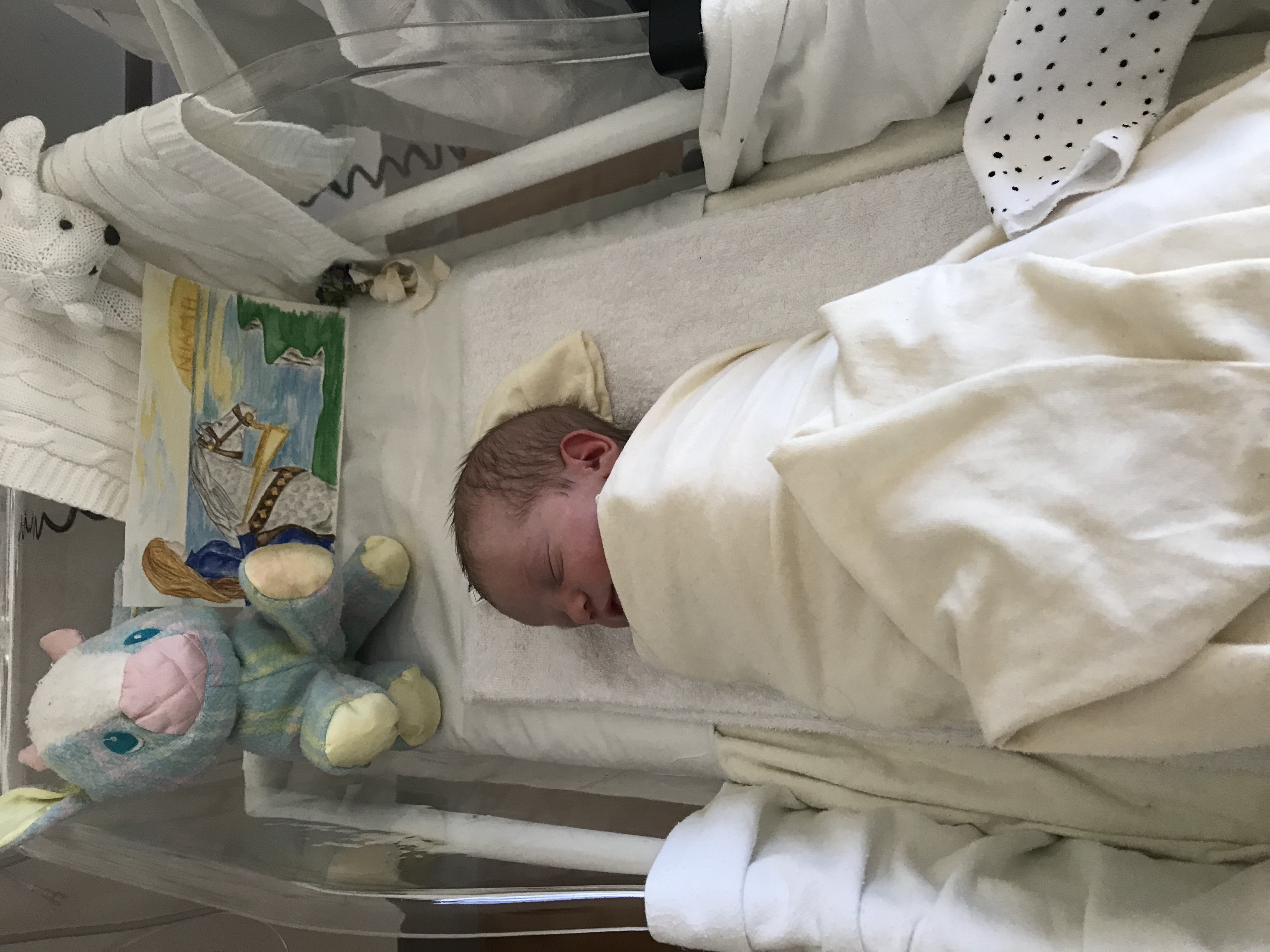
Dear Charlene, I just wanted to give you an update on how I have been doing and let you know our little baby girl “Niamh” arrived safely with us in hospital at 10.07am on the 8th May 2020 at 6 Ib 15 oz and we are all doing great! I am sorry I haven’t been in contact sooner – I just wanted to sit down when I had some time to fill you in properly. I have emailed you because if I sent you a voice over on whats app I would be in tears!
Just to give you some background on myself, I had extreme anxiety about labour for as long as I can remember and this soon got worse when I became pregnant. To give you an example I had previously passed out from getting cervical smears done and I am just not good with that kind of stuff! – ironic really considering I am a horse vet!
You couldn’t have come at a better time for me as the anxiety was getting the better of me as time progressed. I remember around 26 weeks in tears at my midwife appointment feeling completely overwhelmed and not knowing what to expect. I spoke to my dear friend Felicity Meek who put me in touch with you. As soon as I started listening to your affirmations and then doing your course from around 33 weeks my mind set started to change and I began to relax ! Your course allowed me to understand the process but in a way that wasn’t scary but beautiful, something to look forward and that my body was going to do it! I had no idea how powerful hypnobirthing could be but it was the best thing I could have done to prepare myself ! I can not thank you enough Charlene – you are incredible and what an amazing birthing experience you and your course have given me.
Now for the gorey details………… well there aren’t any! Haha! I went into latent labour on the 4th May ( my due date) with mild contractions every 10-20 mins for about 20 seconds in length on / off through to the 7th May when the contractions gradually got stronger and longer. I had a “Show” over this time too which I admit did freak me out a bit but I had your voice saying “Show time!” in my head which helped to ground me and stop me panicking. I laboured at home for as long as possible and made a wonderful area in my sitting room with candles, diffuser with lavender oil, exercise ball, cushions, fairy lights etc …. with my husband, 2 dogs and my favourite movies on.
It was really beautiful and my husband was absolutely amazing using some of your massage techniques on my lower back and making sure I was eating/drinking. I used a water colour painting of a lotus flower to remember your affirmations and a colour card to look at to help me focus on the rainbow breathing technique. During contractions I would also think about your lovely knitted uterus which helped me visualise and understand what mine was doing!
By the 7th May from 6pm the contractions got stronger and lasted longer until I was getting contractions every 3-4 minutes lasting a minute by midnight – I was in/out of the bath at this point which helped a lot.
We made our way to the hospital at this point and got screened at the entrance for COVID-19. We entered the maternity ward and the corridors were lined with pastel balloons and fairy lights which was wonderful! I was examined (I was apprehensive about the examination) and found to be 8 cm dilated. My waters broke at this point – I was delighted thinking ” not long to go now!”
I went into a bath and my husband and midwife set up some led candles and my affirmation cards. I stayed in the bath from about 2 am to 6 am . I was examined a few times and found to be 10 cm by 4 am but my contractions started to get weaker and further apart. I got out of the bath and tried sitting on a squatting stool but that didn’t really bring things on.
Up to this point everything was 100 % perfect but I started to feel anxious and willing for more intense contractions! I was examined by an Obstetrician at 6.30 am – he was astounded that I had no pain relief and I remember the midwife saying proudly “she’s using hypnobirthing!” The obstetrician confirmed with the midwife that all was well with baby and there was no reason why she shouldn’t come through my pelvis.
It was discussed with me to go on a Pitocin drip to get contractions going. My platelets were low so it was not recommended to have an epidural, but I remember feeling so exhausted and the thought of pain relief sounded good! Your affirmations grounded me through this process and helped me focus and I just continued to breath, eyes closed and I just went into myself. Once the drip was in and monitor put on baby head I was allowed go on 4’s on the bed. The contractions came – I took gas as I found them heaps stronger than my own ones but I could tell we were making great progress. I remember feeling my baby head turn and pop through my cervix. An incredibly visceral and alive feeling I had – I think I shouted out “Fecking hell!!!” and “How close are we now?”
Then I felt the wee burn feeling and I remember thinking “We are nearly there!” My midwife got me on my back at this point, one of my legs was wrapped around her neck. I couldn’t believe how much pushing I had to do along with the contractions. She got me to really push with my breath. At this point I remember taps going on and her telling me try not to push at the moment. She was putting hot flannels on me. Then the last contraction came and she warned me she may give me an episiotomy (I didn’t care at that point !) but she didn’t have to in the end and Niamh’s head came out followed shortly by the rest of her and up she went onto my chest – total magic!!!
My husband Josh cut the cord and she stayed on my chest for an hour. I got a small superficial tear that was stitched (about an inch or so long), but that was it. I passed the afterbirth and I remember the umbilical cord some how slid up between my bum cheeks and I said “Guys – the cord is giving me a wedgey!” , then I proceeded to wiggle around on the bed trying to pull it out.
I walked out of the delivery room an hour later feeling completely elated and so proud of myself. I had a beautiful and empowering birth experience and when one of my fears of having interventions occurred I was able to process and deal with it thanks to you and your course.
So Charlene, I can not thank you enough. Every first time mum should be doing this as it has honestly helped me beyond belief. I really think it should be offered to all expectant mums at their first midwife/doctors appointment. A huge thank you from the bottom of my heart. Love from Pip.
Want to find out more about Relax Into Birth Hypnobirthing? Enjoy a more comfortable, empowered birth and click below to enroll and find out more. Relax Into Birth is an Online Birth Preparation Course, of international standard, teaching women and their partners Hypnobirthing techniques and deep relaxation methods for a more comfortable and manageable birth experience at home or at hospital, for natural or caeasarean birth.
It was my honour to walk beside Aimee and Ryan for the birth of their baby girl Kenzy. Here is their story…
When I think back on my “Birth Day” it was nowhere near what I expected, despite all my reading and “scenario-planning.” And to be honest, I wasn’t convinced I needed a doula in the beginning. I went to the Relax into Birth workshop which was incredible and empowering. Then I listened to the tracks every single day, and after a month I’d realized something. Not only did I now want a doula, but I only wanted Charlene. I couldn’t actually imagine giving birth without her there. I didn’t know my water had broken on Saturday. It just felt like I’d wet my pants. On Monday a confirmation call for Tuesday’s gynae appointment became the green light to come into hospital *with my bags*… There was some urgency as it had been almost 40 hours since the water breaking and I hadn’t experienced any contractions. But the phone call was pleasant and relaxed; and when I hung up I had a little joyful cry and some reflective me-time while I waited for Ryan to come home.At the hospital, a litmus test for amniotic fluid was positive and the gynae started a Propess induction immediately. (According to my Birth Plan, I hadn’t wanted to be induced, but by then it had been 45 hours since my waters had broken, and I was completely at peace with it). I was told it would take a while, and we could just relax! Great! The baby would be coming that night or in the early hours of the morning (it was only 2pm at that point). We were excited, joyful, “floating”! So we started sending some messages to the family and we told Charlene that she could come in after the traffic died down.
Half an hour later, I was in agony and I couldn’t bear to lie down on my back. The baby’s heart rate was high. She was in distress – fetal tachycardia. The Propess was removed and I needed to have an emergency caesarean. My gynae was so kind, gentle and professional. She knew I had wanted to have a vaginal delivery, but we talked through the situation and I felt like we were always on the same page. Physically, it was agony, but emotionally I felt cared for and respected. I even felt quite content about going in for the surgery, knowing that my baby needed it. (We learned later, during the surgery, that it was all because her umbilical cord was wrapped around her neck twice. I am so glad I trusted my doctor.)
Then it was a whirlwind to get prepped for surgery. Even though our time schedule had changed drastically, I was mostly just feeling excited to meet my baby. Charlene arrived just in time! I was relieved to hear her voice: the same calming voice I’d been listening to every day. She put on some beautiful music and came to massage my shoulders, which was just what I needed then because I started to really feel a lot of pain. It felt like I was being bullied internally, my organs being pushed and pulled. Tears were rolling down my face and I could hear myself groaning with every surgical touch. The pain was too much and I agreed to a general anesthetic. I know I was hyperventilating, but I felt Charlene’s firm grip around my shoulders and chest guiding me to breathe slowly while the gas was administered. Despite the intensity of it all, I felt safe. I closed my eyes and woke up to see my beautiful healthy baby 45 minutes later.
Five months later I filled in that missing 45 minutes. Charlene had captured the whole birth on video on my husband’s phone! It was such a gift.
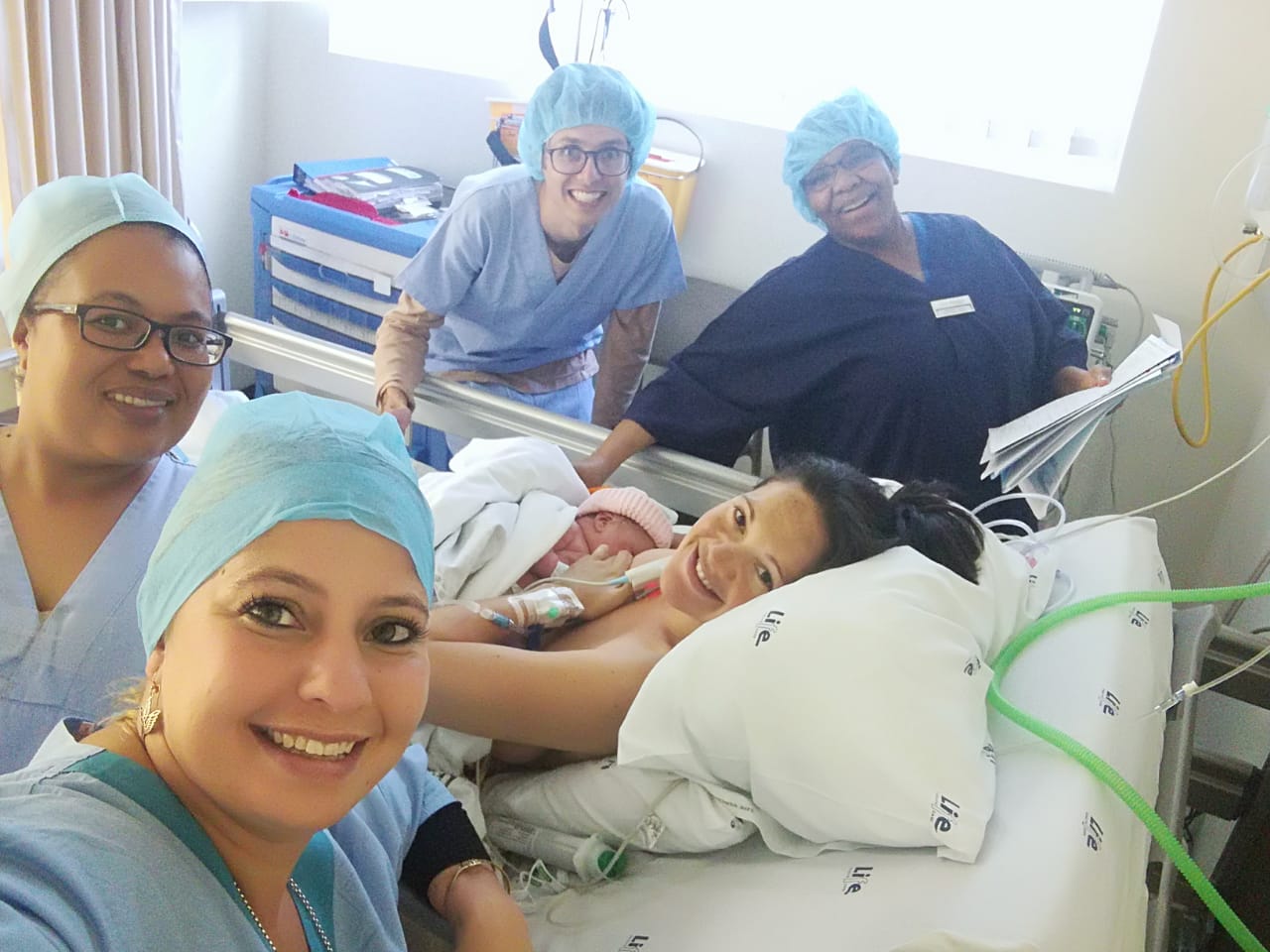
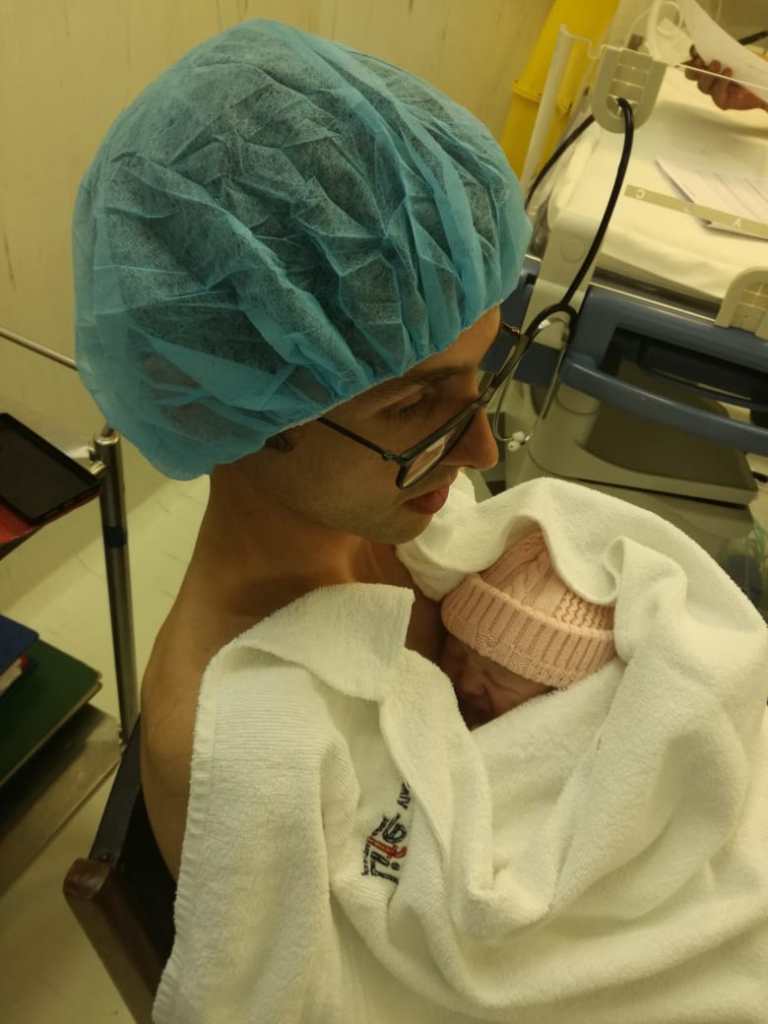
Ryan and I hadn’t spoken through the “sedated-scenario” and by that stage he was quite traumatised by my pain. He was so worried about me that he didn’t even watch the birth; he just held my hand and kept watch over me. When Kenzy was born, he didn’t know what to do or expect. (And that was exactly why I had wanted a doula: Someone to be a guide for us both, to be on our “new parents” team, our coach.) Ryan was particularly grateful to Charlene for talking him through those first moments of our daughter’s life. A funny moment comes up in the video where we hear Charlene saying “take off your shirt” and Ryan looks so surpised! He thinks she’s joking. But because he listens, the nurse brings Kenzy to put on Dad’s chest right away for skin-to-skin. I bet she didn’t expect to get a mouth full of hair while looking for her first drink! He really cherishes that time he got to share with his daughter.
Ryan bonding with his baby girl for the first time
It was an unexpected arrival in most ways, but I am so grateful I was prepared for every surprise step. I praise the Lord for modern medicine and how swiftly and professionally the whole team worked!
I was when I found out I was pregnant… I wanted a caesarean! I was so terrified of even the thought of birth. Then I educated myself, learnt the Hypnobirthing technique and then had a home waterbirth. I’m now a doula and teach Relax Into Birth and my whole life has changed since the birth of my son… His birth taught me so much; that my body is amazing, that women don’t have to fear birth, that women have options and should know about their options, that because I was now empowered I had to share that with others. Even though birth is the most intense thing you will ever endure – and will push you out of your comfort zone, YOU can do it. It is worth a try…. You never know until you’ve tried. Leave no room for questions or regret afterwards… Choose a Midwife, get a considerate pro-options/pronatural gynae and a doula and then if a Caesar is called at the end of it all you know it was a necessary one. 😘😘
It’s essential you choose your birth team with utmost care, empowering yourself with information, educating yourself on the birth landscape you find yourself in.
You don’t get to do it all over again. You don’t get a retake… You only get to do this birth once, so that even if it ends up in a caesarean section, you will have peace in your heart, because you know you tried and exhausted all avenues.
I wish you joy and a sense of empowerment and confidence as you prepare to meet your baby!
Check out http://www.relaxintobirth.com for more info on doula care, pre and postnatal pampering, products and the Relax Into Birth course, which includes Hypnobirthing techniques for labour and birth and caesarean section.
The power of each surge Flows through me Like water. Washing off my skin, Taking my breath away, Bringing forth life… And Opening me up. Stripping away the layers and layers Of holding back I leave my body Surrendering and merging with my baby’s soul Hovering around me. Come my love I say… It’s time. Let’s emerge together…
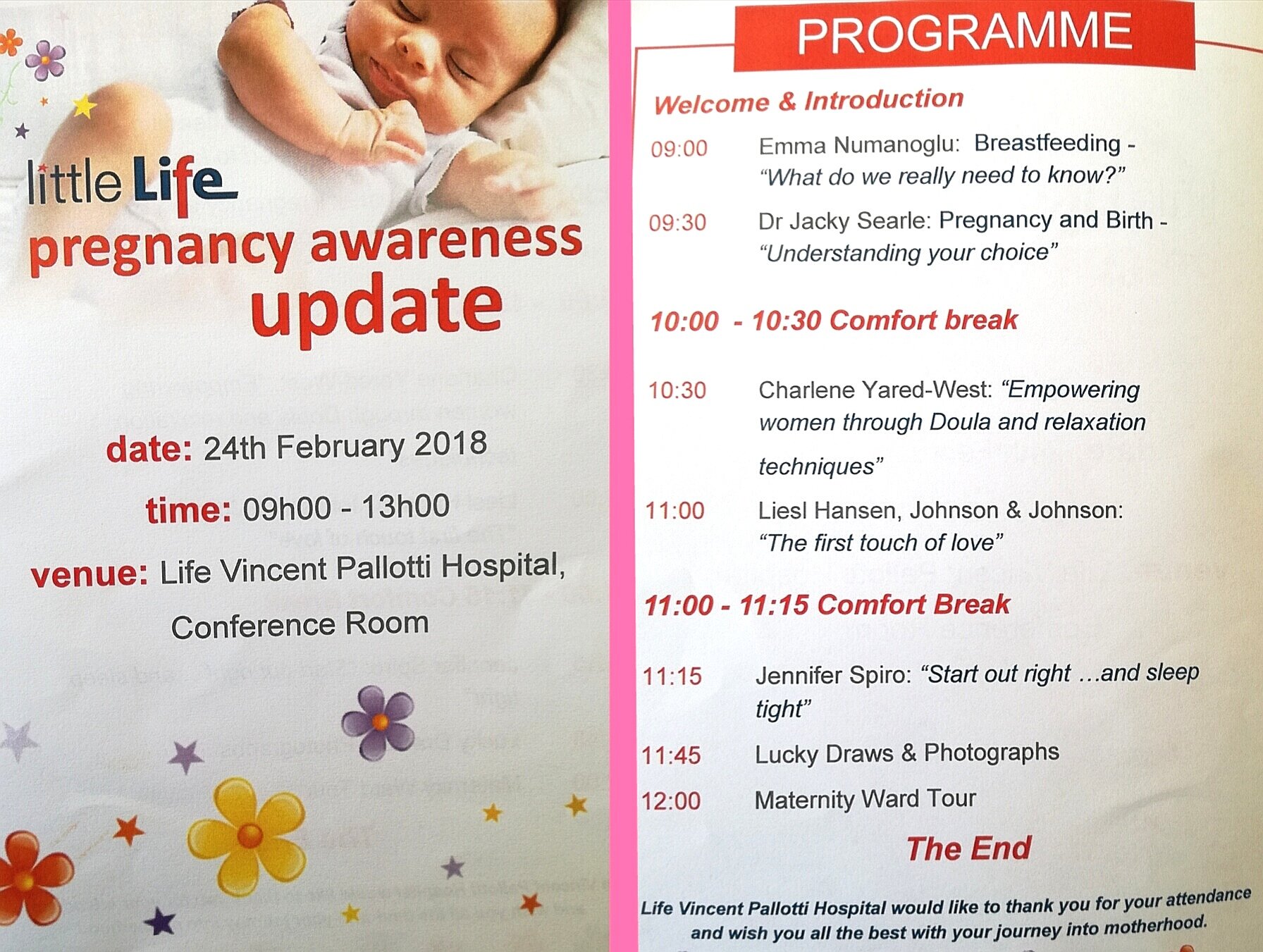
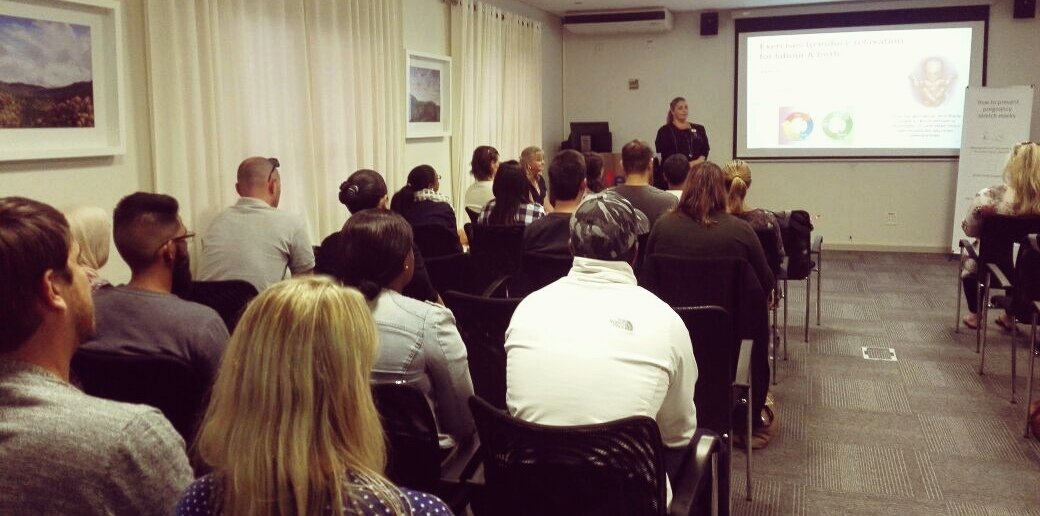
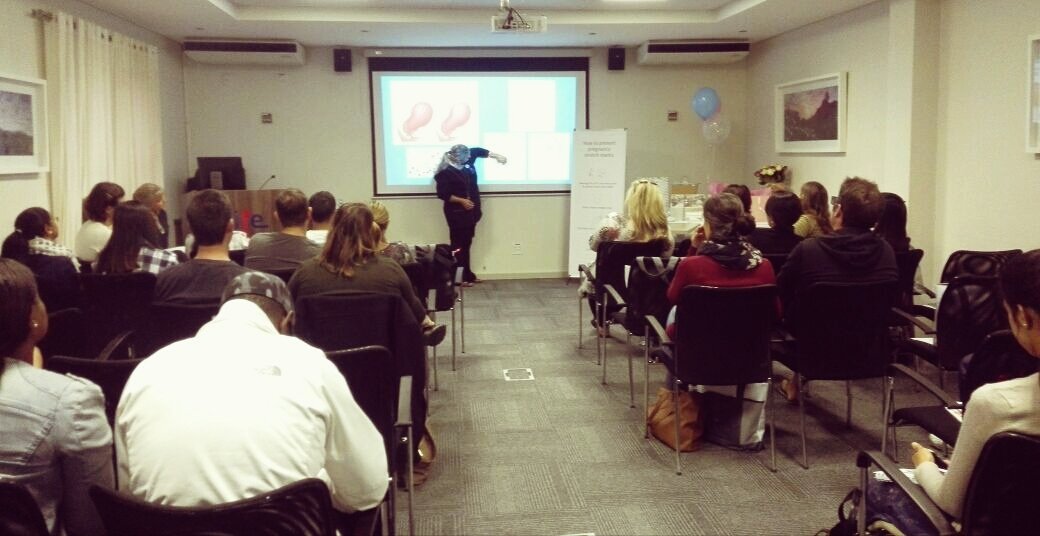
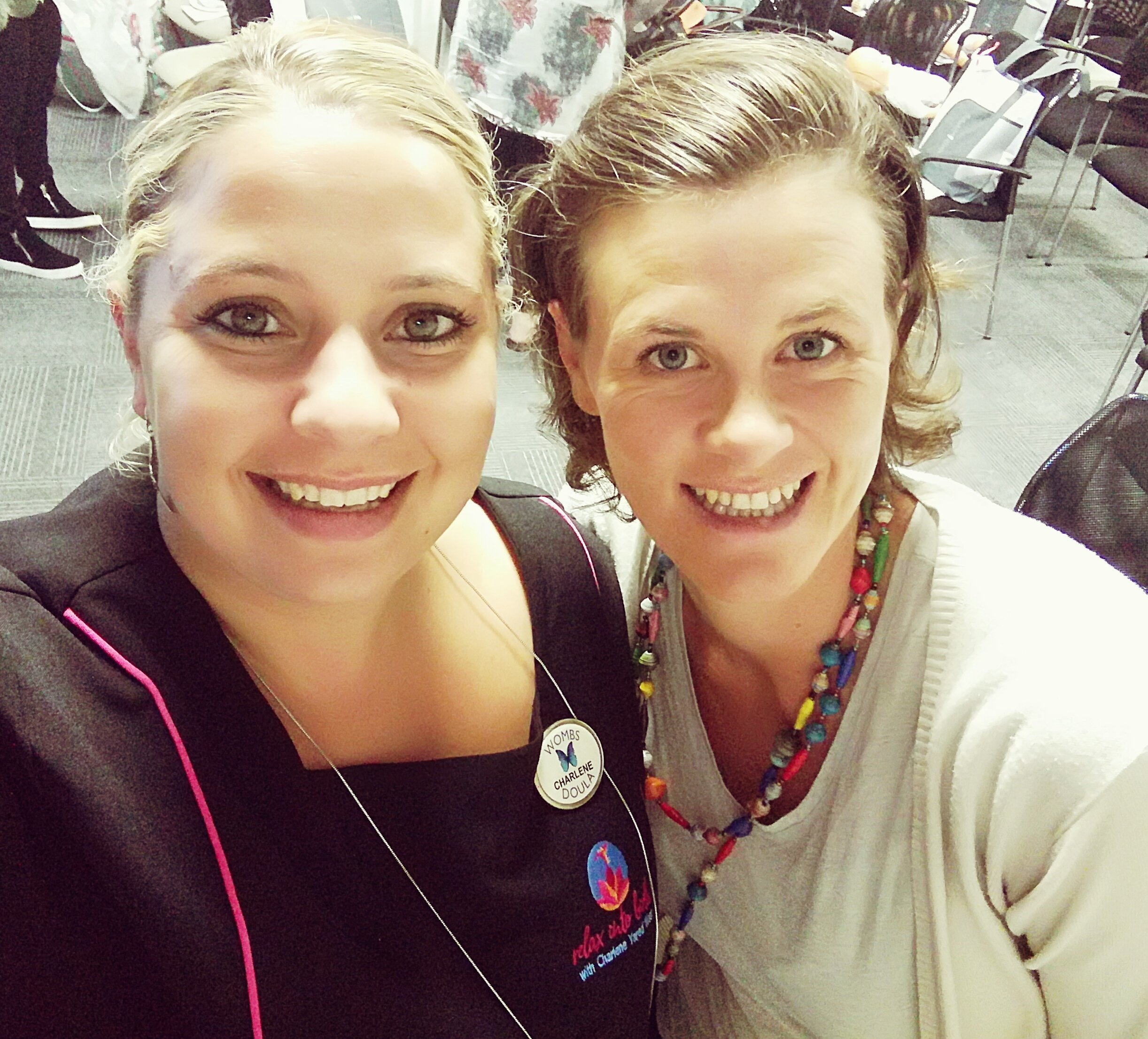
Pregnancy Awareness Week takes place annually and this year’s theme was about empowering parents for their journey to birth. I was there representing Relax Into Birth, talking about doula care and relaxation techniques. Many thanks to Sister Lindsay Donnachie, Carline and Vaughanine for arranging such an inspiring event.
Sister Lindsay Donnachie opening the day’s Pregnancy Event.
Sister Donnachie reminded women about their invisible bejeweled crowns on their heads and that no matter how their births turned out – or what turn they took, natural or caesarean, that they would still, no matter what, be the queen of their own births. She emphasised that what really mattered was how the mother viewed her birth and that in order to have a positive experience, she needed to empower herself with information and to know her options. She welcomed all attendees and speakers to the event.
Sister Donnachie reminding mothers to wear their invisible crowns.
Sister Emma Numanoglu of Breastfeeding Matters was first up and is a lactation consultant extraordinairre. Her talk focused on debunking myths around the subject of breastfeeding. Emma’s heart and soul is in her teaching and consulting and those who have been touched by her kindness can attest to that. Nothing is too big or too small – Emma will help you! Did you know that you don’t have to cut out any major food groups while breastfeeding? You don’t have to go gluten free or dairy free (unless medically indicated)! And, did you know there is science behind the use of cabbage leaves for sore, engorged breasts? Also that Jungle Juice is not helpful for anything except a sugar overload and does not help with supply issues… only a good latch can ensure that baby is getting milk… and milk being extracted from the breast helps to increase milk supply. Emma shared these titbits with us and more…
Sister Emma Numanoglu presenting a breastfeeding talk.
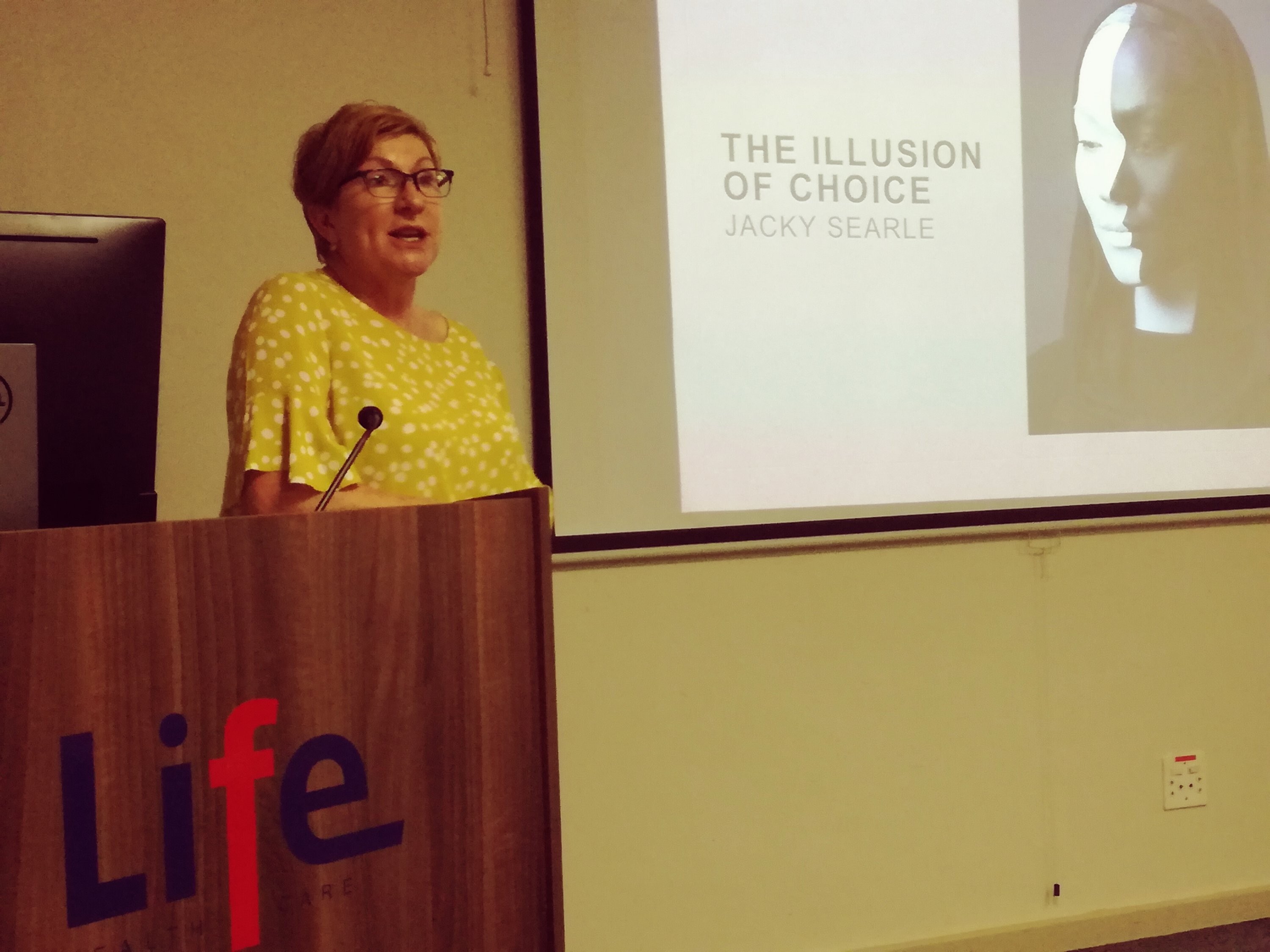
Next up was Dr Jacky Searle. One of the most gentle, aware and intuitive doctors in Cape Town, her talk focused on choice and birth. She made attendees aware of the choices available in pregnancy and birth and how to navigate the landscape of those choices in Cape Town and within the limitations of medical aids. Practical and always so encouraging, Dr Searle empowers women daily in her work life and beyond. Births with this fine doctor are always Beautiful.
Dr Jacky Searle presenting a talk on choices in the birthing landscape.
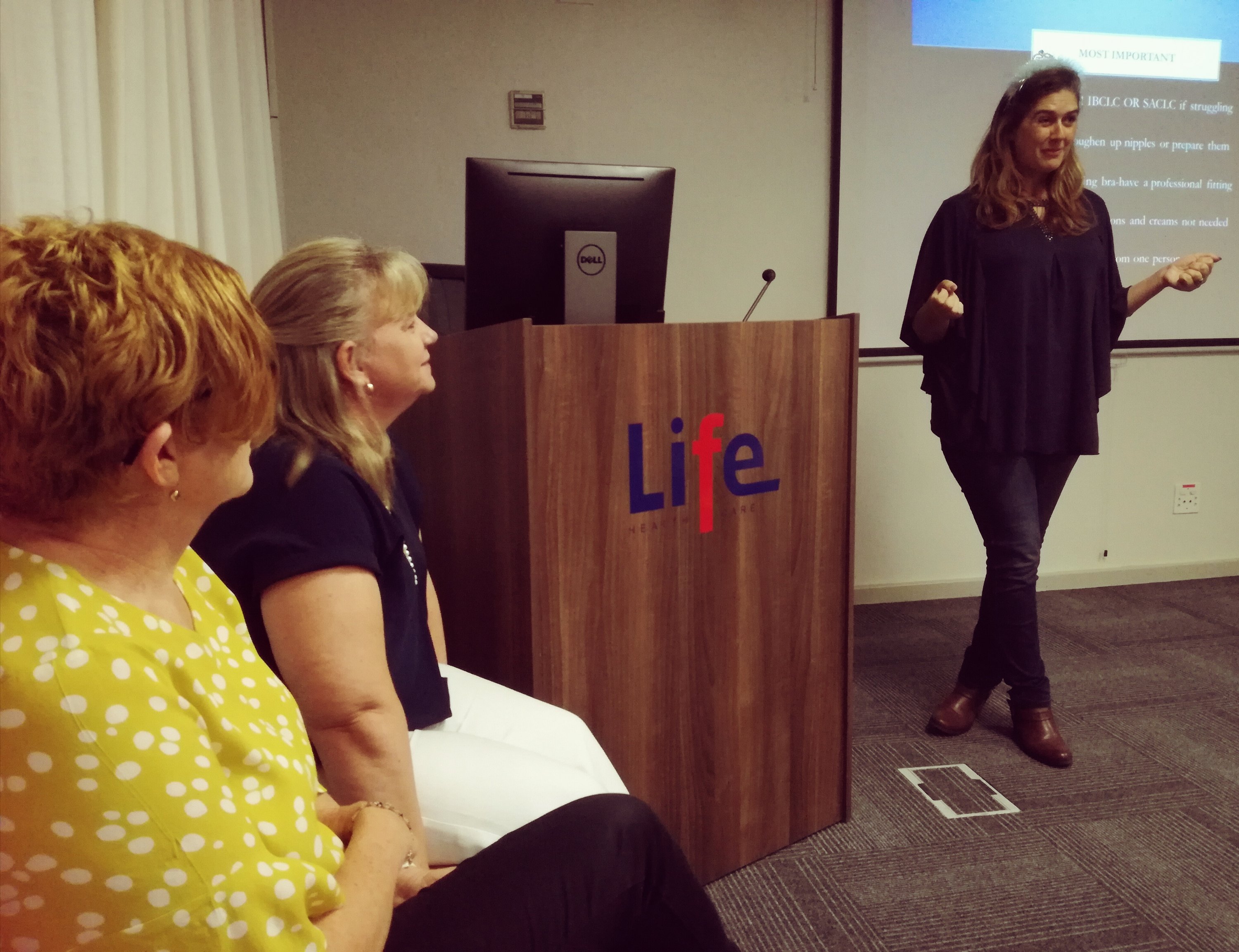
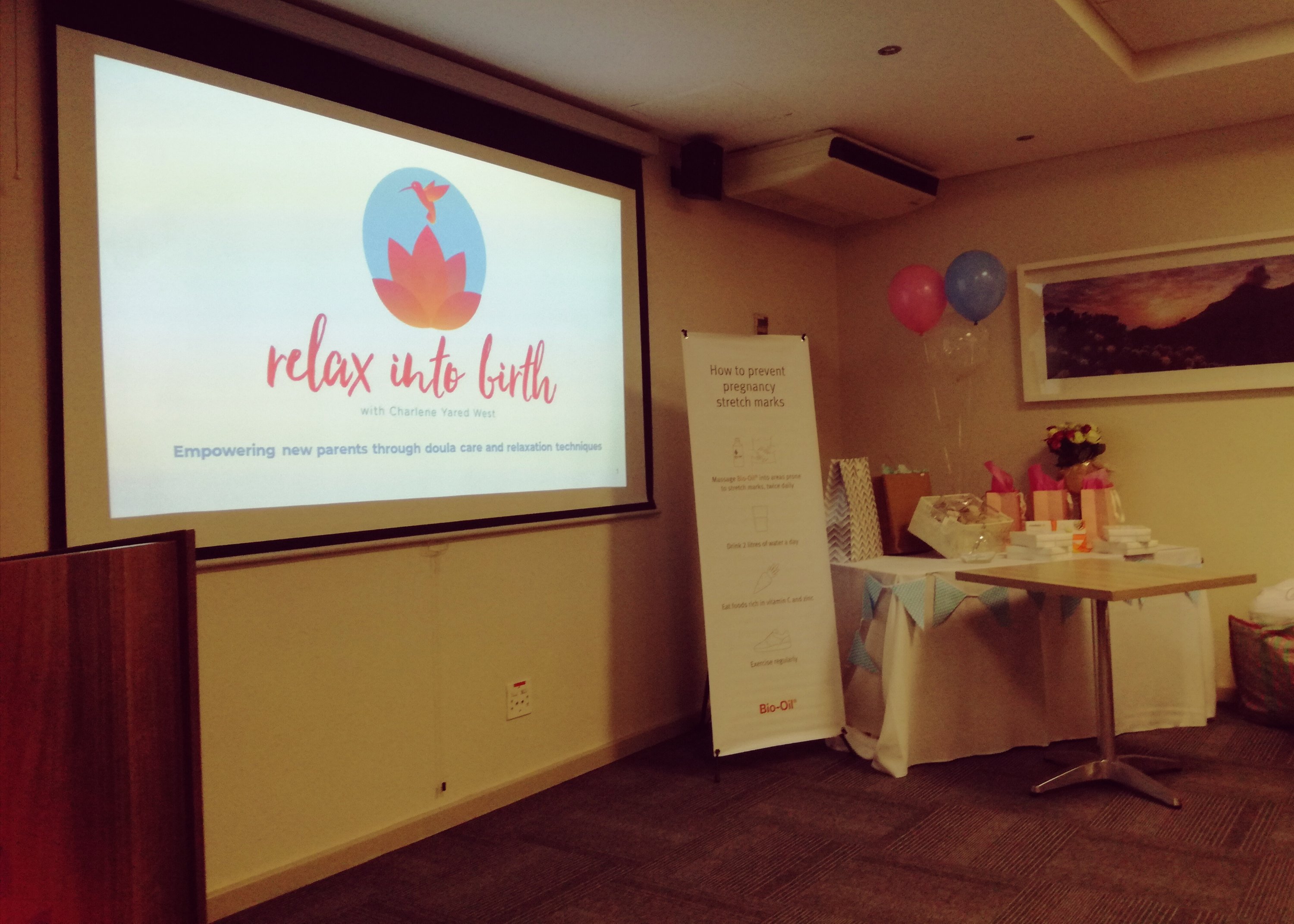
I was next in line and my talk was entitled “Empowering women through doula care and relaxation techniques”. Doula care is often misunderstood and so my talk opened with an explanation of the doula role through pregnancy and birth and how it differs from that of a midwife. I also shared some tools for relaxation, excerpted from the Relax Into Birth course.
Attendees trying out some Relax into Birth breathing techniques.
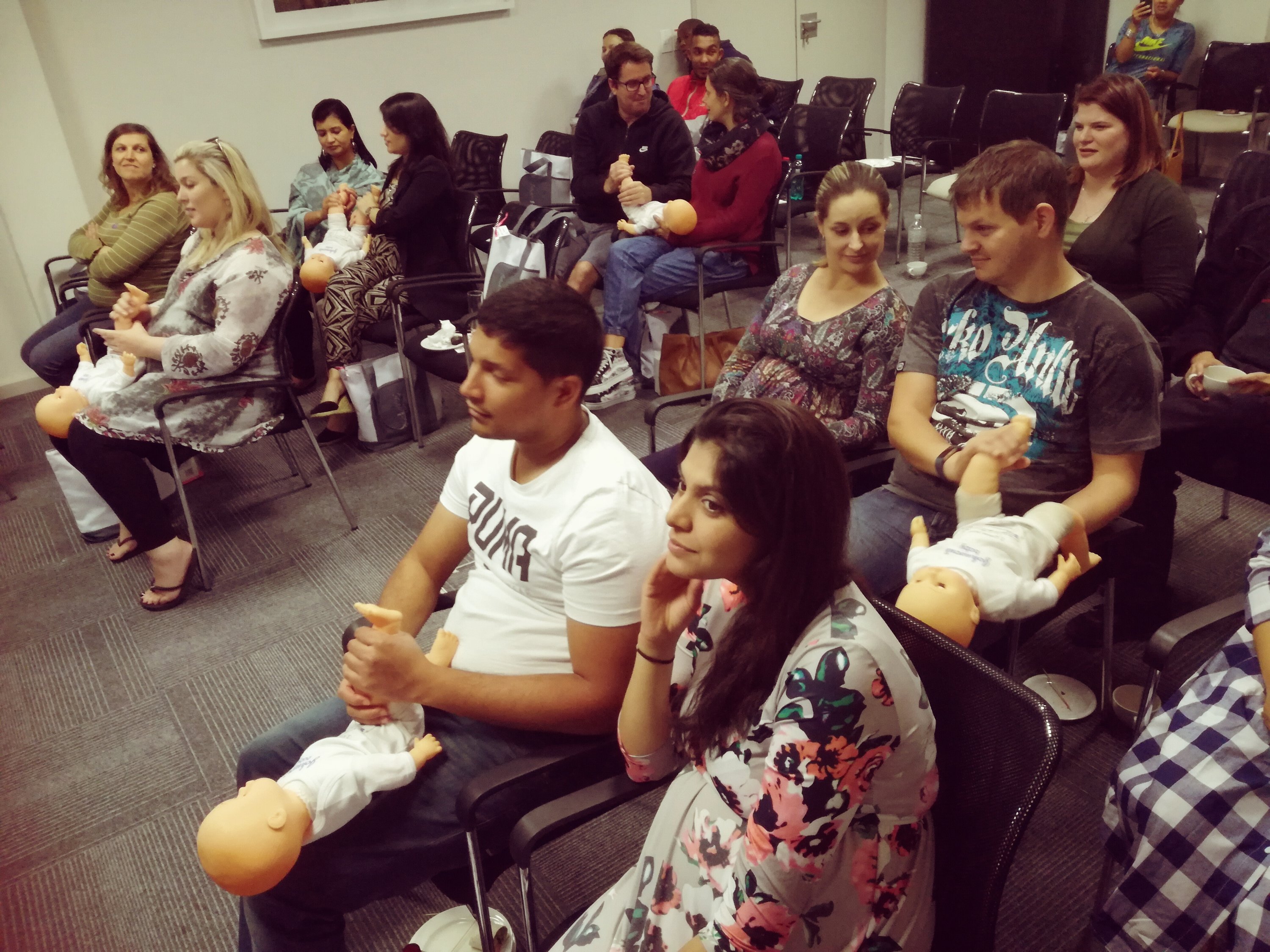
Next up was Liesl Hansen from Johnson and Johnson, who spoke about the benefits of massage in pregnancy, labour and the postnatal period in her talk; “The first touch of love.” When it came to baby massage, she handed out dolls for the parents to practice on, which was just so much fun and so informative! Who doesn’t love a good massage and these parents left feeling equipped to give their babies some extra tlc through massage. She was assisted by Lisa Townend of Holistic Baby – Baby Massage Classes, a certified infant massage instructor.
Liesl Hansen and Lisa Townend share their learnings around baby massage techniques.
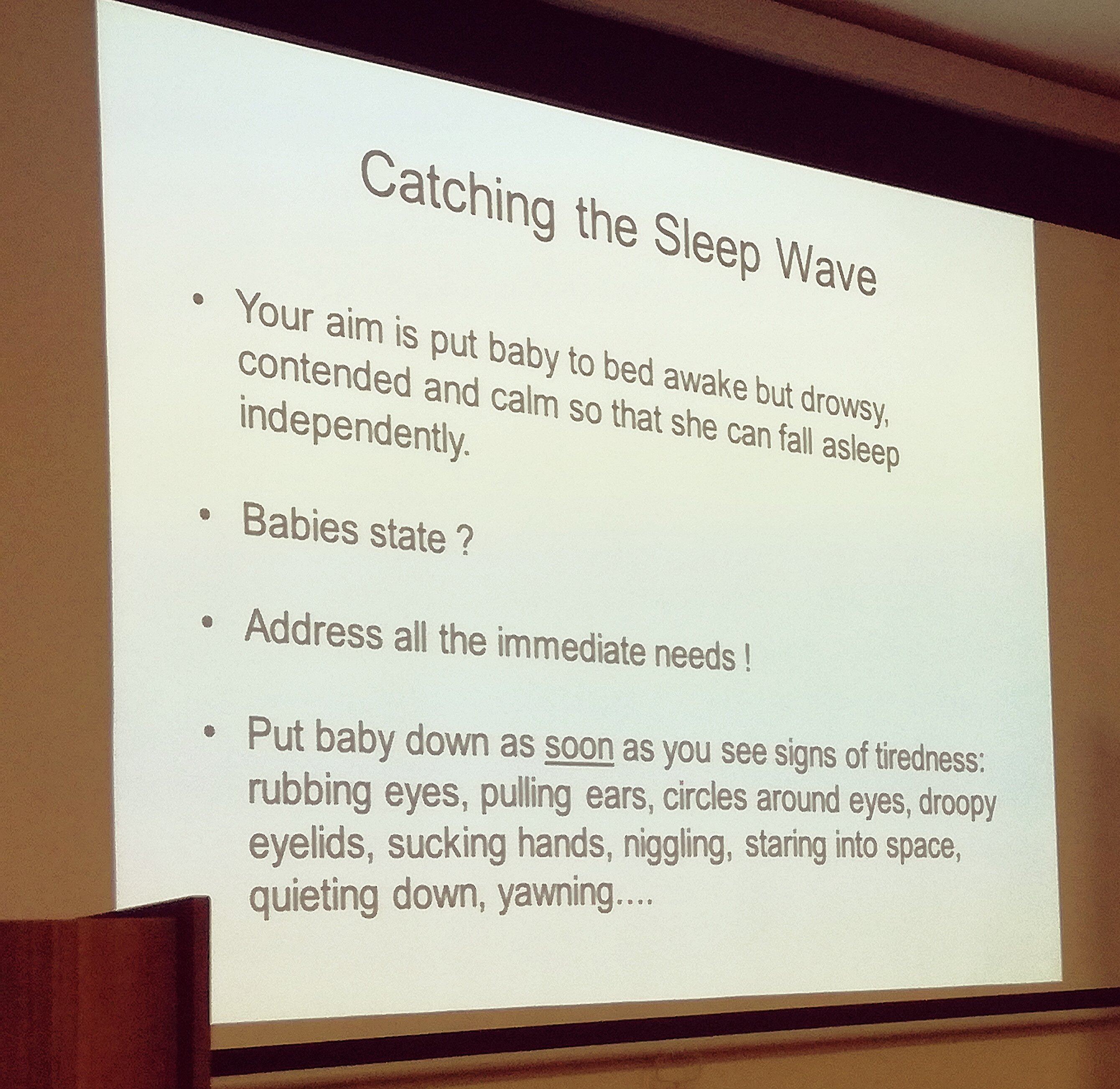
Last but not least, Jenny Spiro of Nurture One delivered a very interesting talk entitled “Start out right… And sleep tight.” She emphasised the importance of catching the sleep wave to assist your baby to sleep as best as possible. She also showed parents a very clever way of using the amazing Nurture One nesting pillow to put baby to sleep. The pillow cleverly mimics a womb-like environment and gives newborns much comfort.
Jenny Spiro shares info around baby sleep methods to help new parents also get more sleep!
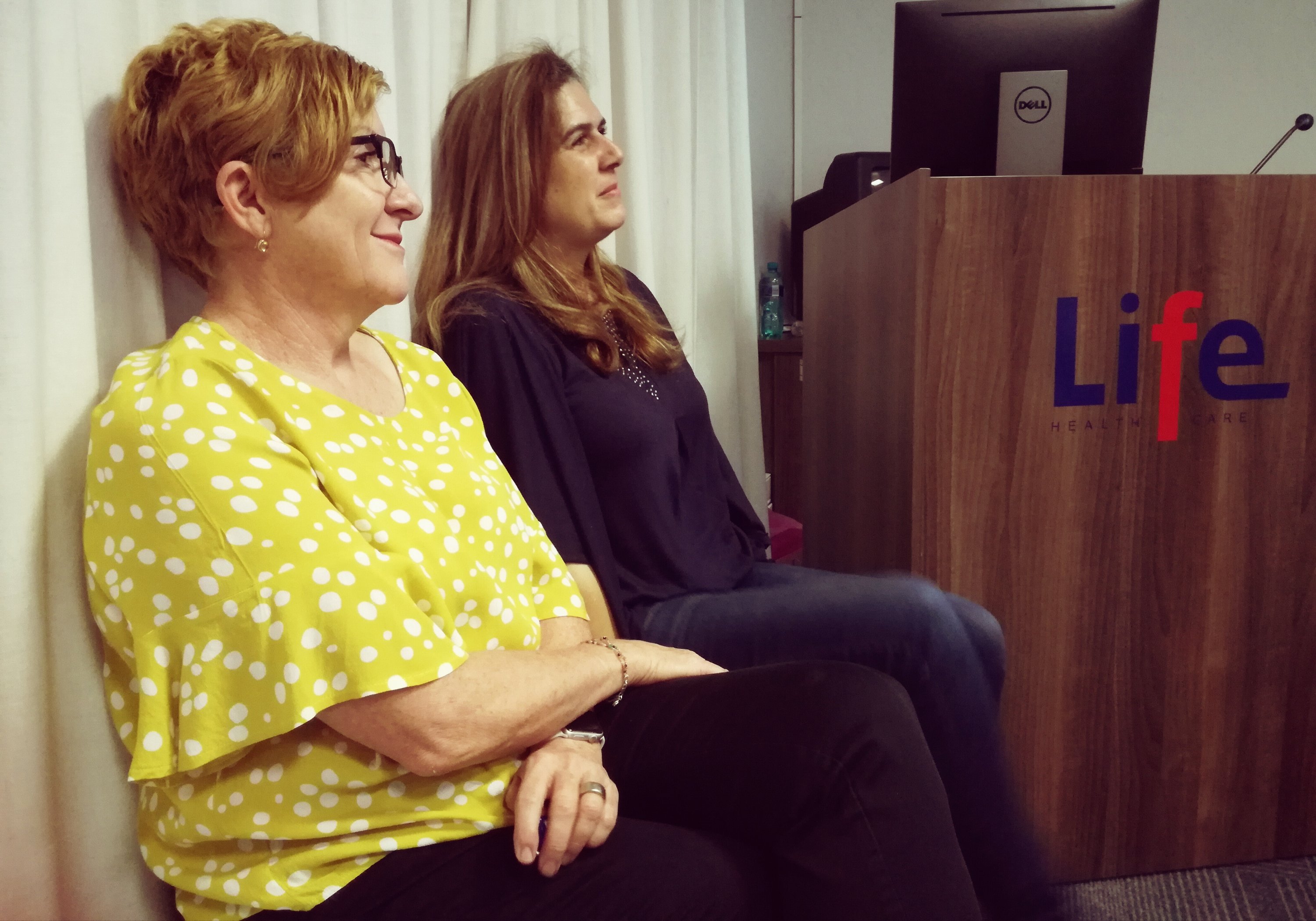
Here are some other pics from Saturday’s fun event:-)
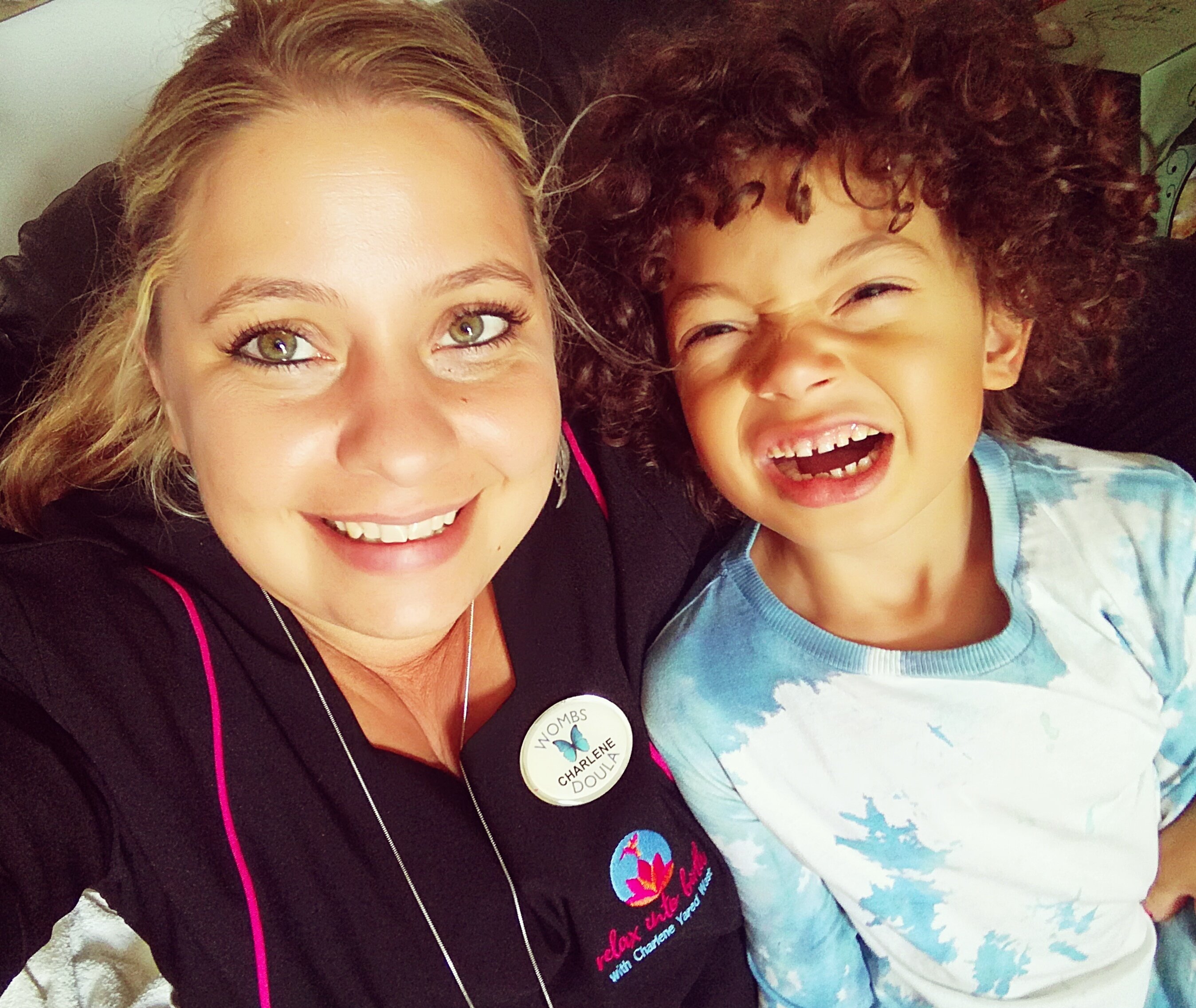
And here’s one of my son and I; my inspiration to do this work in the first place… Dearest Leonardo… Funny face selfie 😍:
See you at the next pregnancy event! Wishing you a wonderful birthing day, no matter what turn it takes ❤️❤️
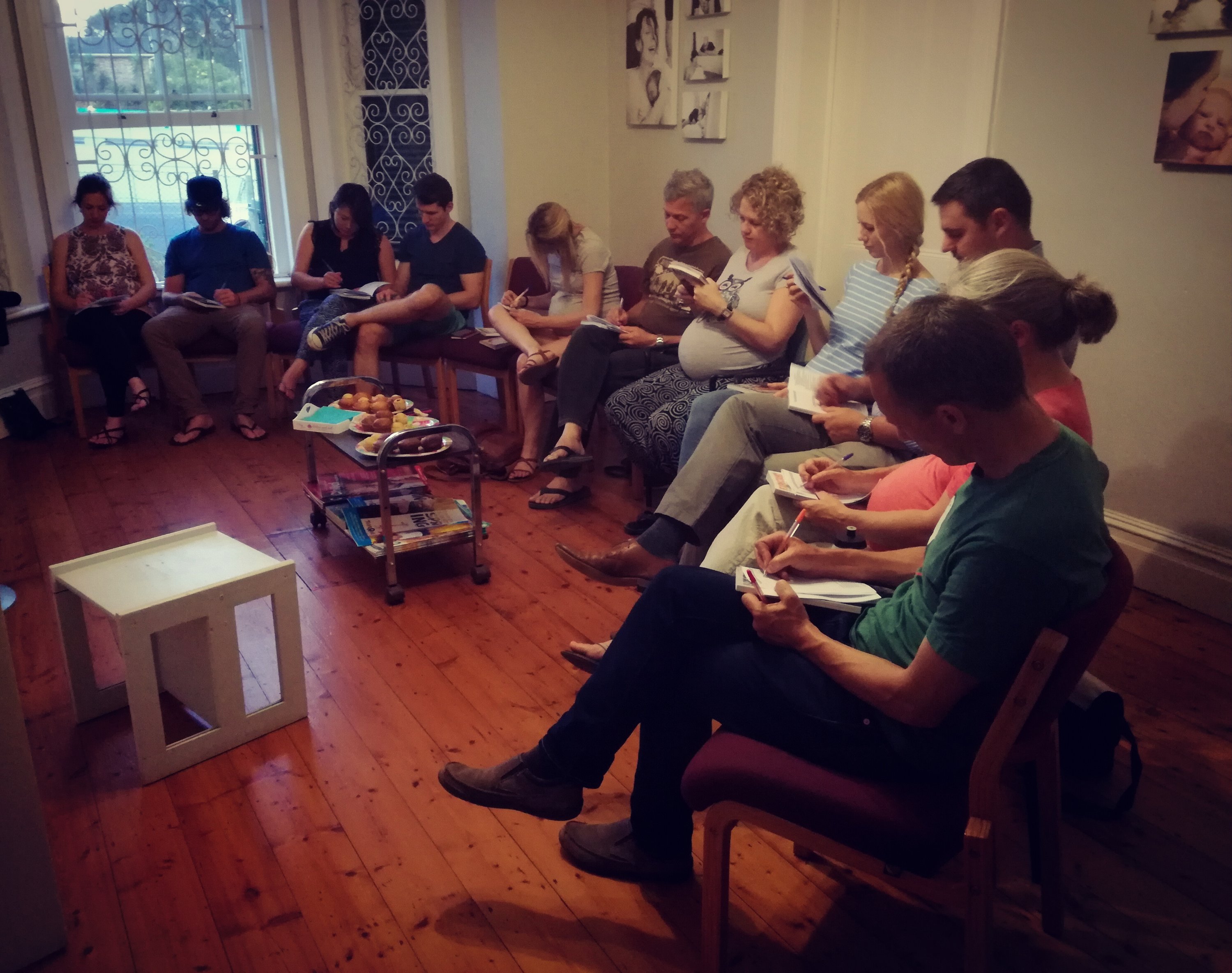
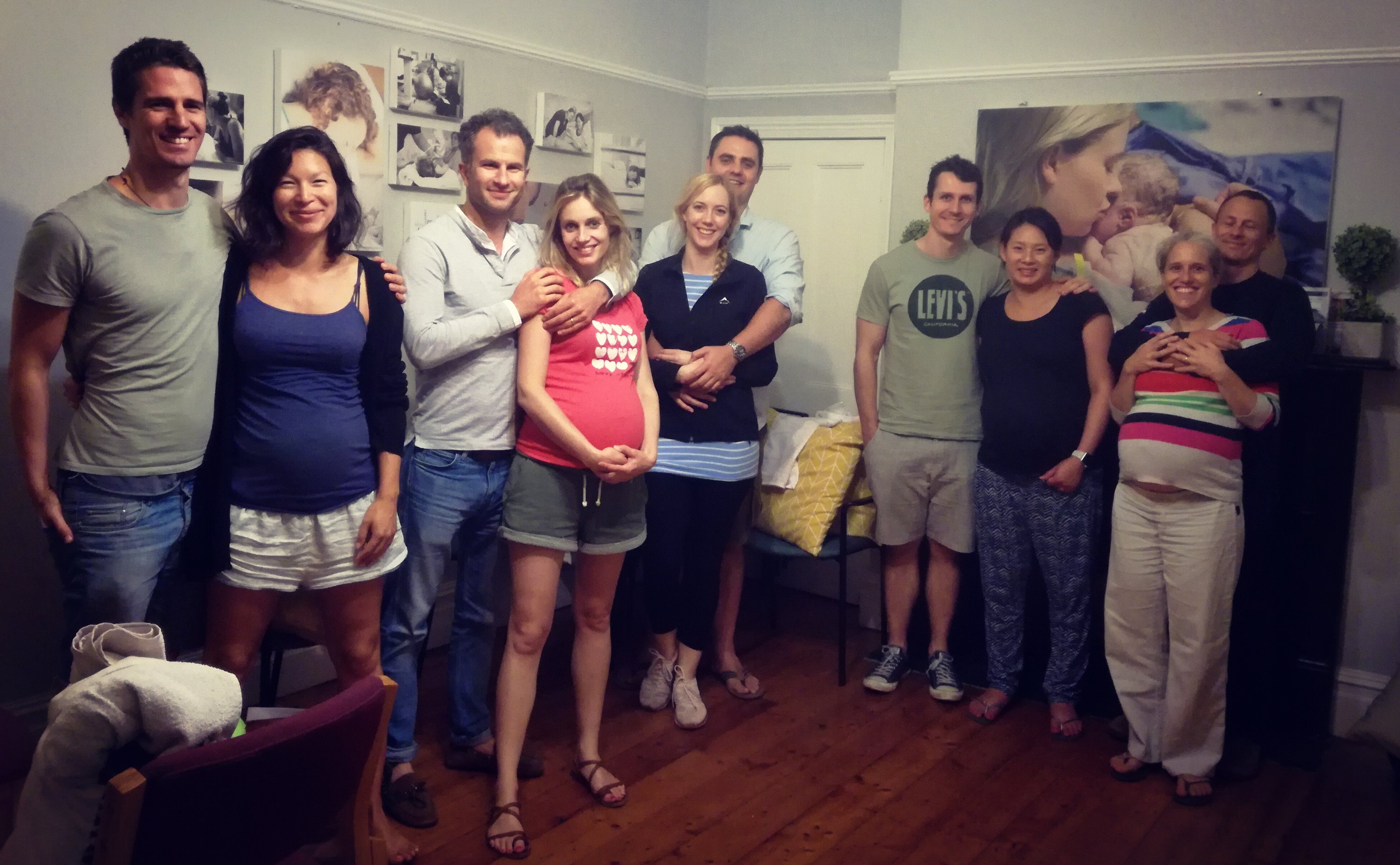
It really is the parents who make this course what it is… One dad at the January course held at Birth Options in Plumstead, shared that one of the exercises we did made him feel more empathy and compassion for what his wife was going to face in labour.
“It made me realise what she might experience and how I can perhaps help her – as best I can,” he said. Dads do not have to be helpless on labour day and that’s why Relax Into Birthprovides birth companions aka dads and partners with a toolkit to become doula dads, who feel more at ease in the birth space.
I love seeing lightbulb moments for dads come to life when they suddenly feel more empowered to fully embrace what the experience holds in store.





















 Charlene Yared West